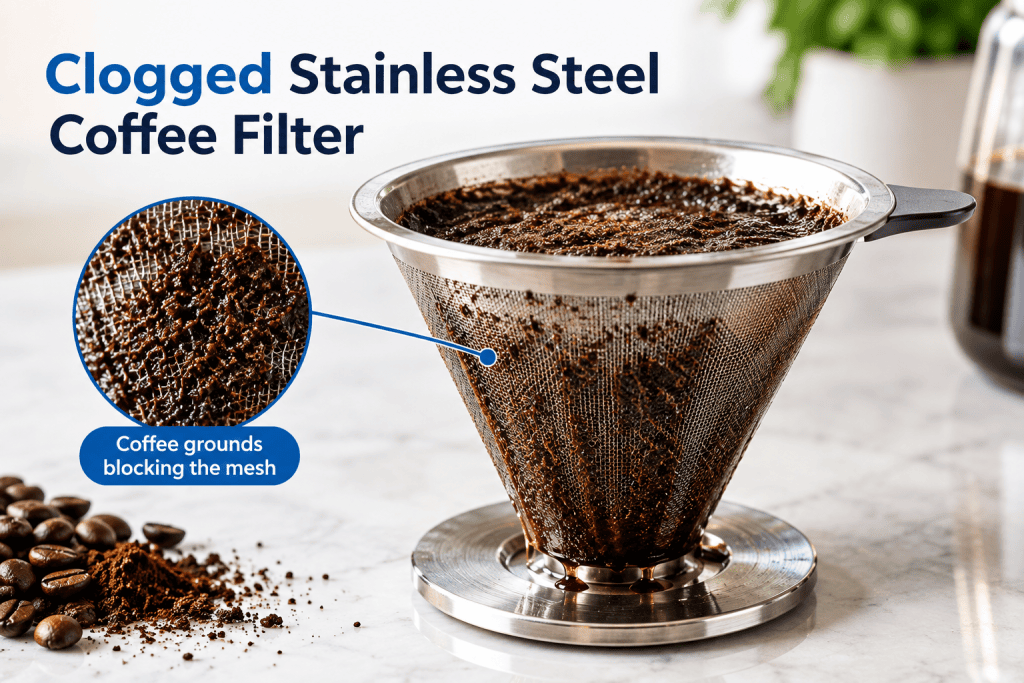
To clean a clogged stainless steel coffee filter, soak it for 20 to 30 minutes in equal parts hot water and white vinegar, scrub both sides with a soft brush, then rinse and dry it. Oily build-up needs a baking soda paste first. This guide is for home brewers, café owners and buyers of stainless steel filter elements. After reading, you can match the cleaner to the clog, avoid the habits that damage stainless steel, and decide whether a filter needs cleaning or replacing.
Who this is not for: espresso group-head screens (use a backflush detergent), filters with glued plastic parts, and pressure-rated industrial elements that have a manufacturer-validated cleaning procedure. Follow that procedure instead.
Why does a stainless steel coffee filter clog?
A stainless steel coffee filter clogs because three deposits fill its openings: coffee oils, fine particles called fines, and mineral scale from the water. Oils turn sticky as they cool. Fines wedge into the mesh. Scale then hardens around both. Each deposit needs a different cleaner, so a tap rinse alone rarely restores flow.
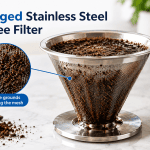
A stainless steel coffee filter is a woven or perforated sheet of iron-chromium alloy that holds back ground coffee while brewed liquid passes through openings measured in microns.
Paper filters absorb oils and get thrown away. Metal filters keep every oil film you give them. Over weeks that film oxidizes, smells rancid and traps fines. The first symptom is slow drip, and a bitter cup follows. Hard water adds a white scale layer that narrows the holes further.
How do you clean a clogged stainless steel coffee filter step by step?
Rinse from the underside, scrub with baking soda paste, soak in vinegar and hot water for 20 to 30 minutes, then rinse and dry. The order matters. The alkaline paste removes oil first, and the acid soak then dissolves the scale that the oil was shielding. The whole job takes about 40 minutes, mostly waiting.
- Knock the used grounds into a bin, not the sink.
- Rinse the filter under hot water from the underside, against the brewing direction, for 30 seconds.
- Mix 2 tablespoons of baking soda with 1 tablespoon of water. Rub the paste over both sides with a soft nylon brush.
- Soak the filter for 20 to 30 minutes in equal parts hot water and white vinegar.
- Brush again, following the direction of the weave.
- Rinse with hot water until the vinegar smell is gone, then air dry fully.
- Hold the filter up to a light. If any openings look blocked, repeat steps 3 to 5.
Rinse after every brew and run this deep clean weekly.
Which cleaner works for which type of clog?
Match the cleaner to the deposit. Alkaline cleaners such as baking soda remove coffee oil. Acids such as white vinegar or citric acid remove limescale. Mechanical action clears fines: brushing, a reverse-flow rinse or an ultrasonic bath. The wrong chemistry on the wrong clog wastes time and leaves the holes half blocked.
| Clog type | Typical sign | Best cleaner | Contact time | Avoid |
| Coffee oil | Sticky film, rancid smell | Baking soda paste or alkaline coffee-equipment detergent | 10 to 15 min | Cold water alone |
| Fines | Slow drip, visible grit | Reverse-flow rinse and soft brush | 1 to 2 min | Metal picks |
| Limescale | White crust on the wire | White vinegar 1:1 or citric acid solution | 20 to 30 min | Hard scraping |
| Mixed, heavy | Slow flow plus smell plus crust | Ultrasonic bath with detergent, then vinegar rinse | 10 to 15 min | Steel wool |
What do you do when brushing and soaking fail?
Use an ultrasonic cleaner for 10 to 15 minutes with a few drops of dish detergent, then rinse. Ultrasonic waves form tiny bubbles that shake particles out of openings a brush cannot reach. If flow is still slow afterward, the mesh is probably deformed or permanently scaled, and a new filter costs less than another hour of scrubbing.
- Pro: reaches fine-mesh pores without scratching the wire.
- Pro: finishes in 10 to 15 minutes with no hand scrubbing.
- Con: needs a bench-top unit, which many households do not own.
- Con: does not remove thick, polymerized oil unless detergent is in the bath.
Replace the filter if the weave is torn, the rim is bent, or rust-coloured spots return after cleaning.
What should you never use to clean a stainless steel filter?
Never use chlorine bleach, steel wool or metal picks. Chlorides attack the thin chromium oxide layer that makes stainless steel resist rust, and the result is pitting. Steel wool leaves carbon-steel fragments that rust on the surface. Picks enlarge openings and change what the filter can hold back.
Do not combine vinegar and bleach either, because the mixture releases chlorine gas. The Nickel Institute and the Specialty Steel Industry of North America both publish stainless steel care and cleaning guidance. Rinse every cleaner off completely, since residue left to dry can mark the surface.
Does the same method work on industrial perforated tube filters?
Partly. An industrial perforated tube is a metal tube punched with a uniform hole pattern, used as a filter element or as the support core inside one. It follows the same sequence as a coffee filter: remove loose solids, dissolve what remains with the right chemistry, rinse, inspect. The differences are scale, chemical control and a final passivation step.
For dust-collection systems, operators first clear loose dust by reverse air pulse or backflushing. Chemical cleaning then follows ASTM A380, the standard practice for cleaning and descaling stainless steel parts. Passivation under ASTM A967 removes free iron and lets the chromium oxide layer reform, which matters for any corrosion resistance tube in humid or salty air.
How do you choose an industrial filter manufacturer?
Choose an industrial filter company that states the stainless grade, supplies mill test certificates and tests finished elements against a published standard. ISO 16889 covers hydraulic filter performance and ISO 11057 covers cleanable filter media. Among industrial air filter manufacturers, traceability separates reliable suppliers from the rest.
- Grade: 06Cr19Ni10 (304) or 022Cr17Ni12Mo2 (316L) under the Chinese standard GB/T 20878.
- Documents: mill test certificate and a current ISO 9001 certificate you can verify with the issuing body.
- Specs in writing: hole diameter, open area percentage, wall thickness and weld method.
- Finish: confirmation that cleaning and passivation were done before shipping.
Frequently asked questions
Can you clean a stainless steel coffee filter in the dishwasher?
Most all-metal filters tolerate a dishwasher cycle, but the cycle rarely removes oil that has worked into the weave. Use it for routine washing and still hand-scrub weekly. Check the maker’s instructions first if the filter has a plastic or silicone rim.
How often should you deep clean a metal coffee filter?
Rinse after every brew and deep clean once a week for daily use. Clean sooner if drip time lengthens or the cup tastes bitter.
Does white vinegar damage stainless steel?
Diluted white vinegar, which is typically about 5% acetic acid, is widely used on stainless steel for short soaks. Long exposure to strong or hot acid can etch the surface. Limit contact to 30 minutes, then rinse well with clean water.
Why does coffee taste bitter after cleaning the filter?
Rancid oil in the pores is the usual cause, so repeat the baking soda step or run an ultrasonic cycle with detergent. A grind that is too fine also over-extracts coffee and tastes bitter, no matter how clean the filter is.
What is passivation, and does a coffee filter need it?
Passivation is an acid treatment that removes free iron from stainless steel and lets the protective chromium oxide layer reform. A home coffee filter does not need it. Industrial perforated tubes often do after fabrication or aggressive cleaning, as ASTM A967 describes.
What is the difference between 304 and 316L stainless steel for filter tubes?
Type 316L adds about 2 to 3% molybdenum and has lower carbon than 316. That gives better resistance to chloride pitting than 304. Choose 316L for coastal sites, salt-laden air or chemical exposure. Type 304 suits dry, mild environments.