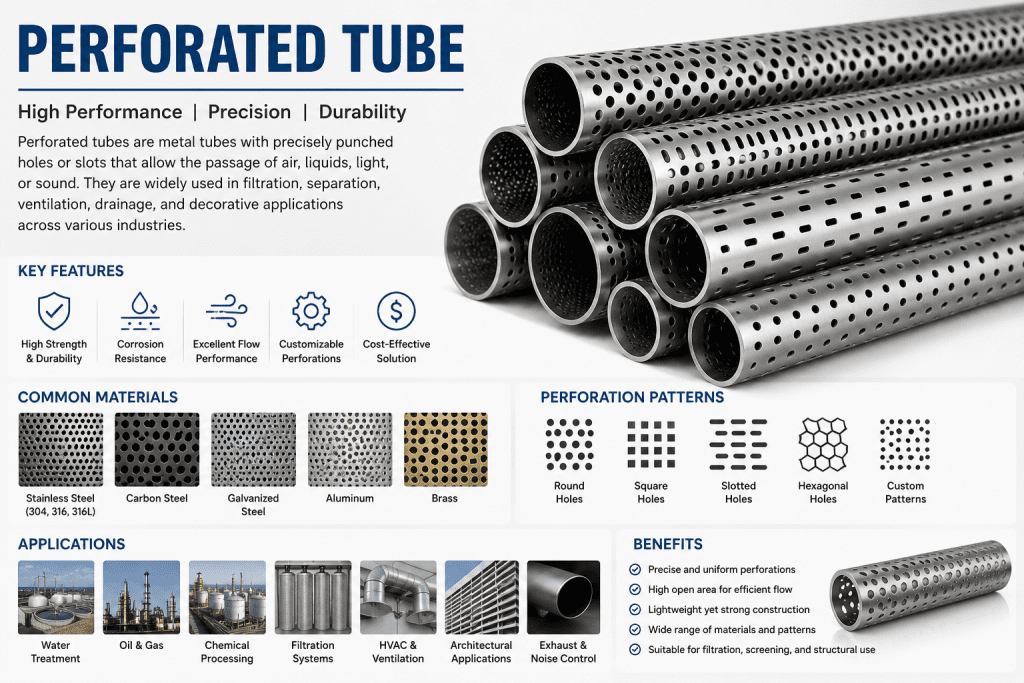
Perforated tubes are cylindrical metal tubes manufactured with precisely punched holes, slots, or custom perforation patterns across their surface. These engineered components are widely used in filtration systems, water treatment plants, oil and gas processing, chemical manufacturing, exhaust systems, and industrial equipment where controlled flow, filtration, and structural support are required.
The combination of strength, durability, and high open-area design makes perforated tubes one of the most versatile products used across modern industries. Whether serving as a filter support core, drainage component, or airflow control device, perforated tubing provides efficient performance while maintaining structural integrity under demanding operating conditions.
What Is a Perforated Tube?
A perforated tube is a metal tube containing a series of precisely engineered holes distributed along its surface. The perforations allow liquids, gases, air, light, or sound to pass through while maintaining the mechanical strength of the tube.
Depending on the intended application, perforated tubes can be manufactured with round holes, square holes, slotted openings, hexagonal patterns, or custom perforation designs. These perforations are carefully selected to achieve specific flow rates, filtration efficiency, and structural performance.
How Are Perforated Tubes Manufactured?
The manufacturing process begins with a flat metal sheet that is perforated using CNC punching machines or precision stamping equipment. The perforated sheet is then rolled into a cylindrical shape and welded to form a durable tube.
The production process typically includes:
- Material selection
- Precision perforating
- Sheet rolling and forming
- Welding and assembly
- Surface treatment
- Quality inspection
Modern manufacturing techniques ensure uniform hole distribution, dimensional accuracy, and consistent product quality.
Common Materials Used in Perforated Tubes
Stainless Steel Perforated Tubes
Stainless steel is the most commonly used material due to its excellent corrosion resistance, durability, and high-temperature performance. Grades such as SS304 and SS316 are widely used in industrial filtration systems.
Carbon Steel Perforated Tubes
Carbon steel perforated tubes offer excellent strength and cost efficiency, making them suitable for general industrial applications.
Galvanized Steel Perforated Tubes
Galvanized steel provides additional protection against corrosion and environmental exposure, making it ideal for outdoor applications.
Aluminum Perforated Tubes
Aluminum perforated tubes are lightweight, corrosion-resistant, and frequently used in architectural and ventilation applications.
Types of Perforation Patterns
Round Hole Perforated Tubes
Round holes are the most common perforation pattern due to their versatility and excellent open-area performance.
Slotted Perforated Tubes
Slotted openings provide increased flow capacity and are often used in drainage and filtration systems.
Square Hole Perforated Tubes
Square perforations offer uniform appearance and efficient material separation capabilities.
Custom Perforation Patterns
Manufacturers can create customized perforation designs to meet specific flow, filtration, or structural requirements.
Key Benefits of Perforated Tubes
Excellent Filtration Performance
Perforated tubes are commonly used as support cores in filter cartridges and filtration systems, allowing fluids to flow while supporting filter media.
High Mechanical Strength
Despite having numerous perforations, perforated tubes maintain excellent structural integrity and resistance to pressure.
Improved Flow Characteristics
The open-area design promotes efficient airflow, liquid flow, and drainage while minimizing pressure drop.
Corrosion Resistance
When manufactured from stainless steel or other corrosion-resistant materials, perforated tubes perform reliably in harsh environments.
Versatile Applications
Perforated tubing can be customized for virtually any industrial, commercial, or engineering application.
Applications of Perforated Tubes
Industrial Filtration Systems
Perforated tubes are widely used as support structures for filter cartridges, filter elements, and filtration assemblies.
Water Treatment Plants
Water treatment facilities use perforated tubes in filtration units, drainage systems, and purification equipment.
Oil and Gas Industry
Perforated tubes support filtration systems, sand control equipment, and process filtration operations.
Chemical Processing
Chemical plants utilize perforated tubing in filtration and separation processes where corrosion resistance is essential.
Exhaust and Silencer Systems
The perforated structure helps reduce noise while maintaining efficient gas flow in industrial and automotive exhaust systems.
Architectural Applications
Architects and designers use perforated tubes in decorative structures, handrails, facades, and modern building designs.
Technical Considerations When Choosing a Perforated Tube
Several factors should be considered when selecting perforated tubing:
- Material type
- Hole size and pattern
- Open area percentage
- Tube diameter
- Wall thickness
- Operating pressure
- Corrosion resistance requirements
- Flow rate specifications
Choosing the correct combination ensures optimal performance and long-term reliability.
Why Perforated Tubes Are Important in Modern Industry
Perforated tubes play a critical role in improving filtration efficiency, enhancing flow control, reducing maintenance requirements, and supporting industrial processes. Their ability to combine strength with controlled permeability makes them indispensable in water treatment, filtration, manufacturing, energy production, and environmental applications.
As industries continue to demand more efficient and durable filtration solutions, perforated tubes remain a reliable and cost-effective component for countless engineering applications.
Conclusion
Perforated tubes are versatile industrial components designed to provide controlled flow, filtration support, drainage, and structural strength. Available in various materials, perforation patterns, and custom configurations, they are widely used across filtration, water treatment, oil and gas, chemical processing, and architectural industries. Understanding their materials, benefits, and applications helps engineers and buyers select the right perforated tube solution for their specific operational requirements.