Choosing the right metal perforation method can make or break the performance, cost, and lead time of a perforated tube production run. Two technologies dominate the industry: laser cutting and punching. Each brings distinct strengths to the table, and the “better” choice always depends on your material, hole pattern, production volume, and application requirements.
This guide breaks down both metal perforation methods in detail precision, speed, cost, material compatibility, and industrial use cases so engineers, procurement managers, and OEM buyers can make an informed decision for their next project.
What Is Perforated Tube Production?
Perforated tube production is the manufacturing process of creating cylindrical metal tubes with a pattern of holes, slots, or other openings cut through the tube wall. These openings are engineered to precise sizes, spacing, and layouts to achieve a specific open area and flow characteristic.
The production process typically starts with raw tube stock stainless steel, carbon steel, aluminum, or specialty alloys which is then perforated using either laser cutting or mechanical punching. Depending on the application, tubes may also go through secondary operations such as deburring, rolling, welding, or surface finishing.
Precision perforation matters because the size, shape, and consistency of each opening directly affects flow rate, filtration efficiency, structural integrity, and acoustic or aesthetic performance. A tube with inconsistent hole sizing or excessive burring can underperform even if the base material and dimensions are correct.
Industries that rely heavily on perforated tubes include water and wastewater treatment, oil and gas, chemical processing, food and beverage, pharmaceutical manufacturing, HVAC, automotive exhaust systems, mining, and general industrial filtration and OEM equipment manufacturing.
What Is Metal Perforation?
Metal perforation is the broader manufacturing category that covers any process used to create a defined pattern of holes or openings in a metal sheet, coil, or tube. The purpose of perforation is to allow controlled passage of liquid, gas, light, or sound while maintaining the structural strength of the surrounding material.
Common perforation methods include laser cutting, CNC or turret punching, mechanical stamping, and hydraulic punching. Each method removes material in a different way laser cutting uses a focused beam of light to melt or vaporize material, while punching methods use physical tooling to shear holes through the metal.
The perforation method chosen has a direct impact on filtration performance (hole consistency affects particle capture), airflow (open area percentage and hole geometry determine flow resistance), structural strength (heat-affected zones or stress points can weaken a tube), and overall product performance in the field.
What Is Laser Cutting?
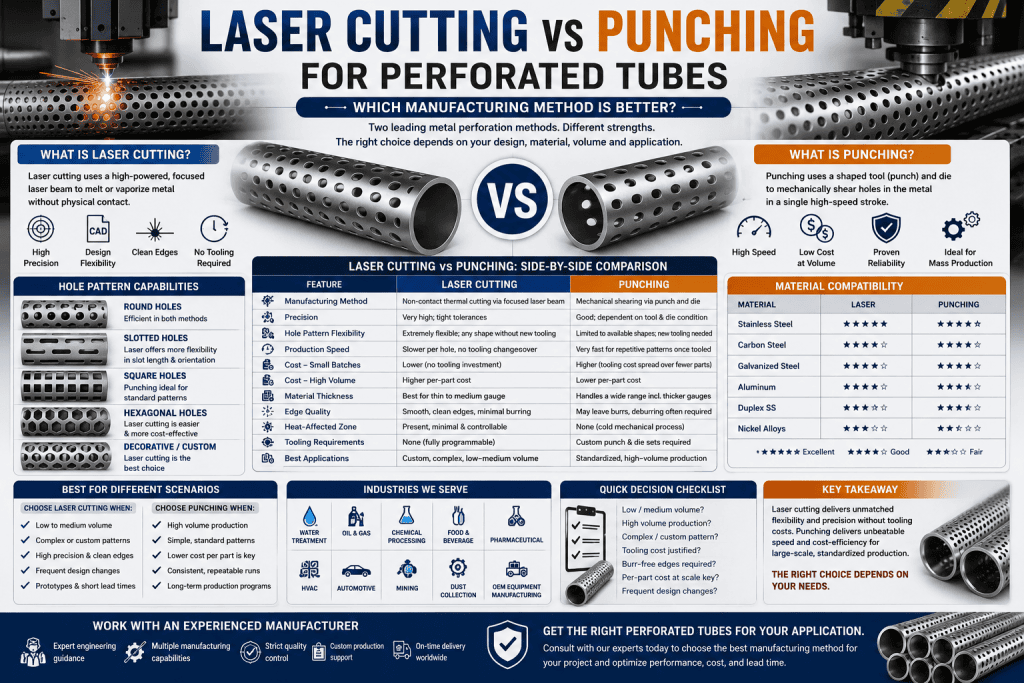
Laser cutting uses a high-powered, focused beam of light to melt, burn, or vaporize metal along a programmed path, creating clean holes or patterns without physical contact between tooling and material.
Fiber laser technology has become the industry standard for metal perforation because it delivers high energy efficiency, faster cutting speeds on reflective metals like stainless steel and aluminum, and lower maintenance requirements compared to older laser systems.
CO₂ laser technology is still used in some applications, particularly for thicker materials or specific finish requirements, though it has generally been surpassed by fiber lasers for most metal perforation work due to speed and operating cost advantages.
Because laser cutting is fully digital and tool-free, it offers exceptional precision and automation. Hole patterns are programmed directly from CAD files, allowing tight tolerances and highly repeatable results without physical dies. This also makes laser cutting particularly strong for complex perforation patterns, irregular shapes, variable hole spacing, decorative designs, and patterns that would require multiple expensive tools if punched.
What Is Punching?
Punching is a mechanical perforation process where a shaped tool (punch) forces material through a matching die, shearing out a hole in a single stroke.
CNC punching integrates computer-controlled positioning with mechanical punching heads, allowing programmed hole patterns to be produced with good repeatability and moderate design flexibility.
Turret punching machines hold multiple tool stations on a rotating turret, allowing several hole shapes and sizes to be punched in a single production run without manual tool changes, which speeds up mixed-pattern jobs.
Mechanical punching uses a flywheel-driven ram for high-speed, high-force punching, ideal for simple, repetitive hole patterns in high volumes.
Hydraulic punching uses hydraulic pressure to drive the punch, offering more controllable force for thicker materials or tougher alloys, often at a slightly slower cycle time than mechanical presses.
Across all these variations, punching’s core strength is high-volume production capability once tooling is set up, punching can produce large quantities of identical parts very quickly and at a low cost per piece.
Laser Cutting vs Punching: Side-by-Side Comparison
| Feature | Laser Cutting | Punching |
| Manufacturing Method | Non-contact thermal cutting via focused laser beam | Mechanical shearing via punch and die |
| Precision | Very high; tight tolerances from CAD-driven paths | Good; dependent on tool and die condition |
| Hole Accuracy | Consistent across simple and complex geometries | Consistent for standard shapes; wear affects accuracy over time |
| Production Speed | Slower per hole, but no tooling changeover time | Very fast for repetitive patterns once tooled |
| Cost for Small Batches | Lower no tooling investment required | Higher tooling cost is spread over fewer parts |
| Cost for High-Volume Production | Higher per-part cost at scale | Lower tooling cost amortized over large runs |
| Material Thickness | Best for thin-to-medium gauge; thick material slows cutting | Handles a wide range, including thicker gauges, with proper tonnage |
| Hole Pattern Flexibility | Extremely flexible; any shape without new tooling | Limited to available punch/die shapes unless new tooling is made |
| Edge Quality | Smooth, clean edges with minimal burring | Can leave burrs requiring secondary deburring |
| Heat-Affected Zone | Present, but minimal and controllable with proper settings | None a cold mechanical process |
| Material Waste | Low; narrow kerf width | Slightly higher due to slug removal and tooling clearances |
| Tooling Requirements | None; fully programmable | Custom punch and die sets required per hole shape |
| Maintenance | Optics, lenses, and laser source upkeep | Tool sharpening, die replacement, press maintenance |
| Best Applications | Custom, complex, or low-to-medium volume runs | Standardized, high-volume production runs |
Advantages of Laser Cutting
High Precision
Laser cutting delivers tight, repeatable tolerances because the cutting path is controlled digitally rather than by physical tooling that wears over time.
Complex Hole Patterns
Irregular shapes, variable spacing, and intricate geometric or decorative designs can be cut directly from a CAD file without needing custom tooling.
Minimal Material Waste
The narrow kerf width of a laser beam removes very little material, improving yield especially on expensive alloys.
No Tooling Costs
Because the cutting path is programmed rather than tooltied, there are no punch and die investments required, which is especially valuable for prototypes or custom orders.
Smooth Edge Quality
Laser-cut holes typically have clean, smooth edges with minimal burring, reducing or eliminating secondary finishing steps.
Fast Prototyping
New designs can move from CAD file to finished part almost immediately, without waiting on tool fabrication.
Easy Design Changes
Adjusting a whole pattern is as simple as updating the program file no new tooling required, which is ideal for iterative product development.
Ideal for Custom Manufacturing
Laser cutting suits one-off, low-volume, and highly customized perforated tube orders where flexibility matters more than raw throughput.
Advantages of Punching
High-Speed Production
Once tooled, mechanical or hydraulic punching presses can produce holes at very high cycle rates, making punching well suited to large production runs.
Lower Cost for Mass Production
Tooling costs are fixed and amortized across large batch sizes, driving down the cost per part significantly at scale.
Excellent Repeatability
Well-maintained tooling produces highly consistent hole geometry across thousands or millions of parts.
Efficient Standard Hole Patterns
For common round, square, or slotted hole patterns, punching is often the fastest and most economical option.
Lower Cost Per Part
At high volumes, the amortized tooling cost combined with fast cycle times generally results in a lower cost per finished tube than laser cutting.
Proven Industrial Reliability
Punching is a mature, well-understood technology with decades of industrial use, making it a dependable choice for standardized production programs.
Limitations of Each Manufacturing Method
Laser Cutting Limitations
Laser cutting can be slower for high-volume production compared to punching, since each hole is cut individually rather than stamped simultaneously. Equipment investment for industrial fiber laser systems is also significant. There are heat-affected zone considerations, particularly on heat-sensitive alloys, and production costs can be higher than punching for simple, highly repetitive hole patterns produced at scale.
Punching Limitations
Punching tools experience wear over time, which can gradually affect hole accuracy and edge quality. The process offers limited flexibility since each hole shape requires its own tooling, and tooling costs can be substantial for custom or low-volume orders. Punching can also leave burrs that require secondary deburring, and it has practical restrictions on very complex or intricate designs.
Material Compatibility
| Material | Laser Suitability | Punching Suitability | Recommended Applications |
| Stainless Steel | Excellent clean cuts, minimal distortion | Excellent strong, wear-resistant results | Filtration, food & beverage, pharmaceutical |
| Carbon Steel | Very good | Excellent, cost-effective at volume | Structural, industrial, mining |
| Galvanized Steel | Good, with attention to coating fumes/finish | Good | HVAC, construction, general industrial |
| Aluminum | Very good with fiber laser systems | Good, with appropriate tooling | Automotive, lightweight structural parts |
| Duplex Stainless Steel | Good, requires tuned parameters | Good, with robust tooling | Oil & gas, chemical processing |
| Nickel Alloys | Good, but slower cutting speeds | Fair, faster tool wear | High-corrosion, high-temperature environments |
Which Method Is Best for Different Hole Patterns?
Round holes are efficiently produced by both methods; punching is often more economical at high volumes, while laser cutting is preferred for tight tolerances or low-volume runs.
Slotted holes are well suited to both processes, though laser cutting offers more flexibility for varying slot lengths and orientations within the same tube.
Square holes typically favor punching for standardized patterns, since custom square-punch tooling is common and cost-effective at scale.
Hexagonal holes and other polygonal shapes are generally easier and more cost-effective with laser cutting, since custom hex punches can be expensive and slower to produce.
Decorative patterns including artistic, architectural, or branded designs are almost always better suited to laser cutting due to the design freedom it provides.
Custom designs that vary from tube to tube, or that require frequent revisions, are best handled with laser cutting to avoid repeated tooling investment.
Industrial Applications
Water Treatment
Both methods are used, but laser cutting is often preferred for custom filtration geometries requiring precise open-area control.
Oil & Gas
Punching is common for standardized well screens and structural components produced at volume, while laser cutting supports custom downhole tooling.
Chemical Processing
Laser cutting is frequently favored for corrosion-resistant alloys where clean edges reduce the risk of stress concentration and material failure.
Food & Beverage
Laser cutting’s smooth edge quality supports the hygienic requirements common in food-grade filtration and processing equipment.
Pharmaceutical
Laser cutting is generally preferred for its precision and cleanliness, which support strict regulatory and cleanliness standards.
Dust Collection
Punching is often used for standard dust collection cartridge cores produced in high volume.
HVAC
Punching is typically the go-to method for standardized ductwork and diffuser components manufactured at scale.
Automotive
Punching dominates high-volume automotive component production, while laser cutting supports prototyping and specialty parts.
Mining
Punching is common for rugged, high-volume screening components used in mineral processing.
OEM Equipment Manufacturing
Many OEM manufacturers use a combination of both methods depending on whether a component is standardized or custom-engineered.
How to Choose the Right Manufacturing Method
Selecting between laser cutting and punching depends on several interrelated factors:
- Production Volume — Low-to-medium volumes favor laser cutting; high volumes favor punching.
- Budget — Consider both upfront tooling costs and long-term per-part costs, not just the initial quote.
- Material Type — Some alloys cut more efficiently with lasers, while others punch cleanly with less tool wear.
- Hole Pattern Complexity — Intricate or variable patterns favor laser cutting; simple repeated patterns favor punching.
- Precision Requirements — Tight tolerance applications often lean toward laser cutting.
- Lead Time — Laser cutting can start immediately without tooling; punching requires tool fabrication time upfront.
- Product Performance — Consider how edge quality, heat-affected zones, or burring will affect the tube’s performance in service.
- Customization Needs — Frequent design changes favor the flexibility of laser cutting.
Quick Decision Checklist
- [ ] Is this a prototype or low-volume custom order? → Consider laser cutting
- [ ] Is this a large, standardized production run? → Consider punching
- [ ] Does the hole pattern include complex or variable shapes? → Consider laser cutting
- [ ] Is tooling investment justified by long-term volume? → Consider punching
- [ ] Does the application demand burr-free edges? → Consider laser cutting
- [ ] Is per-part cost at scale the primary driver? → Consider punching
Common Mistakes to Avoid
Buyers and engineers often run into avoidable issues when selecting a perforation method, including:
- Selecting a method based only on upfront cost, without factoring in volume-based economics
- Ignoring production volume when comparing quotes between laser cutting and punching
- Choosing the wrong material for the intended process, leading to slower cycle times or poor edge quality
- Overlooking tolerance requirements that one method may not reliably meet
- Not considering tooling costs and lead times when planning custom punching programs
- Ignoring long-term manufacturing efficiency in favor of the lowest initial quote
Why Work with an Experienced Perforated Tube Manufacturer?
An experienced manufacturer brings engineering expertise to help match the right perforation method to your specific application, rather than defaulting to whichever process they happen to run. Manufacturers with multiple manufacturing capabilities both laser cutting and punching can objectively recommend the most cost-effective and technically sound option for your project.
Look for a manufacturer with precision quality control processes, the ability to support custom production for unique hole patterns or tube dimensions, and material traceability for industries with strict compliance requirements. Technical consultation before production begins can help avoid costly redesigns, and established OEM manufacturing services streamline the path from drawing to finished, field-ready perforated tube.
Frequently Asked Questions
What is the difference between laser cutting and punching?
Laser cutting uses a focused beam of light to melt or vaporize metal in a programmed pattern, while punching uses a mechanical punch and die to physically shear holes through the material.
Which method is better for perforated tube production?
Neither method is universally better; laser cutting suits custom, complex, or lower-volume production, while punching is generally more economical for large, standardized production runs.
Is laser cutting more accurate than punching?
Laser cutting typically offers tighter, more consistent tolerances since it isn’t affected by tool wear the way punching is over time.
Which process is more cost-effective?
It depends on volume: laser cutting is often more cost-effective for small batches, while punching becomes more economical as production volume increases.
Which method is better for stainless steel perforated tubes?
Both methods work well on stainless steel; the choice typically comes down to hole pattern complexity and production volume rather than material limitations.
Can laser cutting create custom hole patterns?
Yes laser cutting is particularly well suited to custom, irregular, or frequently changing hole patterns since it requires no physical tooling.
Which method is faster for mass production?
Punching is generally faster for high-volume production of standardized hole patterns once tooling is in place.
Does punching leave burrs?
Punching can leave burrs on the exit side of the hole, often requiring a secondary deburring step depending on the application’s tolerance for edge roughness.
How do I choose between laser cutting and punching?
Base the decision on production volume, budget, material type, hole pattern complexity, precision requirements, lead time, and customization needs ideally with input from an experienced manufacturer.
Which manufacturing process is best for industrial filtration?
Laser cutting is often preferred for filtration applications requiring precise, consistent open area and clean edges, though punching is used for standardized filtration components produced at high volume.
Conclusion
Both laser cutting and punching are proven, capable methods for perforated tubes and each excels under different conditions. Laser cutting stands out for precision, custom designs, complex hole patterns, and low-to-medium production volumes, while punching remains the preferred choice for high-volume production of standardized perforation patterns at a lower per-part cost.
The right choice ultimately depends on your specific combination of material, hole pattern, precision requirements, and production volume. Consulting with an experienced perforated tube manufacturer who offers both capabilities can help ensure you select the most technically sound and cost-effective process for your project.