A stainless steel vent hood filter is the first line of defense between your kitchen air and the grease, oil, and smoke that cooking produces. Every time you fry, sauté, or grill, airborne grease particles pass through the hood and get trapped in the filter before the rest of the air is exhausted outside. Over time, that trapped grease builds up, and knowing how to clean a stainless steel vent hood filter properly is what keeps your ventilation system working the way it’s supposed to.
A dirty filter doesn’t just look bad. It can restrict airflow, make your exhaust fan work harder, and leave grease and odors circulating in the kitchen instead of being pulled out. Cleaning needs also look different depending on where the filter is installed a home range hood filter and a commercial kitchen hood filter face very different grease loads and, in many jurisdictions, different regulatory requirements. Whatever type of filter you have, your manufacturer’s instructions should always be your first reference point, since filter construction and finish can affect which cleaning methods are safe to use.
The Quick Answer
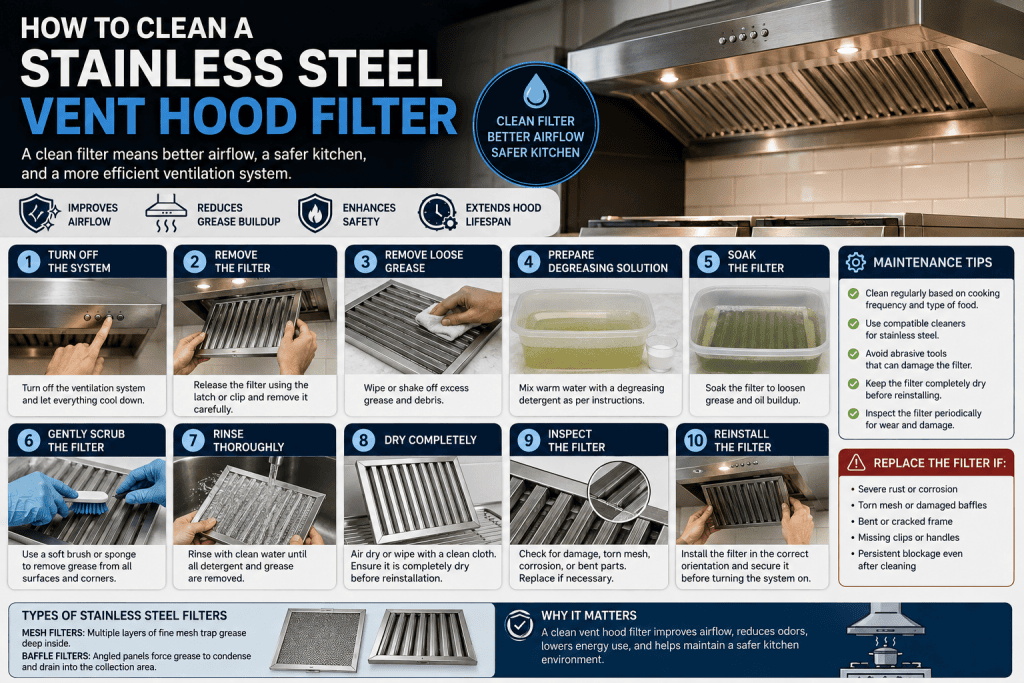
To clean a stainless steel vent hood filter, remove the filter after turning off the ventilation system, soak or wash it with a suitable degreasing solution, gently remove grease buildup, rinse it thoroughly, dry it completely, and reinstall it according to the manufacturer’s instructions.
What Is a Stainless Steel Vent Hood Filter?
A vent hood filter is the removable panel installed inside a range hood or exhaust hood that catches grease, oil, and airborne particles before they enter the ductwork or fan. As kitchen air is pulled up and through the hood, the filter forces it through a barrier of metal that traps grease droplets on contact, letting cleaner air pass through to the exhaust system.
Stainless steel filters work through two common designs, and the design determines how the filter should be cleaned:
- Mesh filters use layers of fine woven or crimped stainless steel screen. The layered mesh creates a lot of surface area for grease to cling to, which makes mesh filters effective but also means grease can get trapped deep inside the layers.
- Baffle filters use a series of angled, overlapping metal panels rather than a mesh screen. As air changes direction moving through the baffles, grease droplets are forced to condense on the metal surfaces and drain down into a collection area.
Not every stainless steel vent hood filter is built the same way, and the specific frame, gauge of steel, and finish can vary between manufacturers. Because of that, it’s worth checking your filter’s documentation before assuming a cleaning method that worked on one filter will work equally well on another.
Why Do Stainless Steel Vent Hood Filters Need Cleaning?
Filters are designed to trap contaminants, which means they accumulate residue by design. Over time, a filter in regular use can build up:
- Cooking grease and oil
- Smoke residue
- Airborne dust
- Small food particles
- Other airborne cooking byproducts
When that buildup isn’t cleaned off, it can start to cause problems. Grease-clogged mesh or baffles restrict how much air can pass through, which reduces the hood’s ventilation efficiency and forces the fan to work harder. A heavily soiled filter is also more difficult to clean than one that’s maintained regularly, since dried, layered grease is much harder to break down than fresh residue. Buildup can contribute to lingering kitchen odors as well.
In commercial cooking environments, grease accumulation is also a recognized fire-safety concern, which is why commercial kitchens are typically subject to specific inspection and cleaning schedules. Rather than relying on general assumptions about fire risk, always follow the fire-safety codes that apply in your area and the maintenance schedule recommended by your filter or hood manufacturer.
How Often Should You Clean a Stainless Steel Vent Hood Filter?
There’s no single cleaning interval that applies to every kitchen. How often a filter needs cleaning depends on several factors:
- How much cooking is done and how frequently
- The type of food being prepared (high-fat and fried foods generate more grease)
- How much grease and smoke the cooking process produces
- Whether the system is residential or commercial
- The specific filter design (mesh filters can trap grease differently than baffle filters)
- The capacity and setup of the ventilation system itself
- The manufacturer’s stated cleaning recommendations
- Any local fire-safety or health regulations that apply to your kitchen
Home kitchens with light, occasional cooking may only need filter cleaning every few weeks to a couple of months. Commercial kitchens, especially those with fryers, grills, or high cooking volume, typically require far more frequent cleaning sometimes weekly because grease accumulates much faster. In the U.S., NFPA 96 (the national standard covering ventilation and fire protection for commercial cooking operations) directs that commercial exhaust hood systems be inspected on a schedule tied to cooking volume and equipment type, with cleaning triggered when grease buildup exceeds the levels the standard allows. If you operate a commercial kitchen, check with your local fire authority and your hood manufacturer to confirm the schedule that applies to you.
What You Need to Clean a Stainless Steel Vent Hood Filter
Before you start, gather the following:
- Warm water
- A degreasing detergent suitable for stainless steel
- A sink, basin, or other cleaning container large enough to hold the filter
- A soft-bristle brush
- A non-abrasive sponge or cloth
- Gloves
- Eye protection
- A clean, dry cloth
- A flat area or rack for air-drying
The cleaning solution you use should be compatible with stainless steel and with the specific filter you’re cleaning check the manufacturer’s documentation if you’re unsure. Never mix cleaning chemicals together, even household products that seem harmless individually, since combining certain cleaners can create hazardous fumes.
How to Clean a Stainless Steel Vent Hood Filter Step by Step
Step 1: Turn Off the Ventilation System
Before touching the filter, turn off the hood and, where appropriate, disconnect power to the unit. Let the system and filter cool completely if it’s been in use recently never remove a hot filter unnecessarily, since this creates a burn risk and can warp the metal. Put on gloves and eye protection before handling a soiled filter.
Step 2: Remove the Stainless Steel Filter
Follow your manufacturer’s instructions for removing the filter. Most filters release with a latch, spring clip, or knob, but the exact mechanism varies by model. Handle the filter carefully to avoid bending the frame, denting the mesh or baffles, or damaging clips and handles during removal.
Step 3: Remove Loose Grease and Debris
Before washing, shake off or wipe away any loose grease, dust, or food particles with a soft cloth. This keeps the worst of the debris out of your cleaning solution and makes the soaking and scrubbing steps more effective. Avoid aggressive scraping at this stage, since forcing dried grease off with a hard tool can bend or deform the mesh or baffles.
Step 4: Prepare a Degreasing Solution
Mix warm water with a degreasing detergent that’s compatible with stainless steel, following the product’s instructions for dilution. If you’re using a commercial degreaser, confirm on the label that it’s safe for stainless steel surfaces. As noted above, never mix cleaning products together.
Step 5: Soak the Filter
Submerge the filter in the degreasing solution and let it soak. Soaking helps loosen grease, oil residue, and cooked-on deposits, especially in the layered mesh or between baffle panels where buildup is hardest to reach. How long to soak depends on the cleaning product you’re using and how much grease has accumulated follow the product’s instructions rather than a fixed universal time, and expect heavier buildup to need longer soaking.
Step 6: Gently Scrub the Filter
After soaking, use a soft brush or non-abrasive sponge to work through the remaining grease. Pay particular attention to mesh openings, the spaces between baffles, corners, and the frame, since grease tends to concentrate in these areas. Avoid steel wool, abrasive pads, or anything that could scratch the stainless steel finish or distort delicate mesh.
Step 7: Rinse Thoroughly
Rinse the filter with clean water until all grease, detergent, and loosened residue are gone. Check mesh layers and baffle gaps closely, since soap residue left behind can attract dust once the filter is back in use.
Step 8: Dry the Filter Completely
Let the filter air dry fully, or dry it with a clean cloth, before reinstalling. Don’t put a wet filter back into the hood trapped moisture can promote corrosion over time, particularly in tight mesh layers or seams where water can collect. Give extra attention to any areas where water could be hiding inside the construction.
Step 9: Inspect the Filter
Before reinstalling, look the filter over for:
- Damaged or torn mesh
- Bent or warped frames
- Broken welds or seams
- Corrosion or rust spots
- Deformed baffles
- Openings that are still blocked after cleaning
- Loose handles, clips, or hardware
- General wear that affects how well the filter fits or functions
If cleaning hasn’t restored the filter to good condition, or if you find structural damage, replacement is usually the safer option rather than continuing to reuse a compromised filter.
Step 10: Reinstall the Filter
Confirm the filter is completely dry, then install it in the correct orientation according to your hood’s design. Make sure it’s fully secured in place before turning the ventilation system back on, and check that the hood runs normally once the filter is reinstalled.
Best Ways to Remove Heavy Grease From a Stainless Steel Hood Filter
For filters with heavy, built-up grease, an extended soak with an approved degreaser is usually the most effective starting point giving the solution more time to break down layered residue before you scrub. Hot water improves the effectiveness of most degreasers, and a soft brush worked patiently through mesh or baffle gaps will do more good than pressing hard with an abrasive tool. In commercial settings, dedicated soak tanks or commercial-grade cleaning equipment are sometimes used to handle higher grease volumes efficiently.
If grease buildup is extremely heavy, has hardened over a long period, or keeps recurring despite regular cleaning, professional filter or hood cleaning services may be the more practical and effective option particularly for commercial kitchens where NFPA 96 requires certain cleaning to be performed and documented by qualified technicians.
Can You Put a Stainless Steel Vent Hood Filter in a Dishwasher?
It depends on the filter. Some stainless steel hood filters are labeled dishwasher-safe by their manufacturer, and dishwasher cycles can be a convenient way to clean lightly soiled filters. Others are not designed for dishwasher use, particularly filters with certain frame materials, finishes, or components that may not hold up to dishwasher detergents and heat over repeated cycles.
Always check the manufacturer’s instructions before putting a filter in the dishwasher. If there’s no clear guidance, hand-washing with a degreasing solution is the safer default. It’s also worth noting that a heavily greasy filter can leave excess oil in the dishwasher itself, so many manufacturers and cleaning guides recommend a preliminary hand-clean for filters with significant buildup, even if the filter is otherwise dishwasher-rated.
Can You Use Baking Soda or Vinegar to Clean a Stainless Steel Hood Filter?
Both are common household options, and they can be effective for lighter contamination, depending on the filter. A baking soda paste mixed with a small amount of dish soap is sometimes used to help lift grease, and diluted vinegar is a mild degreaser that many people use on stainless steel surfaces. For heavier grease buildup, though, a purpose-designed degreaser formulated for stainless steel is generally more effective than household substitutes.
If you choose to use baking soda or vinegar, confirm first that it’s compatible with your filter’s material and finish, and follow your manufacturer’s cleaning guidance if one is provided. Never mix vinegar with bleach or other incompatible chemicals combining them can produce hazardous fumes.
Common Mistakes When Cleaning Stainless Steel Hood Filters
- Using abrasive brushes, steel wool, or scouring pads that scratch the finish
- Scraping dried grease off aggressively instead of soaking it loose first
- Using cleaning chemicals that aren’t compatible with stainless steel
- Mixing different cleaning products together
- Skipping the rinse step and leaving detergent residue behind
- Reinstalling the filter while it’s still wet
- Ignoring torn mesh or damaged baffles instead of addressing them
- Cleaning the filter without turning off the ventilation system first
- Not following the manufacturer’s specific removal or cleaning instructions
- Applying excessive pressure or force on delicate mesh layers
How to Clean Different Types of Stainless Steel Hood Filters
Stainless Steel Mesh Filters
Fine mesh filters have more layered surface area than baffle filters, which means grease can settle deep between the layers. A longer soak in a degreasing solution, followed by gentle brushing that reaches into the mesh from multiple angles, generally gets better results than trying to scrub the surface alone. Rinse thoroughly to make sure no grease or detergent is trapped between layers.
Stainless Steel Baffle Filters
Grease tends to collect in the gaps between angled baffle panels and around the edges where panels overlap. Soaking loosens this buildup, and a soft brush worked along each panel and into the corners helps clear grease that a quick wipe would miss. Baffle filters are often somewhat more resistant to bending than fine mesh, but the panels can still warp under excessive force, so scrub gently.
Commercial Stainless Steel Hood Filters
Commercial kitchen filters are exposed to significantly higher grease loads than residential filters, especially in kitchens running fryers, grills, or high-volume cooking. This typically means more frequent cleaning and, in many jurisdictions, cleaning that must be documented and performed on a defined schedule. Commercial operators should follow applicable local fire-safety codes (such as NFPA 96 in the U.S.) and work with qualified professionals for hood and duct cleaning where required, rather than relying solely on in-house filter washing.
Stainless Steel Hood Filter vs. Aluminum Hood Filter
| Feature | Stainless Steel Filter | Aluminum Filter |
| Durability | Generally high | Depends on construction |
| Corrosion resistance | Generally good | Depends on alloy and environment |
| Cleaning | Depends on design (mesh vs. baffle) | Requires material-compatible methods |
| Weight | Generally heavier | Generally lighter |
| Maintenance | Regular cleaning required | Regular cleaning required |
| Application | Residential and commercial applications | Application-dependent |
Both materials require regular maintenance to perform well, and the right choice often comes down to the specific ventilation system, cooking volume, and manufacturer specifications rather than one material being universally better than the other.
Signs That a Stainless Steel Hood Filter Needs Replacement
- Severe corrosion or rust that cleaning doesn’t remove
- A cracked or bent frame
- Broken or torn mesh
- Bent, warped, or deformed baffles
- Missing clips, handles, or other components
- Blockage that persists even after thorough cleaning
- Visible structural deformation
- A filter that no longer seats or fits correctly in the hood
- Damage that makes effective cleaning impossible
A filter that’s structurally compromised shouldn’t be reinstalled, even if it still looks mostly clean damaged filters can allow grease to bypass the filtration surface or fail to seat properly in the hood.
Stainless Steel Vent Hood Filter Maintenance Tips
- Clean the filter based on actual usage, not a fixed calendar date alone
- Inspect the filter regularly, even between full cleanings
- Remove grease before it has a chance to build up heavily
- Follow the manufacturer’s cleaning instructions for your specific filter
- Use cleaning products confirmed compatible with stainless steel
- Avoid abrasive brushes, pads, or tools
- Make sure the filter is completely dry before reinstalling
- Keep maintenance and cleaning records for commercial kitchens
- Replace any filter that’s damaged rather than continuing to reuse it
Frequently Asked Questions
- How do you clean a stainless steel vent hood filter?
Turn off the ventilation system, remove the filter, soak it in a degreasing solution, gently scrub with a soft brush, rinse thoroughly, dry completely, and reinstall according to the manufacturer’s instructions.
- How often should a stainless steel hood filter be cleaned?
It depends on cooking volume, food type, and whether the system is residential or commercial. Commercial kitchens generally need more frequent cleaning than home kitchens always check your manufacturer’s recommendation and any applicable local regulations.
- Can stainless steel hood filters go in the dishwasher?
Some are dishwasher-safe and some aren’t, depending on the filter’s construction and finish. Check the manufacturer’s instructions before washing a filter in the dishwasher.
- What is the best way to remove grease from a hood filter?
Soaking in a compatible degreasing solution followed by gentle scrubbing with a soft brush is generally the most effective approach, especially for heavier buildup.
- Can you use a degreaser on a stainless steel hood filter?
Yes, as long as the degreaser is confirmed compatible with stainless steel and used according to the product’s instructions.
- Can you use baking soda to clean a stainless steel hood filter?
A baking soda paste can help with light to moderate grease, depending on the filter, but heavier buildup usually responds better to a dedicated degreaser.
- Can you use vinegar on a stainless steel hood filter?
Diluted vinegar can work as a mild degreaser for light contamination on some filters, but never mix it with bleach or other cleaning chemicals, and confirm compatibility with your specific filter first.
- How do you clean a greasy stainless steel mesh filter?
Soak the filter to loosen grease trapped between the mesh layers, then gently brush from multiple angles to reach embedded residue, and rinse thoroughly before drying.
- When should a stainless steel hood filter be replaced?
Replace the filter if it shows corrosion, torn mesh, a bent or cracked frame, warped baffles, missing hardware, or persistent blockage that cleaning doesn’t resolve.
- Can you pressure wash a stainless steel hood filter?
Follow the manufacturer’s guidance before using high-pressure water, since excessive pressure can damage delicate mesh or force water into areas of the filter that are difficult to dry completely. A controlled soak-and-scrub method is generally the safer standard approach.
Conclusion
Stainless steel vent hood filters accumulate grease, oil, and airborne residue simply by doing their job, which is why regular cleaning matters for both performance and safety. The core process is straightforward: turn off the system, remove the filter safely, degrease and soak it, scrub gently, rinse thoroughly, dry it completely, and inspect it before reinstalling. Filters that are corroded, torn, bent, or otherwise damaged should be replaced rather than reused, since a compromised filter can’t do its job effectively regardless of how well it’s cleaned.
Whether you’re maintaining a single residential range hood or managing filters across a commercial kitchen, following your manufacturer’s instructions and any applicable local fire-safety requirements will help your ventilation system keep running efficiently.
Looking for durable stainless steel filters or custom filtration components? Contact Xintan Filter to discuss your stainless steel filter, mesh filter, and application-specific filtration requirements.