Mining and heavy industrial operations place extreme demands on every component in the processing chain, and the humble mining perforated tube is no exception. From filtration and screening to dewatering, dust collection, and material handling, perforated tubes provide the structural support and controlled flow that keep mining equipment running in some of the harshest operating environments on earth. Because these components face constant abrasion, heavy loads, moisture, and corrosive slurries, abrasion resistance, corrosion resistance, high mechanical strength, and precision manufacturing aren’t optional extras they’re baseline requirements. This guide covers what mining-grade perforated tubes are, the materials used to build them, their key applications, and how to select the right tube for demanding heavy-industry conditions.
What Is a Mining Perforated Tube?
A mining perforated tube is a cylindrical metal component with a pattern of holes formed into its wall, engineered specifically to withstand the abrasive, high-load, and corrosive conditions typical of mining and heavy industrial environments.
Structure and design: These tubes are typically fabricated from thick-walled carbon steel, stainless steel, or wear-resistant alloy, then perforated in a pattern chosen to balance flow performance against structural strength. Compared to lighter-duty perforated tubes, mining-grade versions generally use heavier wall thicknesses and more robust hole geometries to survive constant mechanical stress.
Working principle: As slurry, water, ore, or air passes through or around the tube, the perforations allow fluid or gas to pass while retaining solids above a certain size, supporting filter media, or channeling material flow in a controlled direction.
Why they’re widely used: Mining operations depend on continuous, high-volume processing of abrasive materials. Perforated tubes offer a durable, cost-effective way to filter, screen, drain, and ventilate at scale without the fragility of finer mesh or the maintenance burden of more complex mechanical separators.
Standard vs. mining-grade tubes: A general industrial perforated tube may prioritize light weight or hygienic finish. A mining-grade tube instead prioritizes wall thickness, wear resistance, and impact tolerance, often sacrificing surface finish refinement for raw durability under continuous abrasive load.
Why Perforated Tubes Are Essential in Mining and Heavy Industries
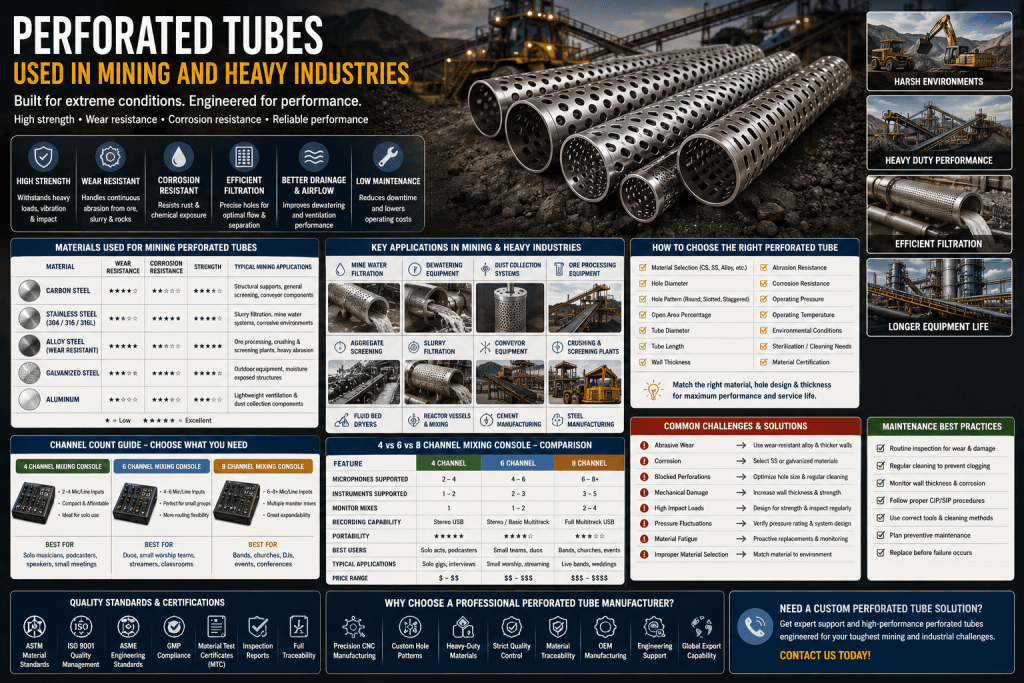
- High mechanical strength — withstands heavy loads, vibration, and impact common in mining equipment.
- Excellent wear resistance — tolerates continuous exposure to abrasive ore, rock, and slurry.
- Reliable filtration support — provides a stable structure for filter media in dewatering and slurry filtration systems.
- Efficient drainage — allows water and fine particles to pass while retaining coarser material.
- Improved airflow — supports ventilation and dust collection systems that keep working environments safer.
- Better material separation — precise hole sizing enables consistent screening and grading of processed material.
- Longer equipment life — durable materials and construction reduce the frequency of component failure.
- Reduced maintenance — robust design lowers the frequency of repairs and unplanned downtime.
- Increased operational efficiency — consistent flow and filtration performance support steady, predictable throughput.
Materials Used for Mining Perforated Tubes
Carbon Steel Perforated Tube
Carbon steel offers high strength and good abrasion resistance at a relatively low cost, making it a common choice for structural and general-purpose perforated tubes in mining equipment where corrosion exposure is limited.
Stainless Steel Perforated Tube
Stainless steel adds corrosion resistance to the strength of steel, making it suitable for applications involving water, slurry, or corrosive chemical exposure such as slurry filtration and mine water systems.
Wear-Resistant Alloy Steel
Alloy steels formulated for high hardness and wear resistance are used where abrasive material contact is most severe, such as in ore processing and crushing/screening equipment, extending service life under continuous abrasive wear.
Galvanized Steel
Galvanized steel provides a zinc coating over carbon steel, offering improved corrosion protection at a lower cost than stainless steel, a practical option for outdoor or moisture-exposed applications where budget is a key consideration.
Perforated Aluminum Tube
Aluminum offers a lightweight alternative for non-structural or lighter-load applications, such as certain ventilation or dust collection components where weight reduction is more important than maximum strength.
| Material | Wear Resistance | Corrosion Resistance | Strength | Typical Mining Applications |
| Carbon Steel | Good | Fair (uncoated) | High | Structural supports, general screening, conveyor components |
| Stainless Steel | Good | Excellent | High | Slurry filtration, mine water systems, corrosive environments |
| Alloy Steel | Excellent | Fair to good, depending on alloy | Very high | Ore processing, crushing and screening plants |
| Galvanized Steel | Good | Good | High | Outdoor equipment, moisture-exposed structures |
| Aluminum | Fair | Good | Moderate | Lightweight ventilation and dust collection components |
Key Features of Mining Perforated Tubes
High Structural Strength
Withstands heavy mechanical loads and vibration without deforming or failing under continuous operation.
Abrasion Resistance
Resists surface wear from continuous contact with ore, rock, and abrasive slurry over long operating periods.
Corrosion Resistance
Protects against rust and material degradation from exposure to water, moisture, and process chemicals.
Precision Hole Patterns
Consistent hole size and spacing ensure predictable filtration, screening, and separation performance.
High Open Area
Maximizes flow capacity for drainage, filtration, and ventilation applications while balancing structural integrity.
Pressure Resistance
Maintains shape and function under the pressure loads typical of slurry filtration and dewatering systems.
Excellent Drainage Performance
Facilitates efficient removal of water and fines from processed material, supporting dewatering operations.
Efficient Material Separation
Enables consistent grading and screening of ore, aggregate, and other processed materials.
Easy Maintenance
Robust construction and accessible design simplify inspection and cleaning in demanding operating conditions.
Long Service Life
The right combination of material and wall thickness extends operational lifespan even under continuous abrasive loading.
Applications in Mining and Heavy Industries
Mine Water Filtration Systems
Perforated tubes support filtration components that remove sediment and particulate from mine water before discharge or reuse, protecting downstream equipment and supporting environmental compliance.
Dewatering Equipment
In dewatering screens and centrifuges, perforated tubes allow water to drain from processed material while retaining solids, improving material handling efficiency.
Dust Collection Systems
Perforated tubes support filter elements in dust collection systems, helping capture airborne particulates and improve air quality in processing facilities.
Ore Processing Equipment
Perforated components support screening, classification, and material handling throughout the ore processing chain.
Aggregate Screening
Perforated tubes and screens grade aggregate material by size, supporting consistent product quality in quarry and construction material operations.
Mineral Processing Plants
Throughout mineral processing, perforated tubes support filtration, drainage, and material separation processes critical to product recovery.
Slurry Filtration Systems
Perforated tubes provide the structural backbone for filter media in slurry filtration, withstanding both abrasive wear and pressure loads.
Conveyor Equipment
Perforated tube components support ventilation, drainage, or structural elements integrated into conveyor systems.
Crushing and Screening Plants
Perforated screens and tube components separate crushed material by size, directly affecting downstream processing efficiency.
Cement Manufacturing
Perforated tubes support material handling, dust collection, and drying processes throughout cement production.
Steel Manufacturing
Heavy-duty perforated components support filtration and material handling in steel production environments.
Quarry Operations
Perforated screening and drainage components support material grading and dewatering in quarry processing.
In each of these applications, mining perforated tubes contribute to improved productivity, better equipment protection, and more consistent operational efficiency by maintaining reliable flow, filtration, and separation performance under continuous heavy-duty conditions.
How Mining Perforated Tubes Improve Equipment Performance
- Improved filtration efficiency — consistent hole geometry ensures reliable particle capture and separation.
- Better drainage — efficient water removal supports faster, more effective dewatering.
- Enhanced airflow — optimized open area improves ventilation and dust collection performance.
- Reduced clogging — appropriately sized perforations minimize blockage from processed material.
- Increased structural support — robust construction helps equipment withstand heavy operational loads.
- Longer service intervals — durable materials reduce the frequency of required maintenance.
- Lower maintenance costs — fewer failures and replacements translate directly into reduced operating expenses.
- Improved productivity — reliable, consistent equipment performance supports steady throughput and reduced downtime.
How to Choose the Right Mining Perforated Tube
- Material Selection — carbon steel, stainless steel, alloy steel, galvanized steel, or aluminum, based on wear, corrosion, and load requirements.
- Hole Diameter — determines the size of material or particles retained versus passed through.
- Hole Pattern — round, slotted, or staggered patterns affect flow, strength, and clogging resistance.
- Open Area Percentage — balances flow capacity against structural strength.
- Tube Diameter — must match the equipment housing or processing system.
- Tube Length — determined by the specific equipment design and installation space.
- Wall Thickness — directly affects strength, impact resistance, and expected service life.
- Abrasion Resistance — critical for applications with continuous contact with abrasive material.
- Corrosion Resistance — important for wet, humid, or chemically exposed environments.
- Operating Pressure — the tube must withstand the pressure loads of the specific filtration or dewatering system.
- Environmental Conditions — temperature, moisture, and exposure to chemicals should inform material and finish choices.
Practical Selection Checklist:
- Define the material being filtered, screened, or drained, and its abrasive characteristics.
- Assess the corrosion exposure of the operating environment.
- Select a material grade that balances wear resistance, corrosion resistance, and cost.
- Specify hole diameter, pattern, and open area for the required flow or separation performance.
- Confirm tube dimensions match the equipment design.
- Determine wall thickness based on expected mechanical loads and impact exposure.
- Confirm the tube can withstand the system’s operating pressure and temperature range.
- Request material certification and quality documentation from the manufacturer.
Common Challenges and Solutions
Abrasive Wear — Continuous contact with ore or rock erodes tube surfaces over time. Solution: select wear-resistant alloy steel or increase wall thickness in high-wear zones.
Corrosion — Moisture and process chemicals can degrade unprotected steel. Solution: use stainless steel or galvanized coatings in wet or corrosive environments.
Blocked Perforations — Fine material or debris can clog holes, reducing flow efficiency. Solution: reassess hole diameter and pattern, and implement regular cleaning schedules.
Mechanical Damage — Heavy impact from processed material can dent or deform tubes. Solution: increase wall thickness or select higher-strength alloy materials.
High Impact Loads — Repeated impact can cause fatigue or cracking over time. Solution: design for adequate structural margin and inspect regularly for early signs of stress.
Pressure Fluctuations — Sudden pressure changes in filtration systems can stress the tube structure. Solution: verify the tube’s pressure rating matches actual system conditions, including surges.
Material Fatigue — Long-term cyclic loading can lead to eventual failure. Solution: follow a proactive replacement schedule based on expected service life and inspection findings.
Incorrect Material Selection — Using a lower-grade material in a high-wear or corrosive application shortens service life. Solution: match material grade carefully to the specific operating conditions before specifying.
Maintenance Best Practices
- Routine inspection — regularly check for wear, deformation, and blocked perforations.
- Cleaning procedures — remove accumulated debris and material buildup to maintain flow performance.
- Wear monitoring — track wall thickness reduction over time in high-abrasion zones.
- Corrosion inspection — check for pitting, rust, or coating degradation, particularly in wet environments.
- Hole blockage prevention — implement cleaning schedules suited to the specific material being processed.
- Preventive maintenance — schedule inspections and part replacements proactively based on operating hours or wear indicators.
- Replacement planning — track service life data to plan replacements before failure risks unplanned downtime.
Quality Standards and Certifications
Perforated tubes are typically manufactured and verified against a combination of the following standards, where applicable:
- ASTM Material Standards — governing the chemical composition, mechanical properties, and dimensional tolerances of the steel or alloy used.
- ISO Quality Management Systems — such as ISO 9001, ensuring consistent manufacturing and quality control practices.
- ASME Engineering Standards — relevant for components used in pressure-related or structural applications.
- Material Test Certificates (MTC) — confirming the chemical and mechanical properties of the specific material batch.
- Dimensional Inspection Reports — documenting that the finished tube meets specified tolerances.
- Traceability Documentation — linking the finished tube back to its raw material source and manufacturing records.
The applicable standards will vary depending on the operating environment, the specific equipment design, and individual customer specifications, so it’s worth confirming requirements directly with your engineering team and equipment supplier.
Why Choose a Professional Perforated Tube Manufacturer?
- Precision CNC manufacturing — ensures consistent hole geometry and dimensional accuracy across large production runs.
- Custom perforation patterns — tailored hole size, spacing, and open area to match specific mining and processing requirements.
- Heavy-duty material options — access to wear-resistant alloys and heavier wall thicknesses suited to harsh operating conditions.
- Strict quality control — rigorous inspection processes that catch dimensional or material defects before shipment.
- Material traceability — full documentation connecting finished components to certified raw material batches.
- OEM manufacturing — capability to produce tubes to a customer’s proprietary specifications and drawings.
- Engineering support — technical guidance on material selection and perforation design for demanding applications.
- Global logistics and export capability — experience shipping heavy industrial components internationally with proper documentation.
Frequently Asked Questions
What is a mining perforated tube?
It’s a metal tube with an engineered hole pattern, built from durable materials such as carbon steel, stainless steel, or alloy steel, designed to withstand the abrasive, high-load conditions of mining and heavy industrial equipment.
Which material is best for mining applications?
It depends on the specific conditions wear-resistant alloy steel suits highly abrasive environments, stainless steel suits wet or corrosive conditions, and carbon or galvanized steel often suits general structural or moderate-exposure applications.
Why is stainless steel used in mining equipment?
Stainless steel combines strength with strong corrosion resistance, making it well suited to slurry filtration, mine water systems, and other applications involving significant moisture or chemical exposure.
What hole pattern is best for mining filtration?
This depends on the material being processed round holes are common for general filtration, while slotted or staggered patterns may be chosen to optimize flow, strength, or clog resistance for specific applications.
Can mining perforated tubes be custom manufactured?
Yes. Material, wall thickness, hole diameter, hole pattern, open area, and tube dimensions can all be tailored to specific equipment and processing requirements.
How do perforated tubes improve dewatering systems?
They provide a durable, precisely perforated structure that allows water to drain efficiently while retaining solid material, improving both dewatering speed and material recovery.
What quality standards apply to mining perforated tubes? Depending on the application, relevant standards may include ASTM material specifications, ISO quality management requirements, and ASME engineering standards, along with material certification and traceability documentation.
How do I choose the right perforated tube for mining equipment?
Consider material grade, hole diameter and pattern, open area, wall thickness, tube dimensions, operating pressure, and the abrasion and corrosion characteristics of the specific application together as an interdependent set of specifications.
How often should mining perforated tubes be inspected?
Inspection frequency depends on the severity of the operating conditions, but routine scheduled inspections combined with wear and corrosion monitoring are recommended to catch issues before they cause unplanned downtime.
What is the expected service life of a mining perforated tube?
Service life varies significantly based on material grade, wall thickness, and the abrasiveness of the operating environment, but selecting the right material and maintaining a proactive inspection and replacement schedule helps maximize longevity.
Conclusion
Mining perforated tubes play a critical role in filtration, drainage, wear resistance, and overall equipment reliability across mining and heavy industrial operations. Selecting the correct material, perforation pattern, wall thickness, and surface treatment isn’t just a technical detail it directly affects equipment performance, maintenance costs, and operational uptime in some of the most demanding environments in industry.
If you’re sourcing perforated tubes for mining, mineral processing, or heavy industrial equipment, working with an experienced perforated tube manufacturer who understands wear-resistant materials, custom fabrication, and heavy-duty engineering requirements can make a measurable difference to your operation’s performance and reliability. Consult a qualified perforated tube manufacturer today to discuss your specifications and get a tailored solution built for your operating conditions.