Stainless steel perforated tubes are among the most widely used components in modern industrial filtration, processing, and support systems. From water treatment plants and chemical processing facilities to food manufacturing and pharmaceutical production, a stainless steel perforated tube provides the ideal combination of corrosion resistance, mechanical strength, and long-term durability. Compared with other materials, stainless steel offers excellent resistance to harsh environments while maintaining structural integrity under demanding operating conditions. Whether used as a filter support tube, protective sleeve, or OEM filtration component, choosing the right perforated tube can significantly improve equipment performance, reduce maintenance costs, and extend service life.
What Is a Stainless Steel Perforated Tube?
A stainless steel perforated tube is a cylindrical metal tube manufactured with precisely engineered holes or slots distributed across its surface. These perforations allow controlled passage of liquids, gases, or air while maintaining the tube’s structural strength.
It is commonly used as:
- Filter support tube
- Industrial filtration component
- Protective screen
- Flow distribution tube
- Structural reinforcement
- OEM machine component
The combination of high-strength stainless steel and precision perforation makes these tubes suitable for demanding industrial environments where durability and corrosion resistance are essential.
Construction
A typical stainless steel perforated tube consists of:
- Stainless steel sheet or seamless tube
- Precision punched or laser-cut perforations
- Welded longitudinal seam (when applicable)
- Smooth finished surface
- Optional end caps or flanges
Manufacturers can customize dimensions, perforation patterns, and surface finishes to meet specific application requirements.
Manufacturing Process
Most SS perforated tubes are manufactured using advanced CNC equipment to ensure consistent quality.
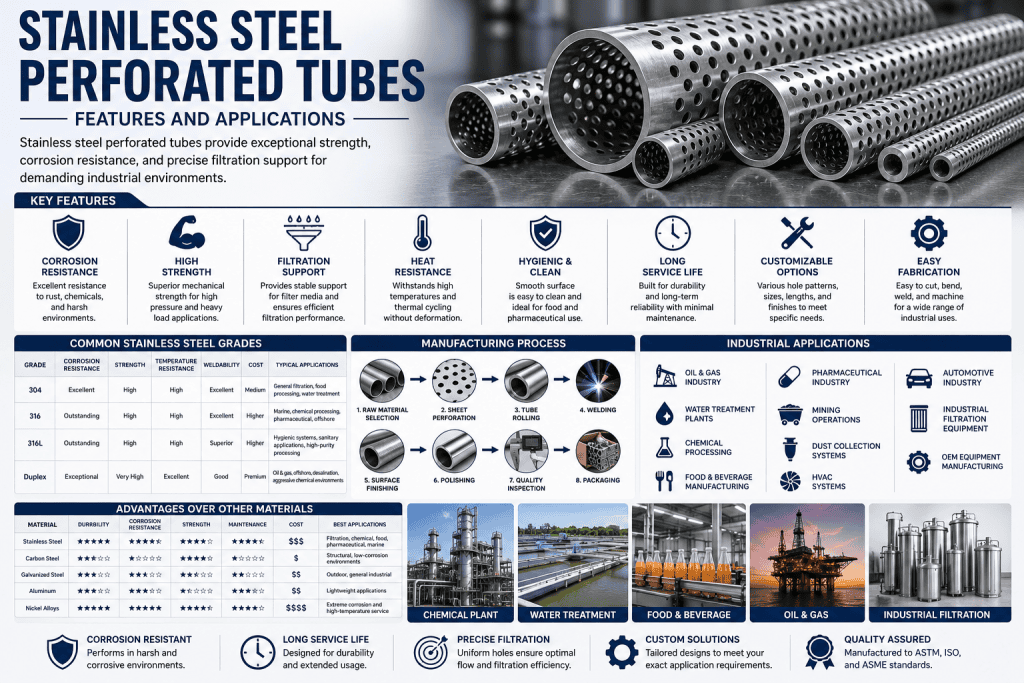
The basic manufacturing steps include:
- Stainless steel material selection
- CNC punching or laser perforation
- Rolling into cylindrical form
- Precision welding
- Surface finishing
- Polishing
- Dimensional inspection
- Packaging
Modern production technology ensures uniform hole spacing, precise tolerances, and excellent repeatability.
Working Principle
The perforated openings allow fluid or air to pass through while supporting filter media or preventing larger particles from entering downstream equipment.
The tube functions by:
- Supporting filtration media
- Maintaining structural integrity
- Promoting uniform flow distribution
- Reducing pressure loss
- Protecting internal components
This design enables high filtration efficiency without sacrificing mechanical strength.
Stainless Steel vs. Other Perforated Tube Materials
Although perforated tubes are available in carbon steel, galvanized steel, aluminum, and specialty alloys, stainless steel offers several advantages.
| Property | Stainless Steel | Carbon Steel | Galvanized Steel | Aluminum |
| Corrosion Resistance | Excellent | Low | Moderate | Good |
| Strength | High | Very High | High | Moderate |
| Maintenance | Low | High | Medium | Low |
| Service Life | Long | Medium | Medium | Long |
| Food Grade | Yes | No | No | Limited |
Because of these advantages, stainless steel remains the preferred material for industrial filtration and processing applications.
Key Features of Stainless Steel Perforated Tubes
Excellent Corrosion Resistance
One of the biggest advantages of stainless steel perforated tubes is their exceptional resistance to corrosion.
The chromium content in stainless steel forms a passive oxide layer that protects the surface from moisture, chemicals, and oxidation.
Industrial examples include:
- Marine filtration systems
- Chemical processing plants
- Water treatment facilities
- Offshore equipment
Even under aggressive environmental conditions, stainless steel maintains its integrity for many years.
High Mechanical Strength
Despite the presence of perforations, stainless steel tubes retain excellent structural strength.
They withstand:
- High internal pressure
- External mechanical loads
- Vibration
- Continuous industrial operation
This makes them suitable for demanding filtration systems and heavy-duty machinery.
Superior Filtration Support
Stainless steel perforated tubes provide excellent support for various filtration media.
They are widely used inside:
- Filter cartridges
- Filter elements
- Wire mesh filters
- Sintered metal filters
The rigid structure prevents collapse while allowing maximum fluid flow.
Heat and Temperature Resistance
Many industrial processes involve elevated temperatures.
Stainless steel maintains its mechanical properties even when exposed to:
- Steam systems
- High-temperature gases
- Industrial furnaces
- Heat exchangers
This makes SS perforated tubes ideal for thermal processing applications.
Hygienic Surface for Food & Pharmaceutical Industries
The smooth, non-porous surface of stainless steel minimizes bacterial growth and simplifies cleaning.
For this reason, stainless steel perforated tubes are widely used in:
- Food processing
- Beverage production
- Dairy equipment
- Pharmaceutical manufacturing
Their hygienic properties help manufacturers comply with strict sanitation requirements.
Long Service Life
Stainless steel is highly resistant to corrosion, wear, and fatigue, allowing perforated tubes to remain in service for many years.
Benefits include:
- Reduced replacement frequency
- Lower maintenance costs
- Increased equipment reliability
- Improved return on investment
Lightweight Yet Durable Construction
Compared with many solid metal components, perforated tubes offer an excellent strength-to-weight ratio.
Benefits include:
- Easier installation
- Reduced equipment weight
- Improved handling
- Lower transportation costs
This combination is especially valuable in OEM equipment manufacturing.
Easy Fabrication and Welding
Stainless steel can be fabricated into a wide variety of custom designs.
Manufacturers can easily perform:
- Laser cutting
- CNC punching
- TIG welding
- Rolling
- Polishing
- Surface finishing
This flexibility allows custom solutions for virtually any industrial application.
Low Maintenance Requirements
Unlike carbon steel, stainless steel requires minimal maintenance.
Routine care generally involves:
- Periodic cleaning
- Visual inspections
- Removal of process residues
- Preventive maintenance
The reduced maintenance requirements lower operating costs over the product’s lifespan.
Custom Hole Patterns and Sizes
Every filtration application has unique performance requirements.
Manufacturers can customize:
- Round holes
- Staggered holes
- Straight hole patterns
- Slotted holes
- Square holes
- Hexagonal perforations
- Custom perforation layouts
Custom perforation improves filtration efficiency while maintaining structural strength.
Common Grades of Stainless Steel Used
Different stainless steel grades offer varying levels of corrosion resistance, strength, and cost. Selecting the appropriate grade depends on the operating environment and application requirements.
| Grade | Corrosion Resistance | Strength | Temperature Resistance | Weldability | Relative Cost | Typical Applications |
| 304 Stainless Steel | Excellent | High | High | Excellent | Medium | General filtration, food processing, water treatment |
| 316 Stainless Steel | Outstanding | High | High | Excellent | Higher | Marine, chemical processing, pharmaceutical |
| 316L Stainless Steel | Outstanding | High | High | Superior | Higher | Hygienic systems, welding-intensive applications |
| Duplex Stainless Steel | Exceptional | Very High | Excellent | Good | Premium | Offshore, oil & gas, aggressive chemical environments |
304 Stainless Steel
304 stainless steel is the most commonly used grade due to its excellent balance of corrosion resistance, strength, and affordability. It is ideal for general industrial filtration, food processing, and water treatment.
316 Stainless Steel
316 stainless steel contains molybdenum, providing enhanced resistance to chlorides and corrosive chemicals. It is preferred for marine, chemical, and pharmaceutical applications.
316L Stainless Steel
316L offers the same corrosion resistance as 316 but with lower carbon content, improving weldability and reducing the risk of corrosion after welding. It is widely used in sanitary and pharmaceutical systems.
Duplex Stainless Steel
Duplex stainless steel combines austenitic and ferritic structures, offering exceptional mechanical strength and superior corrosion resistance. It is commonly selected for offshore platforms, desalination plants, and demanding industrial environments.
Manufacturing Process of SS Perforated Tubes
The performance and durability of a stainless steel perforated tube depend heavily on the quality of its manufacturing process. Advanced production techniques ensure precise hole dimensions, excellent structural integrity, and consistent product quality for industrial filtration and OEM applications.
Raw Material Selection
The process begins with selecting high-quality stainless steel that meets the application’s mechanical, chemical, and environmental requirements.
Common grades include:
- 304 Stainless Steel
- 316 Stainless Steel
- 316L Stainless Steel
- Duplex Stainless Steel
Material certifications are typically verified to ensure compliance with ASTM, ISO, and customer specifications.
Sheet Perforation
Flat stainless steel sheets are perforated using high-speed CNC punching machines or laser cutting systems.
Modern perforation equipment offers:
- Precise hole diameters
- Uniform spacing
- High production efficiency
- Excellent dimensional accuracy
Depending on the application, manufacturers can produce:
- Round holes
- Staggered patterns
- Straight patterns
- Slotted holes
- Square holes
- Hexagonal perforations
- Custom perforation layouts
Tube Rolling
Once perforated, the flat sheet is rolled into a cylindrical shape using precision rolling equipment.
Proper rolling ensures:
- Accurate tube diameter
- Smooth circular profile
- Consistent wall geometry
- Minimal dimensional variation
This step is critical for ensuring compatibility with filtration housings and OEM equipment.
Welding
The rolled sheet is joined using precision welding methods, most commonly TIG welding, to create a strong and uniform longitudinal seam.
High-quality welding provides:
- Excellent structural integrity
- Leak-free construction
- Smooth internal surfaces
- Long-term durability
For demanding applications, welds may be inspected using non-destructive testing (NDT) methods.
Surface Finishing
Surface finishing improves corrosion resistance, appearance, and cleanliness.
Common finishes include:
- Mill Finish
- Brushed Finish
- Polished Finish
- Electropolished Finish
- Pickled and Passivated Surface
Food, beverage, and pharmaceutical industries often require polished or electropolished finishes to meet hygiene standards.
Polishing
Polishing removes surface imperfections and enhances corrosion resistance.
Benefits include:
- Easier cleaning
- Reduced bacterial adhesion
- Improved aesthetics
- Enhanced resistance to contamination
Mirror-polished tubes are frequently used in sanitary processing systems.
Quality Inspection
Before shipment, every stainless steel perforated tube undergoes rigorous quality control procedures.
Typical inspections include:
- Material verification
- Hole diameter measurement
- Hole spacing inspection
- Weld quality inspection
- Surface finish examination
- Dimensional accuracy testing
- Straightness verification
Leading manufacturers also perform random mechanical and corrosion resistance tests to ensure product reliability.
Packaging
Proper packaging protects the finished tubes during transportation and storage.
Packaging methods may include:
- Plastic wrapping
- Protective sleeves
- Wooden crates
- Export cartons
- Custom OEM packaging
Secure packaging minimizes the risk of scratches, dents, and contamination before installation.
Industrial Applications of Stainless Steel Perforated Tubes
Because of their durability, corrosion resistance, and versatility, stainless steel perforated tubes are used in a wide range of industries.
Oil & Gas Industry
The oil and gas sector operates in highly corrosive and high-pressure environments where reliable filtration components are essential.
Typical applications include:
- Sand control systems
- Downhole screens
- Well completion equipment
- Pipeline filtration
- Refinery processing systems
Preferred materials:
- 316 Stainless Steel
- Duplex Stainless Steel
Water Treatment Plants
Water treatment systems rely on stainless steel perforated tubes to support filtration media while maintaining consistent water flow.
Applications include:
- Activated carbon filters
- Sand filtration
- Municipal water treatment
- Reverse osmosis pre-filtration
- Industrial wastewater treatment
Key advantages:
- Excellent corrosion resistance
- Long service life
- Low maintenance
Chemical Processing
Chemical plants process aggressive acids, alkalis, and solvents that require corrosion-resistant filtration components.
Common applications include:
- Chemical reactors
- Catalyst support
- Process filtration
- Solvent recovery
- Acid filtration
316 and duplex stainless steels are widely preferred because of their superior chemical resistance.
Food & Beverage Manufacturing
The food industry requires hygienic equipment that is easy to clean and resistant to contamination.
Stainless steel perforated tubes are commonly used in:
- Beverage filtration
- Dairy processing
- Brewing systems
- Sugar processing
- Edible oil filtration
Food-grade stainless steel complies with sanitary manufacturing requirements and withstands frequent cleaning cycles.
Pharmaceutical Industry
Pharmaceutical manufacturing requires precision-engineered components that maintain sterile processing conditions.
Applications include:
- Sterile filtration systems
- Cleanroom processing equipment
- Pharmaceutical reactors
- High-purity liquid filtration
316L stainless steel is commonly selected because of its excellent corrosion resistance and superior weldability.
Mining Operations
Mining environments expose equipment to abrasive materials, dust, vibration, and heavy mechanical loads.
Applications include:
- Ore processing
- Slurry filtration
- Dewatering systems
- Mineral separation
Heavy-duty stainless steel perforated tubes improve equipment durability under harsh operating conditions.
Dust Collection Systems
Dust collection equipment uses perforated tubes as internal support cores for filter cartridges.
Industries include:
- Cement production
- Steel manufacturing
- Wood processing
- Power generation
Benefits include:
- Improved airflow
- Better filter support
- Reduced pressure drop
- Longer filter cartridge life
HVAC Systems
HVAC equipment incorporates stainless steel perforated tubes for airflow distribution and acoustic control.
Typical applications include:
- Air diffusers
- Silencers
- Ventilation systems
- Industrial air handling equipment
Stainless steel provides long-lasting corrosion resistance even in humid environments.
Automotive Industry
Automotive manufacturers use stainless steel perforated tubing in:
- Exhaust systems
- Mufflers
- Catalytic converters
- Air intake systems
These applications require excellent heat resistance, vibration resistance, and durability.
Industrial Filtration Equipment
One of the largest applications for stainless steel perforated tubes is industrial filtration.
They are used as support tubes in:
- Filter cartridges
- Wire mesh filters
- Sintered filters
- Pleated filters
- Basket filters
Their rigid structure prevents filter collapse while maximizing flow capacity.
OEM Equipment Manufacturing
OEM manufacturers often require customized perforated tubes designed specifically for their equipment.
Customization options include:
- Custom diameters
- Wall thickness
- Hole patterns
- End caps
- Flanges
- Surface finishes
Working with an experienced manufacturer ensures consistent quality and repeatable production.
Advantages Over Other Materials
Although perforated tubes are available in several materials, stainless steel offers the best overall combination of durability, corrosion resistance, and long-term value.
| Property | Stainless Steel | Carbon Steel | Galvanized Steel | Aluminum | Nickel Alloys |
| Durability | Excellent | Good | Good | Moderate | Excellent |
| Corrosion Resistance | Excellent | Poor | Moderate | Good | Outstanding |
| Mechanical Strength | High | Very High | High | Medium | Very High |
| Maintenance | Low | High | Medium | Low | Low |
| Relative Cost | Medium | Low | Low-Medium | Medium | Very High |
| Best Applications | Filtration, Chemical, Food | Structural | Outdoor | Lightweight | Extreme Chemical Service |
Why Stainless Steel Is Often the Best Choice
Compared with other materials, stainless steel provides:
- Superior corrosion resistance
- Long service life
- Excellent hygiene
- High mechanical strength
- Low maintenance costs
- Better lifecycle value
Although the initial investment may be higher than carbon steel, the reduced maintenance and replacement costs often result in a lower total cost of ownership.
How to Choose the Right Stainless Steel Perforated Tube
Selecting the correct stainless steel perforated tube requires evaluating several technical factors.
Consider the following:
Material Grade
Choose 304 for general industrial use, 316 or 316L for corrosive or sanitary environments, and duplex stainless steel for heavy-duty industrial applications.
Hole Pattern
Select a perforation pattern that provides the required balance between flow capacity and structural strength.
Hole Size
Match the hole diameter to the particle size, filtration accuracy, and desired flow rate.
Open Area
Higher open areas increase flow but may reduce structural strength. Lower open areas provide greater rigidity for high-pressure applications.
Tube Diameter
Ensure compatibility with filter housings and process equipment while meeting flow requirements.
Wall Thickness
Choose sufficient wall thickness to withstand operating pressure and mechanical stress.
Operating Pressure
High-pressure systems require stronger materials and thicker tube walls to maintain structural integrity.
Temperature
Consider the maximum operating temperature and select a stainless steel grade that maintains its mechanical properties under those conditions.
Chemical Compatibility
Verify that the selected stainless steel grade is compatible with all process fluids, chemicals, and cleaning agents.
Industry Standards
Purchase products that comply with recognized standards such as ASTM, ISO, and ASME to ensure quality, traceability, and reliable performance.
Maintenance and Cleaning Tips
Proper maintenance helps maximize the performance, reliability, and lifespan of a stainless steel perforated tube. Although stainless steel is highly resistant to corrosion and wear, routine inspections and cleaning are essential for maintaining optimal filtration efficiency.
Routine Inspections
Regular inspections help identify potential issues before they lead to equipment failure.
Check for:
- Surface corrosion or discoloration
- Blocked perforations
- Mechanical damage
- Weld integrity
- Tube deformation
- Excessive wear
Establishing a preventive maintenance schedule can significantly reduce unexpected downtime.
Cleaning Methods
Cleaning frequency depends on the application and the type of contaminants being filtered.
Recommended cleaning methods include:
- Clean water flushing
- High-pressure water cleaning
- Mild alkaline or neutral detergents
- Ultrasonic cleaning
- Steam cleaning (for sanitary applications)
Avoid using highly abrasive tools or strong chloride-based cleaners, as they may damage the stainless steel surface.
Preventing Corrosion
Although stainless steel is corrosion resistant, improper handling or exposure to aggressive chemicals can still affect its performance.
To minimize corrosion:
- Remove chemical residues promptly.
- Avoid prolonged exposure to chlorides.
- Prevent contact with carbon steel particles.
- Use appropriate cleaning chemicals.
- Passivate the surface when required.
Proper material selection remains the best defense against corrosion.
Proper Storage
Correct storage practices help preserve product quality before installation.
Store perforated tubes:
- In a dry, clean environment
- Away from corrosive chemicals
- Off the ground
- Protected from dust and moisture
- Covered with suitable packaging
Separate stainless steel products from carbon steel to prevent surface contamination.
Extending Service Life
To maximize the lifespan of an SS perforated tube:
- Follow recommended operating limits.
- Perform regular cleaning.
- Replace damaged filter media promptly.
- Monitor operating pressure.
- Avoid mechanical impact.
- Use the correct stainless steel grade for the application.
With proper maintenance, stainless steel perforated tubes can provide reliable performance for many years.
Common Mistakes to Avoid
Choosing the wrong perforated tube can reduce filtration efficiency, increase maintenance costs, and shorten equipment life.
Choosing the Wrong Stainless Steel Grade
Different environments require different stainless steel grades.
For example:
- 304 Stainless Steel is suitable for general industrial use.
- 316 Stainless Steel performs better in marine and chemical environments.
- 316L Stainless Steel is ideal for sanitary and welded applications.
- Duplex Stainless Steel is preferred for high-strength and highly corrosive environments.
Selecting the appropriate grade ensures long-term reliability.
Ignoring Chemical Compatibility
Not every stainless steel grade performs equally well with every chemical.
Always verify compatibility with:
- Acids
- Alkalis
- Chlorides
- Solvents
- Cleaning agents
Failure to do so can result in premature corrosion and reduced service life.
Selecting the Wrong Hole Size
Hole diameter directly influences:
- Filtration accuracy
- Flow capacity
- Pressure drop
Choosing an incorrect hole size may reduce filtration performance or increase clogging.
Overlooking Operating Conditions
Always consider:
- Temperature
- Pressure
- Fluid type
- Flow rate
- Mechanical loading
A perforated tube that performs well in one environment may not be suitable for another.
Buying from Inexperienced Manufacturers
An experienced manufacturer provides:
- Engineering support
- Material certifications
- Precision manufacturing
- Consistent quality
- Custom engineering
- Reliable after-sales service
Partnering with a trusted supplier reduces project risk and ensures consistent product performance.
Neglecting Maintenance
Even high-quality stainless steel perforated tubes require routine inspection and cleaning.
Ignoring maintenance can result in:
- Reduced flow
- Increased pressure drop
- Premature wear
- Unexpected equipment failure
Preventive maintenance significantly extends product life.
Frequently Asked Questions
1. What is a stainless steel perforated tube?
A stainless steel perforated tube is a cylindrical metal tube with precisely engineered holes or slots that allow controlled fluid or air flow while providing structural support for filtration and industrial processing systems.
2. What is the difference between SS304 and SS316 perforated tubes?
SS304 is suitable for general industrial applications, while SS316 contains molybdenum, providing superior resistance to chlorides and aggressive chemicals, making it ideal for marine and chemical processing environments.
3. Which stainless steel grade is best for filtration?
304 stainless steel is widely used for general filtration, while 316 and 316L are preferred for corrosive, hygienic, and pharmaceutical applications due to their enhanced corrosion resistance.
4. Are SS perforated tubes corrosion resistant?
Yes. Stainless steel perforated tubes offer excellent corrosion resistance because of the protective chromium oxide layer that forms naturally on the surface.
5. What industries use stainless steel perforated tubes?
They are widely used in oil and gas, water treatment, chemical processing, food and beverage manufacturing, pharmaceuticals, mining, HVAC, automotive, dust collection, and OEM equipment manufacturing.
6. Can stainless steel perforated tubes be customized?
Yes. Manufacturers can customize material grade, hole pattern, hole size, open area, tube diameter, wall thickness, length, and end connections to meet specific project requirements.
7. How long do SS perforated tubes last?
With proper material selection and maintenance, stainless steel perforated tubes can provide many years of reliable service, even in demanding industrial environments.
8. How do I choose the right stainless steel perforated tube?
Consider the operating environment, material grade, hole pattern, hole size, open area, operating pressure, temperature, chemical compatibility, and industry standards before making a selection.
9. Are stainless steel perforated tubes suitable for food processing?
Yes. Food-grade 304 and 316 stainless steel perforated tubes are widely used because they are hygienic, corrosion resistant, and easy to clean.
10. What certifications should I look for when purchasing SS perforated tubes?
Choose products manufactured in accordance with recognized standards such as ASTM, ISO, and ASME. For food and pharmaceutical applications, verify compliance with applicable sanitary regulations and request material test certificates.
Conclusion
A stainless steel perforated tube is an essential component in modern industrial filtration and processing systems, offering an outstanding combination of corrosion resistance, mechanical strength, hygienic performance, and long service life. From oil and gas facilities to food processing plants and pharmaceutical manufacturing, SS perforated tubes provide reliable support and efficient flow control in demanding operating environments.
Selecting the right tube involves evaluating factors such as stainless steel grade, hole pattern, hole size, open area, wall thickness, operating pressure, and chemical compatibility. By partnering with an experienced perforated tube manufacturer, businesses gain access to expert engineering support, precision manufacturing, certified materials, and customized solutions tailored to their specific applications.
Whether you need a standard filtration component or a fully customized OEM solution, investing in a high-quality stainless steel perforated tube ensures improved equipment performance, reduced maintenance costs, and dependable operation for years to come.