Introduction
Perforated tubes play a vital role in modern industrial systems, providing reliable support, filtration, ventilation, and fluid distribution across countless applications. Whether used in filtration equipment, oil and gas pipelines, chemical processing plants, or food production facilities, selecting the right material directly affects equipment performance, maintenance requirements, and long-term operating costs.
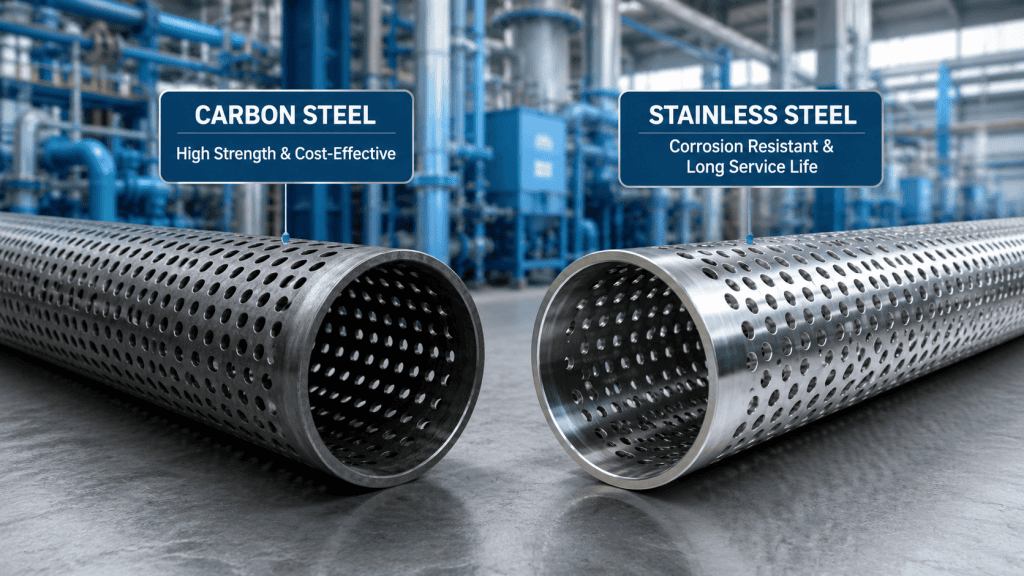
Two of the most widely used materials are the carbon steel perforated tube and the stainless steel perforated tube. While both offer excellent mechanical performance and can be customized with various hole patterns, diameters, and wall thicknesses, they differ significantly in corrosion resistance, durability, hygiene, and overall lifecycle cost.
Understanding these differences helps engineers, procurement teams, OEM manufacturers, and maintenance professionals choose the most suitable solution for their operating environment. This guide compares both materials in detail, covering their characteristics, advantages, industrial applications, cost considerations, and selection criteria to help you make an informed purchasing decision.
If you’re new to industrial filtration, understanding how a perforated tube works is essential before selecting the right material. A perforated tube is a metal cylinder with precisely engineered holes that allow liquids or gases to flow while providing strong structural support for filter media. It is widely used in filter cartridges, dust collection systems, water treatment, and chemical processing. Learn more about its design, working principle, and key industrial applications in our guide, What Is a Perforated Tube and How Does It Work?. This resource also explains how different materials, hole patterns, and manufacturing methods influence filtration efficiency and overall system performance.
What Is a Carbon Steel Perforated Tube?
A carbon steel perforated tube is a cylindrical metal tube manufactured from carbon steel sheets or pipes that are mechanically perforated with precisely engineered holes. These perforations allow controlled flow of liquids, gases, or air while maintaining the structural integrity required for demanding industrial applications.
Carbon steel perforated tubes are widely recognized for their high mechanical strength, cost-effectiveness, and ease of fabrication. They are commonly used in environments where corrosion exposure is minimal or where protective coatings can extend service life.
How Carbon Steel Perforated Tubes Are Manufactured
The manufacturing process combines precision engineering with strict quality control to ensure consistent hole accuracy, dimensional stability, and mechanical performance.
Typical production steps include:
- Selecting the appropriate carbon steel grade.
- Cutting steel sheets or tubes to the required dimensions.
- Creating hole patterns through CNC punching, laser cutting, or precision perforation machines.
- Rolling and welding sheets into tubular shapes when required.
- Straightening and sizing the finished tube.
- Deburring and surface finishing.
- Applying protective treatments such as galvanizing, powder coating, or painting if additional corrosion resistance is needed.
- Conducting dimensional inspections and quality testing in accordance with relevant ASTM, ISO, or ASME standards.
Advanced manufacturing technologies ensure consistent perforation accuracy, smooth edges, and excellent structural performance even in demanding industrial environments.
Common Grades of Carbon Steel
Several grades are used depending on strength requirements, fabrication needs, and operating conditions.
Popular grades include:
- ASTM A36
- ASTM A53
- ASTM A106
- SAE 1010
- SAE 1020
- SAE 1045 (for higher strength applications)
The appropriate grade depends on pressure requirements, load-bearing capacity, weldability, and the intended industrial application.
Key Characteristics
Carbon steel perforated tubes offer several advantages that make them a preferred choice in many industries.
High Mechanical Strength
Carbon steel provides excellent tensile and yield strength, making it ideal for structural components, heavy-duty filtration systems, and equipment exposed to significant mechanical loads.
Excellent Fabrication Performance
Carbon steel is easy to cut, drill, weld, bend, and machine, allowing manufacturers to produce custom perforated tubes in virtually any size or configuration.
Cost-Effective Material
Compared with stainless steel, carbon steel is generally less expensive, making it an economical solution for projects with large material requirements or budget constraints.
Good Wear Resistance
In abrasive environments such as mining or bulk material handling, carbon steel performs well against mechanical wear when properly protected.
Versatile Hole Configurations
Manufacturers can produce a wide range of perforation patterns, including:
- Round holes
- Square holes
- Slotted holes
- Hexagonal holes
- Staggered patterns
- Straight-line patterns
- Custom-designed perforations
These configurations optimize flow rates, filtration efficiency, and structural strength based on specific application requirements.
Typical Industrial Applications
Carbon steel perforated tubes are widely used in industries where strength and affordability are priorities.
Common applications include:
- Industrial filtration systems
- Dust collection equipment
- Filter support cores
- Mining machinery
- Cement plants
- Structural reinforcement
- Grain processing
- HVAC systems
- Power generation facilities
- Construction equipment
- Automotive exhaust components
- Mechanical protection sleeves
In many of these applications, protective coatings or controlled operating environments help maximize the service life of carbon steel components.
What Is a Stainless Steel Perforated Tube?
A stainless steel perforated tube is a precision-engineered tubular component manufactured from stainless steel alloys that contain chromium, which forms a protective oxide layer on the surface. This passive layer provides exceptional resistance to corrosion, oxidation, and chemical attack, making stainless steel the preferred material for harsh operating environments.
Stainless steel perforated tubes are extensively used in industries where cleanliness, corrosion resistance, durability, and long service life are critical. They are commonly found in filtration systems, food processing equipment, pharmaceutical production, marine applications, and chemical processing facilities.
How Stainless Steel Perforated Tubes Are Manufactured
Although the production process is similar to carbon steel, stainless steel requires more precise handling to preserve its corrosion-resistant properties.
The manufacturing process typically includes:
- Selecting the appropriate stainless steel grade.
- Cutting high-quality stainless steel sheets or tubes.
- Precision perforating using CNC punching or laser cutting.
- Forming and welding where necessary.
- Passivation and surface finishing to enhance corrosion resistance.
- Mechanical polishing or electropolishing for hygienic applications.
- Dimensional inspection and quality testing.
- Compliance verification with ASTM, ISO, and ASME standards.
Modern production equipment ensures excellent hole consistency, smooth edges, and high dimensional accuracy.
Common Stainless Steel Grades
Choosing the correct stainless steel grade depends on environmental conditions and application requirements.
304 Stainless Steel
304 stainless steel is the most widely used grade due to its excellent balance of corrosion resistance, strength, and affordability.
Common applications include:
- Food processing
- Water filtration
- Industrial filtration
- General manufacturing
- Architectural applications
316 Stainless Steel
316 stainless steel contains molybdenum, significantly improving resistance to chlorides, seawater, and aggressive chemicals.
Typical applications include:
- Marine equipment
- Chemical plants
- Offshore oil and gas
- Pharmaceutical manufacturing
- Coastal environments
316L Stainless Steel
316L offers lower carbon content, reducing the risk of carbide precipitation during welding and improving corrosion resistance in welded assemblies.
It is widely used for:
- High-purity filtration
- Medical equipment
- Pharmaceutical systems
- Biotechnology
- Sanitary processing industries
Key Features
Outstanding Corrosion Resistance
The chromium-rich passive layer protects stainless steel from rust, oxidation, and many chemical agents, making it ideal for challenging industrial environments.
Hygienic Surface
Its smooth, non-porous surface resists bacterial growth and is easy to clean, making stainless steel the preferred choice for food, beverage, pharmaceutical, and medical applications.
Long Service Life
Stainless steel perforated tubes often remain in service for decades with minimal maintenance, reducing replacement frequency and overall operating costs.
High Temperature Performance
Many stainless steel grades maintain their strength and corrosion resistance at elevated temperatures, making them suitable for heat exchangers, furnaces, and high-temperature filtration systems.
Excellent Chemical Resistance
Depending on the grade, stainless steel can withstand exposure to acids, alkalis, solvents, and other corrosive chemicals that would rapidly degrade carbon steel.
Attractive Appearance
In addition to functional benefits, stainless steel offers a clean, professional finish that is desirable in architectural and visible industrial installations.
Typical Industrial Applications
Because of their superior corrosion resistance and durability, stainless steel perforated tubes are widely used in demanding industries, including:
- Oil and gas processing
- Water treatment plants
- Chemical processing
- Pharmaceutical manufacturing
- Food and beverage production
- Marine engineering
- Pulp and paper industries
- Power generation
- Industrial filtration
- Brewing equipment
- Biotechnology
- OEM filtration components
Their combination of strength, hygiene, and corrosion resistance makes them the preferred choice for applications where reliability and long-term performance are essential.
Carbon Steel vs Stainless Steel Perforated Tubes
Choosing between a carbon steel perforated tube and a stainless steel perforated tube depends on factors such as operating environment, corrosion exposure, budget, maintenance expectations, and service life. While both materials provide excellent structural support and filtration performance, each excels in different industrial conditions.
The following comparison highlights the key differences to help engineers, procurement teams, OEM manufacturers, and industrial buyers select the most suitable material.
| Feature | Carbon Steel Perforated Tube | Stainless Steel Perforated Tube |
| Material Composition | Iron with carbon and small amounts of manganese, silicon, and other elements | Iron alloy containing chromium (minimum 10.5%), nickel, and other alloying elements |
| Corrosion Resistance | Moderate; requires coatings or protective finishes in corrosive environments | Excellent natural corrosion and oxidation resistance |
| Mechanical Strength | Very high strength and toughness | High strength with excellent structural stability |
| Durability | Durable in dry, non-corrosive environments | Exceptional durability even in harsh environments |
| Heat Resistance | Good for moderate temperatures | Excellent for high-temperature applications |
| Chemical Resistance | Limited resistance to chemicals | Outstanding resistance to acids, alkalis, and many chemicals |
| Weight | Similar density with slightly higher overall weight depending on grade | Similar overall weight for comparable dimensions |
| Weldability | Excellent with proper welding procedures | Excellent, especially 304 and 316L grades |
| Maintenance | Requires periodic inspection, painting, or coating | Minimal maintenance required |
| Cost | Lower initial purchase cost | Higher initial investment |
| Service Life | Moderate, depending on environment and maintenance | Long service life with reduced replacement frequency |
| Typical Industries | Mining, construction, HVAC, dust collection, structural applications | Food processing, pharmaceuticals, marine, water treatment, chemical processing |
Performance Overview
Although both materials are used in industrial filtration and structural applications, their performance differs significantly under demanding conditions.
Carbon steel perforated tubes are ideal when:
- Cost is a primary concern.
- The operating environment is dry or non-corrosive.
- High structural strength is required.
- Protective coatings can be applied.
- Regular maintenance is acceptable.
Stainless steel perforated tubes are the preferred choice when:
- Corrosion resistance is essential.
- Hygiene standards are critical.
- Exposure to chemicals or moisture is continuous.
- Long-term durability is required.
- Reduced maintenance costs are desired.
Advantages of Carbon Steel Perforated Tubes
Carbon steel remains one of the most widely used engineering materials because it offers an excellent balance of strength, versatility, and affordability. For many industrial applications, it provides outstanding performance without the higher cost associated with stainless steel.
1. High Mechanical Strength
One of the biggest advantages of a carbon steel perforated tube is its exceptional strength. It can withstand heavy mechanical loads, vibration, and impact, making it suitable for demanding industrial environments.
Applications include:
- Structural support tubes
- Heavy-duty filter cores
- Industrial machinery
- Mining equipment
- Material handling systems
Its high load-bearing capacity makes it a dependable solution where structural integrity is critical.
2. Cost-Effective Solution
Carbon steel is significantly less expensive than stainless steel, making it an economical option for projects requiring large quantities of perforated tubing.
Benefits include:
- Lower raw material costs
- Reduced manufacturing expenses
- Affordable replacement parts
- Lower project investment
For industries working within strict budgets, carbon steel often provides the best value.
3. Excellent Fabrication and Machinability
Carbon steel is easy to:
- Cut
- Drill
- Weld
- Bend
- Machine
- Roll
- Form
This flexibility enables manufacturers to produce custom perforated tubes in virtually any diameter, wall thickness, hole pattern, or length.
OEM manufacturers particularly value carbon steel for customized industrial filtration components.
4. Good Wear Resistance
In abrasive environments such as mining and bulk material handling, carbon steel offers strong resistance to mechanical wear.
Typical applications include:
- Aggregate processing
- Coal handling
- Cement production
- Dust collectors
- Sand filtration equipment
When combined with protective coatings, wear performance improves even further.
5. Suitable for Structural Applications
Carbon steel perforated tubes are frequently used where strength is more important than corrosion resistance.
Examples include:
- Equipment guards
- Support columns
- Protective sleeves
- Reinforcement structures
- Machine frameworks
Their rigidity allows them to support heavy loads while maintaining dimensional stability.
6. Easy Surface Protection
Although carbon steel can rust, various protective finishes help extend its service life.
Common surface treatments include:
- Hot-dip galvanizing
- Zinc plating
- Powder coating
- Epoxy coating
- Industrial painting
These finishes improve corrosion resistance and make carbon steel suitable for a wider range of environments.
7. Wide Availability
Carbon steel is readily available worldwide in numerous grades and sizes, resulting in:
- Shorter lead times
- Lower procurement costs
- Easier replacement
- Broad manufacturing compatibility
This availability is especially beneficial for large industrial projects.
Best Applications for Carbon Steel
Carbon steel perforated tubes are particularly suitable for:
- Dust collection systems
- Industrial ventilation
- Mining operations
- Structural engineering
- Agricultural machinery
- Construction equipment
- Dry material handling
- Mechanical filtration support
- General manufacturing
- HVAC systems
Advantages of Stainless Steel Perforated Tubes
For demanding industrial environments, a stainless steel perforated tube provides exceptional performance, long-term reliability, and minimal maintenance. Although the initial investment is higher, the lower lifecycle cost often makes stainless steel the more economical option over time.
1. Superior Corrosion Resistance
The primary advantage of stainless steel is its natural ability to resist rust and corrosion.
Its chromium-rich oxide layer protects against:
- Moisture
- Saltwater
- Humidity
- Chemicals
- Oxidation
- Industrial pollutants
This makes stainless steel ideal for harsh environments where carbon steel would deteriorate quickly.
2. Hygienic and Easy to Clean
The smooth, non-porous surface of stainless steel resists contamination and is easy to sanitize.
Industries that benefit include:
- Food processing
- Beverage production
- Dairy
- Pharmaceutical manufacturing
- Biotechnology
- Medical equipment
This hygienic property helps meet strict cleanliness and safety standards.
3. Exceptional Durability
Stainless steel perforated tubes maintain their structural integrity even after years of continuous operation.
Benefits include:
- Reduced downtime
- Fewer replacements
- Improved equipment reliability
- Lower maintenance costs
Many stainless steel systems remain operational for decades with proper care.
4. Excellent High-Temperature Performance
Grades such as 304, 316, and 316L retain their mechanical properties at elevated temperatures.
Typical applications include:
- Heat exchangers
- Industrial furnaces
- Boiler systems
- Exhaust systems
- High-temperature filtration
This makes stainless steel a dependable material for thermal processing industries.
5. Outstanding Chemical Resistance
Stainless steel performs exceptionally well when exposed to aggressive chemicals.
It resists many:
- Acids
- Alkalis
- Solvents
- Cleaning agents
- Industrial process fluids
Grade 316 stainless steel is especially suitable for chloride-rich and marine environments.
6. Low Maintenance Requirements
Unlike carbon steel, stainless steel generally does not require:
- Painting
- Galvanizing
- Frequent rust removal
- Protective coatings
Routine cleaning is often sufficient to maintain performance and appearance.
7. Long Service Life
Although stainless steel costs more initially, its durability significantly reduces:
- Replacement frequency
- Maintenance labor
- Equipment downtime
- Total operating costs
For many industrial facilities, this translates into a lower total cost of ownership over the life of the equipment.
8. Attractive Surface Finish
In addition to its functional advantages, stainless steel offers a clean, professional appearance.
Common finishes include:
- Mill finish
- Brushed finish
- Polished finish
- Electropolished finish
These finishes are especially desirable for visible installations and sanitary processing environments.
Best Applications for Stainless Steel
Stainless steel perforated tubes are commonly used in:
- Water treatment plants
- Chemical processing facilities
- Oil and gas operations
- Marine engineering
- Food and beverage processing
- Pharmaceutical manufacturing
- Power generation
- Industrial filtration systems
- Breweries
- Biotechnology facilities
- OEM filtration components
Industrial Applications
Both carbon steel perforated tubes and stainless steel perforated tubes are widely used across industrial sectors. The best choice depends on operating conditions, corrosion exposure, temperature, hygiene requirements, and project budget.
Below is a breakdown of which material performs best in different industries.
Oil & Gas
The oil and gas industry operates under extreme pressures, temperatures, and corrosive environments. Equipment is often exposed to seawater, hydrocarbons, hydrogen sulfide, and various chemicals.
Carbon Steel Perforated Tubes
Carbon steel is commonly used for:
- Onshore drilling operations
- Structural supports
- Equipment guards
- Dry gas filtration
- Temporary filtration systems
It is a cost-effective solution where corrosion risks are controlled through coatings or protective maintenance.
Stainless Steel Perforated Tubes
Stainless steel is preferred for:
- Offshore platforms
- Sand control screens
- Process filtration
- Produced water treatment
- Corrosive gas applications
Grades 316 and 316L are especially suitable due to their excellent resistance to chlorides and aggressive chemicals.
Best Choice: Stainless Steel
Water Treatment
Water treatment systems require reliable filtration materials that can withstand continuous exposure to moisture and dissolved minerals.
Carbon Steel
Suitable for:
- Dry filtration equipment
- Structural frames
- Pre-filtration components
- Equipment housings
Protective coatings are essential to prevent corrosion.
Stainless Steel
Ideal for:
- Drinking water systems
- Wastewater treatment
- Reverse osmosis systems
- Municipal filtration plants
- Industrial water purification
Its corrosion resistance ensures long-term performance with minimal maintenance.
Best Choice: Stainless Steel
Chemical Processing
Chemical plants expose equipment to acids, alkalis, solvents, and aggressive process fluids.
Carbon Steel
May be used for:
- Mild chemical environments
- Structural equipment
- Non-corrosive process lines
However, its use is limited where aggressive chemicals are present.
Stainless Steel
Recommended for:
- Acid filtration
- Chemical reactors
- Catalyst support tubes
- Solvent filtration
- Process equipment
Grades 316 and 316L provide outstanding chemical resistance.
Best Choice: Stainless Steel
Food & Beverage
Food processing facilities require hygienic materials that comply with strict sanitation standards.
Carbon Steel
Generally limited to:
- Equipment frames
- External structural supports
- Non-contact applications
It is not recommended for direct food contact because of corrosion risks.
Stainless Steel
Preferred for:
- Food processing machinery
- Beverage production
- Dairy plants
- Breweries
- Commercial kitchens
Its smooth surface is easy to clean and supports compliance with food safety regulations.
Best Choice: Stainless Steel
Pharmaceutical Industry
Pharmaceutical manufacturing demands contamination-free production environments.
Carbon Steel
Typically restricted to:
- Equipment supports
- External frameworks
- Utility systems
Stainless Steel
Used extensively for:
- Sterile filtration
- Medical equipment
- Pharmaceutical processing
- Cleanroom systems
- High-purity production lines
Electropolished stainless steel is often selected for its superior cleanliness.
Best Choice: Stainless Steel
Mining
Mining operations involve abrasive materials, heavy mechanical loads, and challenging environmental conditions.
Carbon Steel
Widely used for:
- Dust collection
- Aggregate handling
- Crushers
- Conveyor systems
- Heavy-duty filtration
Its strength and affordability make it highly suitable.
Stainless Steel
Selected when:
- Corrosive slurry is present
- Chemical processing is involved
- Water exposure is continuous
Best Choice: Carbon Steel (unless corrosion is significant)
Power Generation
Power plants require dependable materials for filtration, cooling, and structural systems.
Carbon Steel
Suitable for:
- Air filtration
- Mechanical supports
- Boiler equipment
- Dry process systems
Stainless Steel
Preferred for:
- Cooling water filtration
- Steam systems
- Heat exchangers
- Corrosive environments
Best Choice: Depends on operating conditions.
Dust Collection
Industrial dust collection systems rely on perforated tubes to support filter cartridges.
Carbon Steel
Commonly used because:
- It provides high strength.
- It is economical.
- It performs well in dry environments.
Stainless Steel
Recommended when:
- Dust is corrosive.
- Moisture is present.
- Hygienic processing is required.
Best Choice: Carbon Steel for most standard systems.
HVAC Systems
Heating, ventilation, and air conditioning systems use perforated tubes for airflow management and filtration support.
Carbon Steel
Suitable for:
- Commercial HVAC
- Industrial ventilation
- Air distribution systems
Stainless Steel
Preferred for:
- Marine HVAC
- Cleanrooms
- Hospitals
- Coastal buildings
Best Choice: Depends on environmental exposure.
Automotive Industry
Automotive manufacturers use perforated tubes in exhaust systems, filtration, and structural assemblies.
Carbon Steel
Common applications:
- Exhaust supports
- Structural components
- Air filtration
Stainless Steel
Used for:
- High-performance exhaust systems
- Emission control
- Fuel filtration
- Long-life components
Best Choice: Stainless Steel for durability.
Cost Comparison
Material cost should never be the only factor when selecting a perforated tube. Long-term maintenance, replacement frequency, downtime, and service life all contribute to the Total Cost of Ownership (TCO).
Cost Comparison Table
| Cost Factor | Carbon Steel Perforated Tube | Stainless Steel Perforated Tube |
| Initial Material Cost | Low | High |
| Manufacturing Cost | Lower | Higher |
| Fabrication Cost | Low | Moderate |
| Protective Coatings | Usually Required | Generally Not Required |
| Maintenance Cost | Moderate to High | Low |
| Corrosion Repair | More Frequent | Rare |
| Replacement Frequency | Higher | Lower |
| Downtime Cost | Higher over time | Lower |
| Expected Service Life | 5–15 years (environment dependent) | 20+ years (with proper application) |
| Total Cost of Ownership | Lower initially but may increase over time | Higher upfront but often lower over the equipment lifecycle |
Understanding Total Cost of Ownership (TCO)
While carbon steel offers lower initial costs, stainless steel can provide greater long-term value in corrosive or demanding environments by reducing:
- Maintenance expenses
- Equipment downtime
- Replacement frequency
- Labor costs
Evaluating the complete lifecycle cost rather than purchase price alone often leads to a more economical decision.
How to Choose the Right Material
Selecting the right perforated tube material requires balancing performance, durability, and budget. Consider the following factors before making your decision.
1. Corrosive Environment
If your equipment will operate in humid, marine, chemical, or outdoor conditions, stainless steel is usually the better option.
For dry, indoor, or non-corrosive environments, carbon steel is often sufficient.
2. Operating Temperature
High-temperature systems require materials that maintain strength under heat.
Stainless steel generally performs better in:
- Furnaces
- Heat exchangers
- Steam systems
- High-temperature filtration
3. Pressure Requirements
Both materials can perform well under pressure when properly designed. The appropriate material should be selected based on operating conditions, applicable standards, and the required safety margin.
4. Budget
If minimizing upfront investment is the priority, carbon steel provides excellent value.
If long-term operating costs are more important, stainless steel often delivers better overall value despite its higher purchase price.
5. Hygiene Requirements
Industries such as food processing, pharmaceuticals, biotechnology, and medical manufacturing typically require stainless steel because it is easy to clean and resistant to contamination.
6. Structural Strength
Where heavy loads and mechanical stress are the primary concern, carbon steel provides excellent structural performance.
7. Expected Service Life
For projects intended to operate for decades with minimal maintenance, stainless steel is generally the preferred choice.
8. Compliance with Industry Standards
Always ensure the selected material meets relevant standards, such as:
- ASTM material specifications
- ISO quality management requirements
- ASME design and pressure vessel codes
Consult your supplier or engineer to confirm compliance for your application.
Common Mistakes to Avoid
Selecting the wrong perforated tube material can increase maintenance costs, reduce equipment life, and affect system performance. Avoid these common mistakes:
Choosing Based Only on Price
The lowest initial cost does not always result in the lowest lifetime cost. Consider maintenance, downtime, and replacement expenses.
Ignoring Corrosion Risks
Installing carbon steel in highly corrosive environments without adequate protection can lead to premature failure and costly repairs.
Selecting the Wrong Material Grade
Not all steels offer the same performance. Choosing the correct grade—such as ASTM A36, 304, 316, or 316L—is just as important as selecting between carbon and stainless steel.
Overlooking Maintenance Requirements
Carbon steel often requires protective coatings and regular inspections. Plan maintenance schedules and associated costs before making a decision.
Ignoring Operating Conditions
Temperature, pressure, chemical exposure, humidity, and abrasion all influence material performance. Evaluate the complete operating environment rather than focusing on a single factor.
Frequently Asked Questions
1. What is the difference between carbon steel and stainless steel perforated tubes?
The primary difference lies in their material composition and corrosion resistance. A carbon steel perforated tube offers high strength and affordability but requires protective coatings in corrosive environments. A stainless steel perforated tube contains chromium, which forms a protective oxide layer that resists rust, oxidation, and many chemicals, making it ideal for harsh and hygienic applications.
2. Which material is more corrosion resistant?
Stainless steel is significantly more corrosion resistant than carbon steel. Grades such as 304, 316, and 316L perform exceptionally well in humid, marine, chemical, and food-processing environments, while carbon steel typically needs galvanizing, painting, or other protective coatings to prevent rust.
3. Which material is stronger?
Both materials provide excellent strength, but the answer depends on the application.
- Carbon steel generally offers higher yield strength and hardness, making it suitable for structural and heavy-duty applications.
- Stainless steel provides an excellent balance of strength, toughness, and corrosion resistance, making it ideal for demanding industrial environments.
4. Which is more cost-effective?
Carbon steel has a lower initial purchase price and lower manufacturing costs, making it attractive for budget-sensitive projects. However, stainless steel often has a lower Total Cost of Ownership (TCO) because of its longer service life, reduced maintenance, and lower replacement frequency.
5. Which material is better for filtration systems?
The ideal material depends on the operating environment.
- Use carbon steel perforated tubes for dry industrial filtration, dust collection, and structural filter support.
- Choose stainless steel perforated tubes for water treatment, chemical processing, food production, pharmaceuticals, and corrosive environments.
6. Can carbon steel perforated tubes rust?
Yes. Carbon steel is susceptible to rust when exposed to moisture, chemicals, or humid environments. Protective surface treatments such as galvanizing, powder coating, epoxy coating, or painting can significantly improve corrosion resistance and extend service life.
7. Which industries prefer stainless steel perforated tubes?
Industries that commonly specify stainless steel include:
- Food and beverage processing
- Pharmaceutical manufacturing
- Water treatment
- Chemical processing
- Marine engineering
- Biotechnology
- Oil and gas (corrosive environments)
- Power generation
- Medical equipment manufacturing
These industries benefit from stainless steel’s durability, hygiene, and corrosion resistance.
8. How long do perforated tubes last?
Service life depends on the material, operating conditions, and maintenance.
- Carbon steel perforated tubes: Typically 5–15 years in suitable environments with proper maintenance.
- Stainless steel perforated tubes: Often 20 years or more when correctly selected for the application and maintained appropriately.
9. Which material is best for food processing?
Stainless steel is the preferred choice for food processing because it offers:
- Excellent corrosion resistance
- Hygienic, easy-to-clean surfaces
- Compliance with food industry sanitation requirements
- Long-term durability
- Resistance to cleaning chemicals
Grades 304 and 316 are widely used in food and beverage processing equipment.
10. How do I choose the right perforated tube material?
Consider the following factors before selecting a material:
- Corrosion exposure
- Operating temperature
- Pressure requirements
- Budget
- Hygiene standards
- Mechanical strength
- Expected service life
- Industry regulations
- Maintenance requirements
Consulting an experienced perforated tube manufacturer can help ensure you select the most suitable material for your application.
Conclusion
Choosing between a carbon steel perforated tube and a stainless steel perforated tube is not simply a matter of price it is a decision that affects performance, durability, maintenance requirements, and long-term operating costs.
Carbon steel remains an excellent choice for structural applications, dust collection systems, mining equipment, HVAC installations, and other non-corrosive environments where strength and affordability are key priorities. With proper protective coatings and maintenance, it provides reliable performance at a competitive cost.
Stainless steel, on the other hand, is the preferred material for industries requiring superior corrosion resistance, hygienic surfaces, and extended service life. It excels in water treatment, food and beverage processing, pharmaceuticals, chemical manufacturing, marine engineering, and other demanding environments where long-term reliability is essential.
Rather than focusing solely on the initial purchase price, evaluate the complete operating environment, maintenance expectations, lifecycle costs, and applicable industry standards. Considering these factors will help you select the most efficient and cost-effective solution for your project.
Whether you need a standard product or a custom perforated tube designed for specialized filtration or structural applications, partnering with an experienced manufacturer ensures high-quality materials, precision manufacturing, and expert technical support tailored to your requirements.