Introduction
A perforated steel tube is a high-strength metal tube manufactured with precision-punched holes designed to allow airflow, filtration, drainage, sound control, and structural support. These tubes are widely used across industries including construction, filtration, automotive, agriculture, HVAC, oil and gas, water treatment, and industrial manufacturing.
Combining durability, versatility, and cost-effectiveness, perforated steel tubes provide an efficient solution for projects requiring controlled flow, lightweight structures, and reliable performance under demanding conditions.
What Is a Perforated Steel Tube?
A perforated steel tube is a cylindrical steel tube featuring evenly distributed holes or slots along its surface. The perforations are engineered to provide specific open-area percentages while maintaining structural integrity and load-bearing capacity.
Common Characteristics
- High mechanical strength
- Precision perforation patterns
- Excellent durability
- Easy fabrication and welding
- Customizable hole configurations
- Suitable for indoor and outdoor applications
Perforated steel tubing can be manufactured from carbon steel, galvanized steel, or stainless steel depending on project requirements.
Key Features of Perforated Steel Tubes
High Strength and Durability
Steel provides outstanding structural performance, making perforated tubes suitable for heavy-duty industrial applications.
Excellent Flow Performance
The perforated design allows efficient movement of air, liquids, gases, and particles.
Cost-Effective Solution
Steel perforated tubes offer excellent performance at a competitive cost compared to many specialty materials.
Customizable Design
Available in various diameters, wall thicknesses, perforation patterns, and finishes.
Easy Installation
Compatible with welding, threading, cutting, and fabrication processes.
Types of Perforated Steel Tubes
Carbon Steel Perforated Tube
Carbon steel is widely used because of its strength and affordability.
Benefits
- High load capacity
- Cost-effective
- Easy fabrication
- Suitable for structural applications
Common Uses
- Industrial equipment
- Structural supports
- Filtration systems
- Machinery components
Galvanized Perforated Steel Tube
Galvanized steel tubes feature a protective zinc coating that enhances corrosion resistance.
Benefits
- Rust resistant
- Long service life
- Outdoor durability
- Low maintenance
Common Uses
- Agricultural systems
- Fencing
- Outdoor structures
- Ventilation systems
Stainless Steel Perforated Tube
Stainless steel combines corrosion resistance with excellent appearance and durability.
Benefits
- Corrosion resistant
- Hygienic surface
- High-temperature resistance
- Premium appearance
Common Uses
- Food processing
- Pharmaceutical equipment
- Marine applications
- Architectural projects
Standard Perforated Steel Tube Specifications
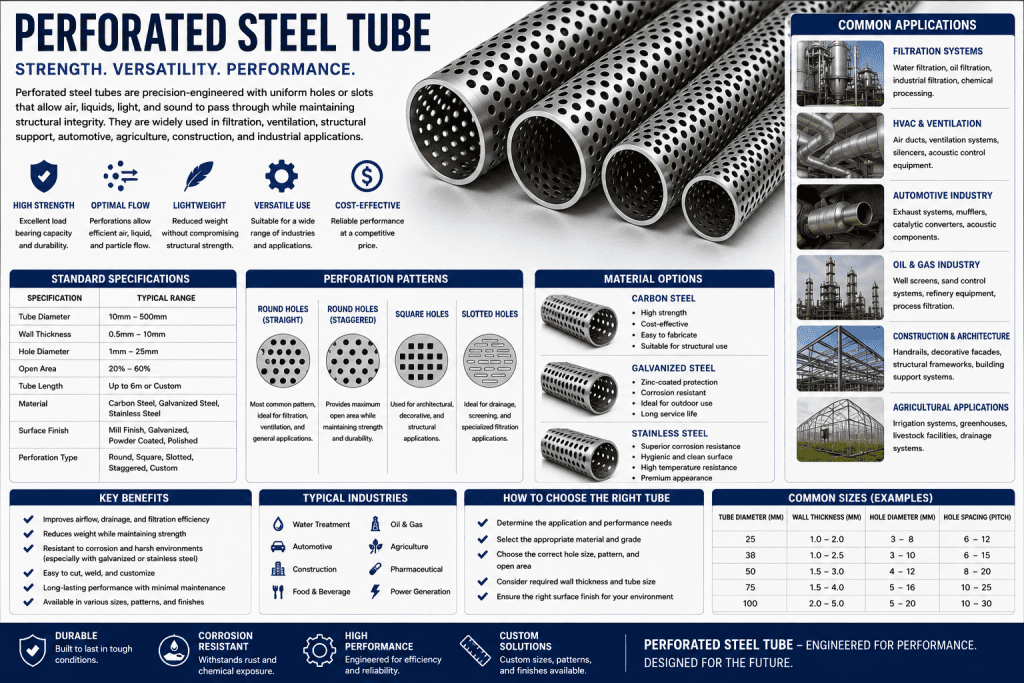
| Specification | Typical Range |
|---|---|
| Tube Diameter | 10mm – 500mm |
| Wall Thickness | 0.5mm – 10mm |
| Hole Diameter | 1mm – 25mm |
| Open Area | 20% – 60% |
| Tube Length | Up to 6m or Custom |
| Material | Carbon Steel, Galvanized Steel, Stainless Steel |
| Surface Finish | Mill Finish, Galvanized, Powder Coated, Polished |
Custom dimensions and perforation patterns are available for specialized applications.
Applications of Perforated Steel Tubes
Filtration Systems
Perforated steel tubes are commonly used as support cores and filtration components.
Applications
- Water filtration
- Oil filtration
- Industrial filtration systems
- Chemical processing
HVAC and Ventilation Systems
The perforated structure allows efficient airflow management.
Applications
- Air ducts
- Ventilation systems
- Silencers
- Acoustic control equipment
Automotive Industry
Automotive manufacturers use perforated steel tubes in exhaust and sound-control systems.
Applications
- Mufflers
- Exhaust systems
- Catalytic converters
- Acoustic components
Oil and Gas Industry
Perforated tubing performs reliably in demanding industrial environments.
Applications
- Well screens
- Sand control systems
- Refinery equipment
- Process filtration
Construction and Architecture
Perforated steel tubes provide both structural support and visual appeal.
Applications
- Handrails
- Decorative facades
- Structural frameworks
- Building support systems
Agricultural Applications
Steel perforated tubes are widely used in agricultural infrastructure.
Applications
- Irrigation systems
- Greenhouses
- Livestock facilities
- Drainage systems
Common Perforation Patterns
Different perforation styles offer unique performance characteristics.
Round Hole Pattern
The most widely used perforation style for filtration and airflow applications.
Staggered Round Holes
Provides maximum open area while maintaining structural strength.
Square Hole Pattern
Often selected for architectural and decorative projects.
Slotted Hole Pattern
Ideal for screening, drainage, and specialized filtration systems.
Benefits of Using Perforated Steel Tubes
Improved Airflow and Filtration
Perforations enhance ventilation and fluid movement.
Reduced Weight
Material removal lowers overall weight while maintaining strength.
Enhanced Structural Efficiency
Strong steel construction provides excellent load-bearing performance.
Long Service Life
Quality steel tubes deliver reliable performance for years.
Flexible Design Options
Custom perforation patterns and dimensions support a wide range of applications.
How to Choose the Right Perforated Steel Tube
Determine Application Requirements
Consider whether the tube will be used for filtration, ventilation, drainage, or structural support.
Select the Appropriate Material
Choose carbon steel, galvanized steel, or stainless steel based on environmental conditions.
Evaluate Perforation Size
Hole diameter and spacing affect airflow, filtration, and strength.
Consider Load Requirements
Wall thickness and tube diameter should match structural demands.
Review Surface Finish Options
Protective coatings improve corrosion resistance and appearance.
Why Perforated Steel Tubes Are Popular
Perforated steel tubes remain one of the most widely used industrial components because they offer:
- High strength
- Cost efficiency
- Excellent airflow performance
- Versatile applications
- Custom manufacturing options
- Long-term durability
These advantages make them suitable for industrial, commercial, agricultural, and architectural projects.
Frequently Asked Questions
What is a perforated steel tube used for?
Perforated steel tubes are used in filtration systems, ventilation equipment, automotive exhaust systems, architectural structures, and industrial processing applications.
Are perforated steel tubes strong?
Yes. Despite the perforations, properly engineered steel tubes maintain excellent structural strength.
Can perforated steel tubes be customized?
Yes. Manufacturers can customize tube diameter, wall thickness, hole size, spacing, material, and finish.
Are perforated steel tubes suitable for outdoor use?
Yes. Galvanized and stainless steel perforated tubes provide excellent corrosion resistance for outdoor environments.
What perforation pattern is most common?
Round hole perforations are the most commonly used pattern because they provide excellent strength and flow characteristics.
What industries use perforated steel tubes?
Construction, automotive, filtration, oil and gas, agriculture, HVAC, water treatment, and manufacturing industries widely use perforated steel tubing.
Conclusion
A perforated steel tube offers the perfect combination of strength, durability, airflow efficiency, and versatility. Whether used in filtration systems, industrial equipment, construction projects, HVAC installations, or agricultural applications, perforated steel tubing provides reliable performance and long-term value. Available in various materials, perforation patterns, and custom specifications, perforated steel tubes continue to be an essential solution for modern engineering and manufacturing needs.