Introduction
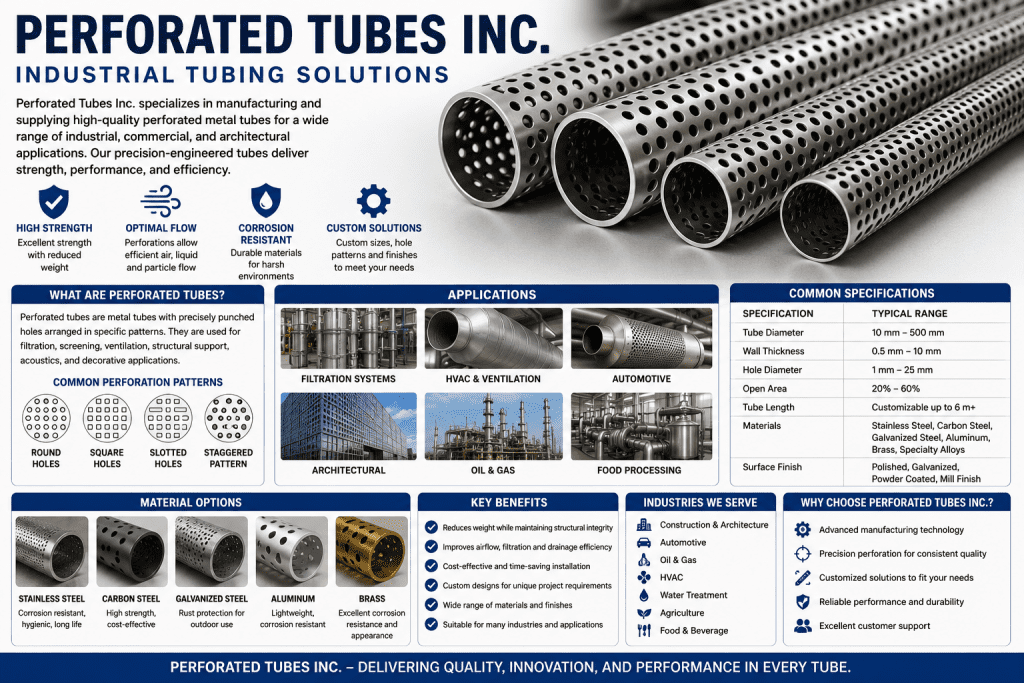
Perforated Tubes Inc. refers to companies specializing in the manufacturing and supply of perforated metal tubing for industrial, commercial, architectural, and filtration applications. Perforated tubes are cylindrical metal tubes with evenly spaced holes that allow airflow, liquid flow, sound control, filtration, and structural efficiency while maintaining strength and durability.
These tubes are widely used across industries such as construction, automotive, oil and gas, food processing, HVAC, agriculture, and water treatment. Their combination of strength, ventilation, and customizable perforation patterns makes them an essential component in modern engineering and manufacturing projects.
What Are Perforated Tubes?
Perforated tubes are metal pipes or cylinders that contain precisely punched holes arranged in specific patterns. The perforations can vary in size, spacing, and shape depending on the application.
Common perforation patterns include:
- Round holes – the most common option for filtration and airflow applications.
- Square holes – often used for architectural and structural purposes.
- Slotted holes – ideal for drainage and screening applications.
- Staggered patterns – provide higher open area and strength.
Typical materials include:
- Stainless steel
- Carbon steel
- Galvanized steel
- Aluminum
- Brass and specialty alloys
Key Features of Perforated Tubes
- High Strength-to-Weight RatioPerforations reduce material weight while retaining structural integrity.
- Excellent Airflow and FiltrationThe open-area design allows efficient passage of air, liquids, and particles.
- Corrosion ResistanceStainless steel and galvanized options provide long-lasting durability in harsh environments.
- Customizable DesignsManufacturers can tailor hole patterns, diameters, tube lengths, and wall thicknesses to project requirements.
- Easy IntegrationPerforated tubes are compatible with welding, threading, and other fabrication processes.
Applications of Perforated Tubes
1. Filtration Systems
Perforated tubes are commonly used as support cores in industrial filters, water treatment systems, and oil filtration equipment.
2. HVAC and Ventilation
They help distribute air evenly in ducts, silencers, and ventilation systems.
3. Automotive Industry
Perforated tubes are used in exhaust systems, mufflers, and catalytic converter assemblies for noise reduction and gas flow management.
4. Construction and Architecture
Architects use perforated tubes for decorative facades, railings, shading systems, and structural elements.
5. Oil and Gas Industry
They serve in well screens, sand control systems, and process equipment where durability and flow efficiency are critical.
6. Food and Beverage Processing
Stainless steel perforated tubes are ideal for hygienic applications involving filtration, drainage, and product handling.
Advantages of Choosing Perforated Tubes Inc.
- Precision Manufacturing: Advanced perforation technology ensures consistent hole patterns and dimensional accuracy.
- Custom Fabrication: Tubes can be produced in specific sizes, materials, and finishes to meet unique project needs.
- Quality Materials: Use of certified metals enhances durability and performance.
- Wide Industry Experience: Solutions are available for filtration, structural, acoustic, and industrial applications.
- Scalable Production: Capable of handling both small custom orders and large industrial volumes.
Common Specifications
| Specification | Typical Range |
|---|---|
| Tube Diameter | 10 mm – 500 mm |
| Wall Thickness | 0.5 mm – 10 mm |
| Hole Diameter | 1 mm – 25 mm |
| Open Area | 20% – 60% |
| Tube Length | Customizable up to 6 m+ |
| Surface Finish | Polished, galvanized, powder-coated, or mill finish |
How to Select the Right Perforated Tube
When choosing perforated tubing, consider:
- Application requirements: filtration, airflow, structural support, or aesthetics.
- Material compatibility: resistance to corrosion, heat, and chemicals.
- Hole pattern and open area: determines flow rate and strength.
- Load and pressure conditions: ensure the tube can withstand operational demands.
- Fabrication needs: welding, threading, bending, or coating requirements.
Frequently Asked Questions
What industries use perforated tubes?
Perforated tubes are used in filtration, HVAC, automotive, construction, oil and gas, agriculture, and food processing industries.
Are perforated tubes strong?
Yes. Despite the perforations, properly designed tubes maintain excellent structural strength while reducing weight.
Can perforated tubes be customized?
Yes. Manufacturers can customize diameter, wall thickness, hole size, spacing, material, and finish.
What is the best material for corrosive environments?
Stainless steel perforated tubes are typically the best choice for corrosive or hygienic environments.
Do perforated tubes improve airflow?
Yes. The perforated design allows efficient airflow and ventilation while maintaining structural support.
Conclusion
Perforated Tubes Inc. products provide a versatile and durable solution for applications requiring airflow, filtration, drainage, sound control, or lightweight structural support. With customizable designs, corrosion-resistant materials, and broad industrial applications, perforated tubes continue to play a critical role in modern manufacturing and engineering projects.