Introduction
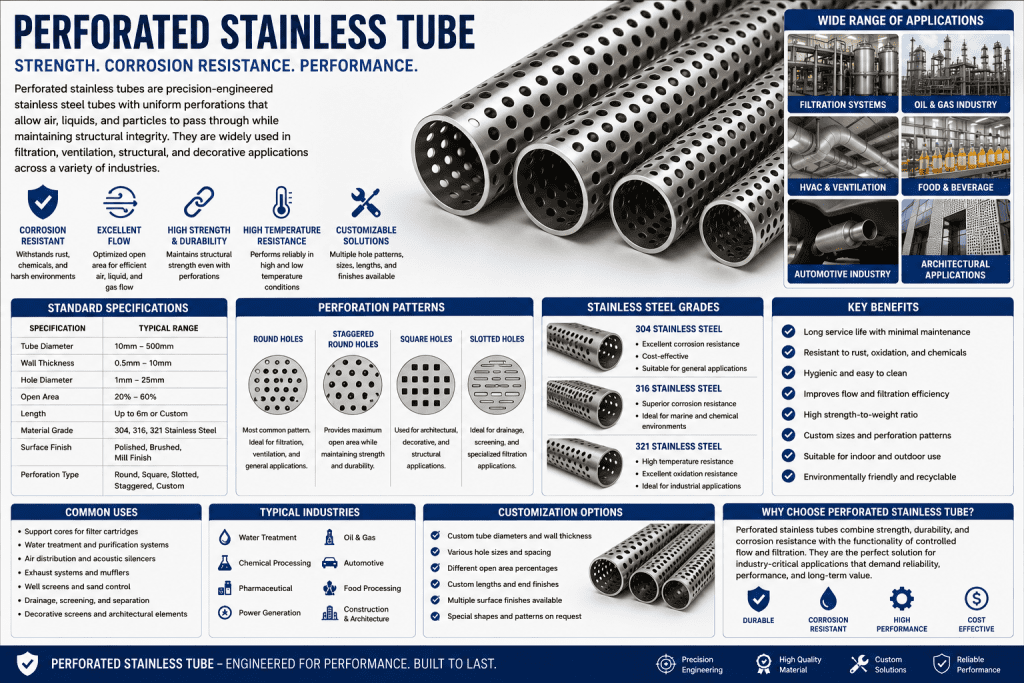
A perforated stainless tube is a high-strength metal tube manufactured from stainless steel and engineered with precision-punched holes to allow airflow, filtration, drainage, sound control, and structural support. These tubes are widely used across industries such as filtration, water treatment, oil and gas, food processing, pharmaceuticals, automotive manufacturing, and architectural construction.
Known for exceptional corrosion resistance, durability, and hygienic properties, perforated stainless tubes provide long-lasting performance in demanding environments where strength and reliability are critical.
What Is a Perforated Stainless Tube?
A perforated stainless tube is a cylindrical stainless steel tube containing uniformly spaced perforations that allow liquids, gases, air, or particles to pass through while maintaining structural integrity.
Common Characteristics
- Corrosion-resistant construction
- Precision perforation patterns
- High strength-to-weight ratio
- Excellent temperature resistance
- Long service life
- Easy fabrication and welding
Perforated stainless tubes are available in multiple diameters, wall thicknesses, perforation styles, and stainless steel grades to suit various industrial applications.
Key Features of Perforated Stainless Tubes
Superior Corrosion Resistance
Stainless steel naturally resists rust, oxidation, and chemical corrosion, making it suitable for harsh environments.
Excellent Strength and Durability
Perforated stainless tubes maintain structural stability even under demanding operating conditions.
Hygienic Surface Finish
The smooth stainless steel surface is easy to clean and ideal for food, beverage, and pharmaceutical applications.
High Temperature Resistance
Stainless steel performs reliably in both high-temperature and low-temperature environments.
Customizable Perforation Patterns
Manufacturers can provide various hole sizes, spacing patterns, and open-area percentages to meet specific project requirements.
Common Stainless Steel Grades
304 Stainless Steel Perforated Tube
The most widely used stainless steel grade.
Benefits
- Excellent corrosion resistance
- Cost-effective
- Easy fabrication
- Suitable for indoor and outdoor applications
316 Stainless Steel Perforated Tube
Offers enhanced corrosion resistance in aggressive environments.
Benefits
- Superior resistance to chemicals
- Marine-grade performance
- Ideal for saltwater environments
- Long service life
321 Stainless Steel Perforated Tube
Designed for high-temperature applications.
Benefits
- Heat-resistant
- Excellent oxidation resistance
- Suitable for industrial processing systems
Standard Perforated Stainless Tube Specifications
| Specification | Typical Range |
|---|---|
| Tube Diameter | 10mm – 500mm |
| Wall Thickness | 0.5mm – 10mm |
| Hole Diameter | 1mm – 25mm |
| Open Area | 20% – 60% |
| Length | Up to 6m or Custom |
| Material Grade | 304, 316, 321 Stainless Steel |
| Surface Finish | Polished, Brushed, Mill Finish |
Custom sizes and perforation patterns are available upon request.
Applications of Perforated Stainless Tubes
Industrial Filtration Systems
Perforated stainless tubes are commonly used as support cores and filtration components.
Applications
- Water filtration
- Oil filtration
- Chemical processing
- Industrial filtration equipment
Food and Beverage Processing
Stainless steel meets strict hygiene requirements.
Applications
- Beverage production
- Dairy processing
- Food manufacturing
- Brewing systems
Oil and Gas Industry
The corrosion-resistant properties make stainless steel ideal for demanding industrial environments.
Applications
- Well screens
- Sand control systems
- Refinery equipment
- Process filtration
HVAC and Ventilation Systems
Perforated tubes help manage airflow and acoustic performance.
Applications
- Air distribution systems
- Ventilation ducts
- Silencers
- Noise control equipment
Automotive Industry
Automotive manufacturers use perforated stainless tubes in exhaust systems.
Applications
- Exhaust components
- Mufflers
- Catalytic converters
- Acoustic control systems
Architectural Applications
Modern architectural projects often incorporate perforated stainless tubing for both functional and decorative purposes.
Applications
- Facades
- Handrails
- Decorative screens
- Structural elements
Benefits of Using Perforated Stainless Tubes
Long Service Life
Stainless steel provides exceptional durability with minimal maintenance requirements.
Low Maintenance
Corrosion resistance reduces the need for protective coatings and repairs.
Improved Flow Performance
Perforations allow efficient movement of air, liquids, and gases.
Attractive Appearance
Polished stainless steel offers a clean, professional finish suitable for visible applications.
Environmentally Friendly
Stainless steel is fully recyclable and sustainable.
Perforation Patterns Available
Different perforation designs offer varying levels of strength and open area.
Round Hole Pattern
Most common design for filtration and airflow applications.
Staggered Round Holes
Provides maximum open area while maintaining strength.
Square Hole Pattern
Often used for architectural and structural applications.
Slotted Hole Pattern
Ideal for screening, drainage, and specialized filtration systems.
Factors to Consider When Choosing a Perforated Stainless Tube
Application Requirements
Determine whether the tube will be used for filtration, ventilation, structural support, or decorative purposes.
Corrosion Exposure
Choose the appropriate stainless steel grade based on environmental conditions.
Hole Size and Open Area
Perforation specifications should match flow and filtration requirements.
Operating Temperature
High-temperature applications may require specialized stainless steel grades.
Tube Dimensions
Select suitable diameter, wall thickness, and length based on performance needs.
Why Perforated Stainless Tubes Are Popular
Perforated stainless tubes combine strength, corrosion resistance, and functionality in a single product.
Key Advantages
- Rust resistant
- Durable and strong
- Hygienic surface
- High-temperature performance
- Excellent filtration capabilities
- Custom manufacturing options
These qualities make them a preferred solution across numerous industries worldwide.
Frequently Asked Questions
What is a perforated stainless tube used for?
Perforated stainless tubes are used for filtration, ventilation, drainage, sound control, structural support, and industrial processing systems.
Which stainless steel grade is best?
Grade 304 is ideal for general applications, while Grade 316 offers superior corrosion resistance in marine and chemical environments.
Are perforated stainless tubes suitable for outdoor use?
Yes. Stainless steel provides excellent weather and corrosion resistance, making it suitable for outdoor installations.
Can perforated stainless tubes be customized?
Yes. Manufacturers can customize tube dimensions, hole patterns, open area percentages, and surface finishes.
Do perforated stainless tubes rust?
High-quality stainless steel offers exceptional resistance to rust and corrosion under normal operating conditions.
Are perforated stainless tubes used in food processing?
Yes. Stainless steel is widely used in food and beverage industries because of its hygienic and corrosion-resistant properties.
Conclusion
A perforated stainless tube is a versatile, corrosion-resistant, and high-performance solution for industrial, commercial, and architectural applications. Whether used for filtration systems, HVAC equipment, food processing, oil and gas operations, or decorative structures, perforated stainless tubing delivers superior durability, airflow efficiency, and long-term reliability. Available in various grades, dimensions, and perforation patterns, these tubes remain an essential component in modern engineering and manufacturing projects.