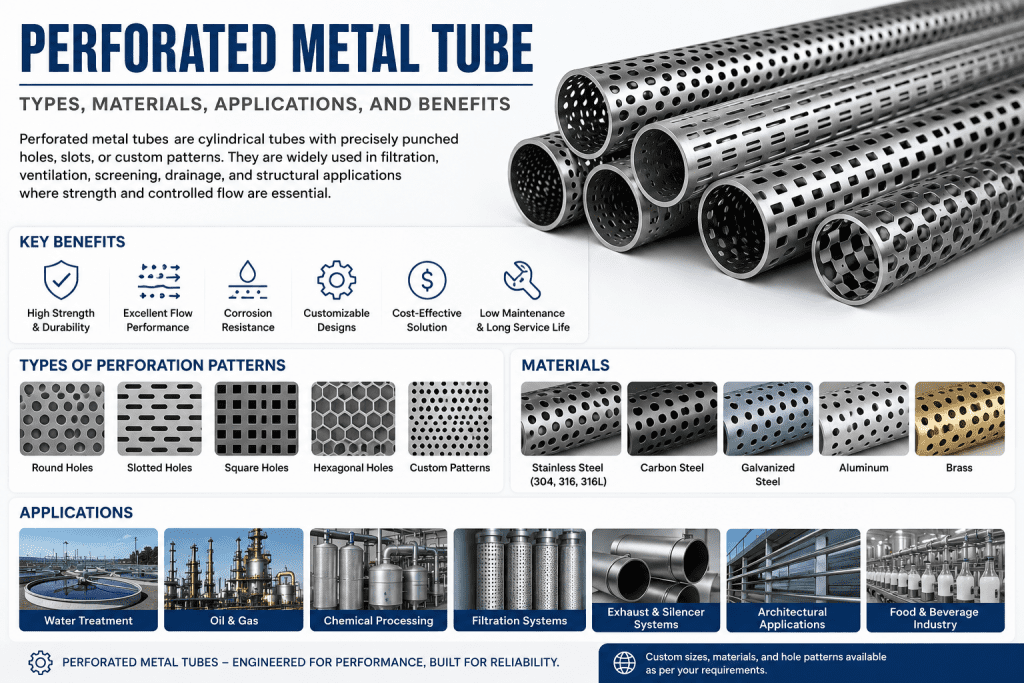
Perforated metal tubes are cylindrical metal components manufactured with precisely engineered holes, slots, or custom perforation patterns throughout their surface. These versatile products are widely used in filtration systems, water treatment plants, oil and gas processing facilities, chemical manufacturing, exhaust systems, and industrial equipment where controlled flow, ventilation, and structural support are required.
Designed to combine strength with optimal open area, perforated metal tubes allow liquids, gases, air, and particles to pass through while maintaining excellent mechanical integrity. Their durability, corrosion resistance, and customizable designs make them an essential component in numerous industrial and commercial applications.
What Is a Perforated Metal Tube?
A perforated metal tube is a metal cylinder formed from a perforated sheet that has been rolled and welded into a tubular shape. The perforations can be round, square, slotted, hexagonal, or custom-designed to meet specific performance requirements.
These tubes are commonly used for filtration support, screening, ventilation, sound attenuation, drainage, and fluid distribution applications where both strength and permeability are essential.
How Perforated Metal Tubes Are Manufactured
The manufacturing process typically involves:
Material Selection
The appropriate metal is selected based on corrosion resistance, strength requirements, and operating conditions.
Precision Perforating
Metal sheets are perforated using CNC punching machines or advanced perforation equipment to create uniform hole patterns.
Rolling and Forming
The perforated sheet is rolled into a cylindrical shape according to the required diameter and dimensions.
Welding and Finishing
The tube is welded using straight seam or spiral welding techniques and finished with polishing, passivation, galvanizing, or other surface treatments.
Quality Inspection
Each perforated metal tube undergoes dimensional and quality inspections to ensure compliance with industry standards and customer specifications.
Common Materials Used in Perforated Metal Tubes
Stainless Steel Perforated Metal Tubes
Stainless steel is the most widely used material due to its excellent corrosion resistance, durability, and high-temperature performance.
Stainless Steel 304
- Excellent corrosion resistance
- High strength and durability
- Cost-effective industrial solution
- Suitable for filtration and processing systems
Stainless Steel 316
- Superior chemical resistance
- Excellent performance in marine environments
- Ideal for pharmaceutical and chemical industries
- Enhanced corrosion protection
Carbon Steel Perforated Tubes
Carbon steel provides high strength and cost efficiency for industrial applications where corrosion resistance is not a primary concern.
Galvanized Steel Perforated Tubes
Galvanized steel offers improved resistance to rust and environmental exposure while maintaining excellent structural performance.
Aluminum Perforated Tubes
Aluminum tubes provide lightweight construction, corrosion resistance, and attractive aesthetics for industrial and architectural applications.
Types of Perforation Patterns
Round Hole Perforated Tubes
Round hole perforations are the most common pattern due to their versatility, strength, and high open-area ratio.
Slotted Perforated Tubes
Slotted perforations provide increased flow capacity and are widely used in drainage, filtration, and well screen applications.
Square Hole Perforated Tubes
Square perforations offer uniform appearance and efficient material separation capabilities.
Custom Perforation Patterns
Custom hole designs can be manufactured to meet specific filtration, airflow, or structural requirements.
Key Benefits of Perforated Metal Tubes
Excellent Flow Characteristics
The perforated design allows efficient movement of liquids, gases, and air while minimizing pressure loss.
High Mechanical Strength
Perforated metal tubes maintain structural integrity even under demanding operating conditions.
Superior Filtration Support
These tubes provide reliable support for filter media and filter cartridges used in industrial filtration systems.
Corrosion Resistance
Stainless steel and galvanized materials ensure long service life in harsh environments.
Versatile Design Options
Available in various diameters, lengths, thicknesses, materials, and perforation patterns.
Cost-Effective Solution
Their durability and low maintenance requirements help reduce operational costs over time.
Applications of Perforated Metal Tubes
Industrial Filtration Systems
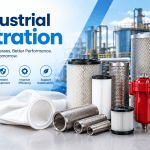
Perforated metal tubes are widely used as support cores for filter cartridges, filter elements, and filtration assemblies.
Water Treatment Facilities
Used in filtration units, drainage systems, and purification equipment to ensure reliable performance.
Oil and Gas Industry
Applied in process filtration, fluid separation, and industrial filtration systems.
Chemical Processing Plants
Suitable for demanding environments requiring corrosion-resistant filtration components.
Exhaust and Silencer Systems
Perforated tubes help reduce noise while maintaining efficient gas flow.
Food and Beverage Industry
Used in sanitary filtration applications where durability and hygiene are critical.
Architectural Applications
Popular in decorative structures, facades, handrails, and modern architectural designs.
Technical Considerations When Selecting a Perforated Metal Tube
Before choosing a perforated metal tube, consider:
- Material type
- Hole size and pattern
- Open area percentage
- Tube diameter
- Wall thickness
- Operating pressure
- Temperature requirements
- Corrosion resistance needs
- Flow rate specifications
Selecting the correct configuration ensures maximum efficiency and long-term performance.
Why Perforated Metal Tubes Are Important
Perforated metal tubes play a crucial role in industrial filtration, process control, ventilation, and structural support applications. Their ability to combine strength, durability, and controlled permeability makes them indispensable across industries ranging from water treatment and manufacturing to energy production and chemical processing.
Conclusion
Perforated metal tubes are versatile industrial components designed to provide efficient flow control, filtration support, ventilation, and structural strength. Available in multiple materials, perforation patterns, and custom configurations, they offer reliable performance across a wide range of industrial and commercial applications. Understanding their types, materials, and benefits helps engineers and buyers choose the most suitable solution for their specific operational requirements.