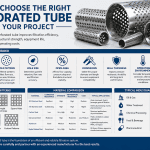
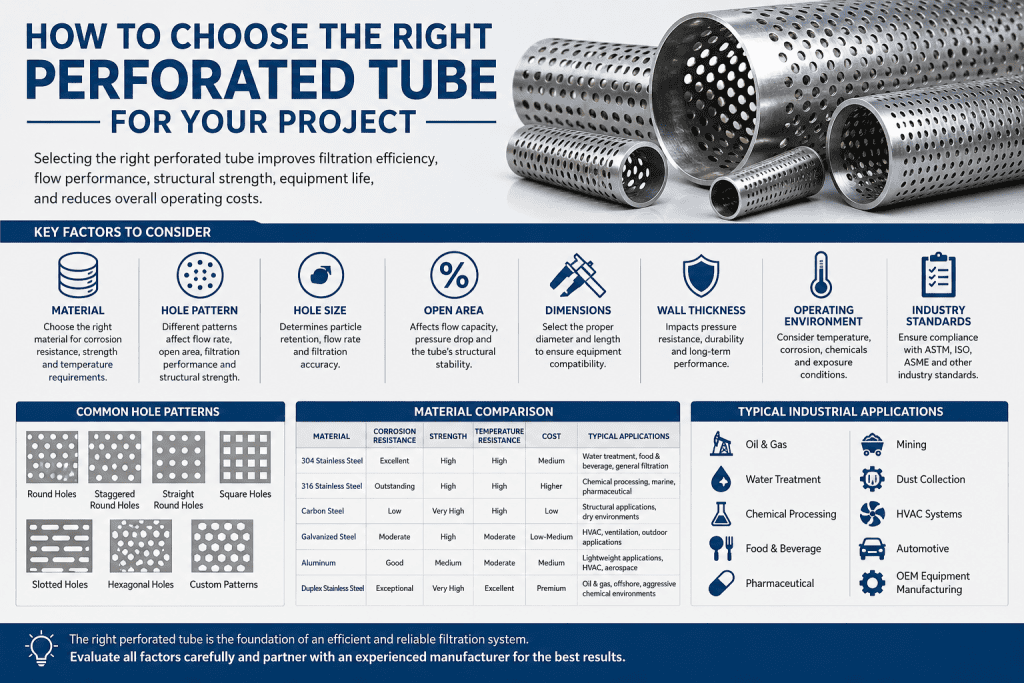
Selecting the right perforated tube is one of the most important decisions in any filtration, processing, or industrial equipment project. Whether you’re designing a new filtration system, upgrading production equipment, or sourcing OEM components, the ability to choose perforated tube specifications that match your application directly affects filtration efficiency, structural strength, flow performance, maintenance intervals, and long-term operating costs. A poorly selected tube can cause excessive pressure drop, premature wear, corrosion, and costly downtime. By understanding factors such as material, hole pattern, open area, wall thickness, and operating environment, engineers and procurement professionals can select an industrial perforated tube that delivers reliable performance and a longer service life.
Choosing the right perforated tube requires evaluating material, hole pattern, open area, dimensions, and operating conditions as a complete system. If you’d like to learn more about the fundamentals of perforated tube design, manufacturing, and industrial applications, read our detailed guide What Is a Perforated Tube and How Does It Work? It offers a comprehensive overview that complements the selection advice in this article.
What Is a Perforated Tube?
A perforated tube is a cylindrical metal tube manufactured with precisely engineered holes or slots distributed across its surface. These perforations allow liquids, gases, or air to flow through the tube while providing structural support, filtration, or protective reinforcement.
Unlike solid tubing, perforated tubes combine strength with controlled permeability, making them indispensable in industrial filtration and process equipment.
Basic Structure
A typical perforated tube consists of:
- Metal sheet or pipe
- Precision perforated holes
- Welded or seamless construction
- Optional end caps or flanges
- Surface treatment when required
The design balances mechanical strength with the desired open area to achieve optimal flow characteristics.
Manufacturing Process
Most industrial perforated tubes are produced through several precision manufacturing steps:
- Material selection
- CNC punching or laser perforation
- Rolling into cylindrical form
- Longitudinal welding (if required)
- Surface finishing
- Straightening
- Dimensional inspection
- Quality testing
Modern CNC equipment ensures consistent hole spacing, dimensional accuracy, and repeatable production quality.
Working Principle
A perforated tube acts as both a structural component and a flow-control medium.
As fluid passes through the holes:
- Larger contaminants remain outside.
- Internal filter media receive structural support.
- Pressure distributes more evenly.
- Flow becomes more uniform.
- Equipment remains mechanically stable.
This combination makes perforated tubes ideal as support cores for filter cartridges and filtration systems.
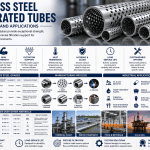
Common Industrial Applications
Perforated tubes are widely used across industries, including:
- Industrial filtration systems
- Oil and gas processing
- Water treatment plants
- Chemical processing
- Food and beverage production
- Pharmaceutical manufacturing
- Dust collection equipment
- HVAC systems
- Mining operations
- Automotive exhaust and filtration systems
- OEM machinery manufacturing
Why Choosing the Right Perforated Tube Matters
Although perforated tubes may appear simple, selecting the wrong specifications can negatively impact equipment performance and operating costs.
Improved Filtration Efficiency
Proper hole size and pattern allow the filtration system to maintain the desired flow while supporting filter media effectively.
Benefits include:
- Better contaminant removal
- Stable filtration performance
- Reduced clogging
- Longer filter life
Better Flow Distribution
Uniform perforations help distribute fluids evenly throughout the system.
Advantages include:
- Lower turbulence
- Consistent pressure
- Reduced dead zones
- Improved process stability
Higher Mechanical Strength
Correct material selection and wall thickness ensure the tube withstands:
- Internal pressure
- External loads
- Vibration
- Mechanical stress
This is especially important in heavy-duty industrial applications.
Longer Equipment Lifespan
Choosing corrosion-resistant materials significantly extends service life.
Benefits include:
- Less corrosion
- Reduced fatigue
- Lower replacement frequency
- Improved reliability
Reduced Maintenance Costs
A well-designed perforated tube minimizes maintenance by reducing:
- Premature failure
- Blockages
- Structural damage
- Unscheduled downtime
Lower maintenance translates directly into lower operational expenses.
Increased Operational Reliability
Industrial processes depend on consistent performance.
Selecting the correct perforated tube improves:
- Process consistency
- Production uptime
- Equipment safety
- Product quality
Key Factors to Consider When Choosing a Perforated Tube
Several engineering factors should be evaluated before purchasing an industrial perforated tube.
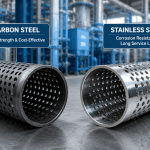
Material Selection
Material selection has the greatest influence on corrosion resistance, durability, mechanical performance, and overall service life.
Material Comparison
| Material | Corrosion Resistance | Strength | Temperature Resistance | Relative Cost | Typical Applications |
| 304 Stainless Steel | Excellent | High | High | Medium | General industrial filtration, food processing, water treatment |
| 316 Stainless Steel | Outstanding | High | High | Higher | Marine environments, chemical processing, pharmaceuticals |
| Carbon Steel | Low | Very High | High | Low | Dry industrial environments, structural applications |
| Galvanized Steel | Moderate | High | Moderate | Low-Medium | Outdoor equipment, ventilation systems |
| Aluminum | Good | Medium | Moderate | Medium | Lightweight applications, HVAC, aerospace |
| Duplex Stainless Steel | Exceptional | Very High | Excellent | Premium | Offshore, oil & gas, aggressive chemical environments |
304 Stainless Steel
304 stainless steel offers an excellent balance of corrosion resistance, strength, and affordability.
Ideal for:
- Water filtration
- Food equipment
- General industrial machinery
- OEM components
316 Stainless Steel
316 stainless steel contains molybdenum, providing superior resistance to chlorides and aggressive chemicals.
Recommended for:
- Chemical plants
- Marine environments
- Pharmaceutical production
- High-corrosion applications
Carbon Steel
Carbon steel provides outstanding mechanical strength at a lower cost but requires protective coatings when exposed to moisture.
Best suited for:
- Dry industrial environments
- Structural support tubes
- Heavy machinery
Galvanized Steel
Galvanized steel features a zinc coating that enhances corrosion resistance for outdoor or mildly corrosive environments.
Common uses include:
- Agricultural equipment
- HVAC systems
- Construction applications
Aluminum
Aluminum combines corrosion resistance with low weight, making it ideal where weight reduction is important.
Applications include:
- Ventilation systems
- Aerospace
- Automotive components
Duplex Stainless Steel
Duplex stainless steel offers exceptional strength and corrosion resistance, making it ideal for demanding environments.
Typical industries include:
- Offshore drilling
- Oil and gas
- Desalination plants
- Chemical processing
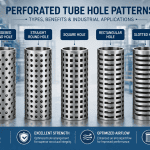
Hole Pattern
The hole pattern influences:
- Flow capacity
- Open area
- Structural strength
- Filtration performance
Selecting the right pattern depends on your application’s flow requirements and mechanical demands.
Round Holes
Round holes are the most commonly used perforation style due to their versatility and ease of manufacturing.
Benefits include:
- Balanced strength
- Reliable flow
- Cost-effective production
- Suitable for most filtration systems
Staggered Round Holes
Staggered hole patterns maximize open area while maintaining structural integrity.
Advantages include:
- Higher flow rates
- Improved filtration efficiency
- Better pressure distribution
- Increased open area
This is often the preferred option for industrial filtration applications.
Straight Round Holes
Straight hole alignment simplifies manufacturing and inspection.
Suitable for:
- Moderate flow requirements
- Structural applications
- OEM equipment
Square Holes
Square perforations provide a larger open area for certain applications.
Commonly used in:
- Screening
- Sorting
- Bulk material handling
Slotted Holes
Slotted perforations are ideal for retaining elongated particles while maintaining high flow capacity.
Applications include:
- Sand control
- Water wells
- Mining
- Industrial filtration
Hexagonal Holes
Hexagonal patterns maximize open area while maintaining good mechanical strength.
Advantages include:
- Excellent airflow
- High liquid flow capacity
- Efficient screening
Custom Hole Patterns
Many manufacturers offer custom perforation designs tailored to specific operational requirements.
Customization options include:
- Variable hole diameters
- Mixed hole patterns
- Precision spacing
- Industry-specific designs
Hole Size
Hole diameter directly affects filtration performance and flow characteristics.
Smaller holes provide:
- Higher filtration accuracy
- Better particle retention
- Increased contaminant capture
However, they may also:
- Increase pressure drop
- Reduce flow rate
- Require more frequent cleaning
Larger holes allow:
- Higher airflow
- Greater liquid throughput
- Lower pressure loss
But they provide less filtration precision.
The optimal hole size depends on the particle size, required flow rate, and filter media used.
Open Area Percentage
Open area refers to the percentage of the tube’s surface occupied by perforations.
Choosing the correct open area is essential because it directly influences flow capacity and structural stability.
Higher open area offers:
- Greater flow rates
- Lower pressure drop
- Improved filtration efficiency
Lower open area provides:
- Increased mechanical strength
- Better resistance to deformation
- Enhanced durability under pressure
Engineers must balance flow performance with the tube’s structural requirements to achieve the best results.
Key Factors to Consider When Choosing a Perforated Tube (Continued)
Tube Diameter and Length
The dimensions of a perforated tube have a direct impact on system compatibility, flow capacity, and structural performance. Selecting the proper diameter and length ensures the tube integrates seamlessly with your equipment while maintaining efficient operation.
Equipment Compatibility
The tube’s outside diameter (OD), inside diameter (ID), and length must match the equipment or filter housing. Even small dimensional inaccuracies can lead to installation issues, vibration, leakage, or poor sealing.
Before placing an order, verify:
- Outside diameter (OD)
- Inside diameter (ID)
- Overall length
- End connection type
- Tolerance requirements
Custom dimensions are often required for OEM machinery or specialized filtration systems.
Flow Capacity
Larger tube diameters generally provide greater flow capacity by increasing the available surface area for perforations. This helps reduce pressure drop and improve overall system efficiency, especially in high-flow applications.
However, increasing the diameter also affects installation space and overall equipment design. Engineers should balance flow requirements with available space.
Installation Requirements
Consider factors such as:
- Mounting method
- Available installation clearance
- Connection fittings
- Support structures
- Accessibility for maintenance
Selecting dimensions that simplify installation can reduce labor costs and future servicing time.
Structural Support
Longer perforated tubes may require additional support to prevent bending or vibration under load. Depending on the application, reinforcement rings, thicker walls, or intermediate supports may be necessary to maintain structural stability.
Wall Thickness
Wall thickness is another critical specification that determines the tube’s ability to withstand pressure, mechanical loads, and long-term wear.
Pressure Resistance
Thicker walls generally provide greater resistance to:
- Internal pressure
- External pressure
- Mechanical impact
- Vibration
High-pressure filtration systems typically require thicker-walled tubes to prevent deformation or collapse.
Mechanical Durability
Industrial environments often expose perforated tubes to continuous vibration, abrasion, and cyclic loading. Selecting the appropriate wall thickness improves durability and reduces the risk of fatigue failure.
Weight Considerations
While thicker walls increase strength, they also add weight. In industries such as aerospace, automotive, or portable equipment manufacturing, reducing weight may be an important design objective.
Long-Term Performance
A properly selected wall thickness contributes to:
- Extended service life
- Improved dimensional stability
- Better resistance to wear
- Reduced maintenance frequency
The optimal thickness depends on pressure requirements, operating conditions, and material properties.
Operating Environment
The operating environment significantly influences the selection of an industrial perforated tube. Factors such as moisture, chemicals, temperature, and exposure conditions determine which material and design will provide the best long-term performance.
Corrosive Environments
Chemical plants, marine facilities, and wastewater treatment systems expose equipment to corrosive substances that can rapidly degrade unsuitable materials.
Recommended materials include:
- 316 Stainless Steel
- Duplex Stainless Steel
- Specialty corrosion-resistant alloys
These materials offer superior resistance to chlorides, acids, and aggressive chemicals.
High-Temperature Applications
Industrial furnaces, heat exchangers, and exhaust systems require perforated tubes capable of maintaining strength at elevated temperatures.
When selecting materials for high-temperature service, consider:
- Maximum operating temperature
- Thermal expansion
- Oxidation resistance
- Mechanical strength at temperature
Stainless steel grades are commonly used due to their excellent heat resistance.
Outdoor Exposure
Outdoor equipment is exposed to rain, humidity, UV radiation, and fluctuating temperatures.
Suitable materials include:
- Galvanized Steel
- Stainless Steel
- Aluminum
Choosing corrosion-resistant materials helps prevent rust and extends equipment lifespan.
Chemical Processing
Chemical processing facilities often require materials that resist aggressive solvents, acids, and alkalis.
Material compatibility should always be verified against the specific chemicals involved in the process.
Food-Grade Applications
Food and beverage processing demands hygienic materials that are easy to clean and resistant to contamination.
304 and 316 stainless steel are widely used because they:
- Resist corrosion
- Maintain smooth surfaces
- Support sanitary cleaning procedures
- Meet food industry requirements
Industry Standards
Purchasing perforated tubes manufactured according to recognized industry standards ensures consistent quality, safety, and performance.
ASTM Standards
ASTM standards define material composition, mechanical properties, testing methods, and manufacturing quality. Compliance helps ensure material reliability across industrial applications.
ISO Standards
ISO standards establish internationally recognized quality management and manufacturing practices, promoting consistency and traceability throughout production.
ASME Standards
For pressure vessels and industrial equipment, ASME standards provide engineering requirements related to safety, design, and construction.
Food and Pharmaceutical Compliance
Applications involving food, beverages, pharmaceuticals, or biotechnology often require additional compliance with sanitary regulations and traceable material certifications.
Working with manufacturers that provide mill test certificates and material traceability is highly recommended.
Choosing the Right Perforated Tube for Different Industries
Different industries have unique operating conditions and performance requirements. Selecting the appropriate perforated tube depends on factors such as pressure, corrosion, temperature, and filtration needs.
Oil & Gas Industry
Oil and gas operations require perforated tubes that withstand extreme pressure, corrosive fluids, and harsh environments.
Typical applications include:
- Sand control
- Well screens
- Downhole filtration
- Separator equipment
- Refinery filtration systems
Preferred materials:
- Duplex Stainless Steel
- 316 Stainless Steel
Key considerations:
- High pressure resistance
- Corrosion protection
- Long service life
Water Treatment
Water treatment systems rely on perforated tubes to support filter media and ensure uniform water distribution.
Common applications include:
- Filter cartridges
- Activated carbon filters
- Reverse osmosis pre-filtration
- Municipal water treatment
Recommended materials:
- 304 Stainless Steel
- 316 Stainless Steel
Important factors:
- Corrosion resistance
- Flow efficiency
- Easy maintenance
Chemical Processing
Chemical plants often process aggressive fluids that require exceptional corrosion resistance.
Applications include:
- Chemical filtration
- Reactor support
- Catalyst retention
- Solvent recovery systems
Preferred materials:
- 316 Stainless Steel
- Duplex Stainless Steel
Selection priorities:
- Chemical compatibility
- Temperature resistance
- Mechanical strength
Food & Beverage Industry
Food processing equipment requires hygienic components that comply with strict sanitation standards.
Typical uses include:
- Beverage filtration
- Dairy processing
- Brewing systems
- Food manufacturing equipment
Recommended materials:
- Food-grade 304 Stainless Steel
- Food-grade 316 Stainless Steel
Key requirements:
- Smooth surfaces
- Easy cleaning
- Corrosion resistance
- Hygienic construction
Pharmaceutical Industry
Pharmaceutical production demands precision, cleanliness, and regulatory compliance.
Applications include:
- Sterile filtration systems
- Process equipment
- Cleanroom manufacturing
- Pharmaceutical reactors
Selection criteria:
- High-purity materials
- Precision manufacturing
- Excellent corrosion resistance
- Traceable certifications
Mining Industry
Mining environments expose equipment to abrasive materials, vibration, and heavy mechanical loads.
Applications include:
- Dewatering systems
- Ore processing
- Slurry filtration
- Dust suppression
Recommended materials:
- Carbon Steel
- Stainless Steel
- Duplex Stainless Steel
Important considerations:
- Wear resistance
- Structural strength
- Impact resistance
Dust Collection Systems
Dust collection equipment uses perforated tubes as support cores for filter cartridges.
Benefits include:
- Uniform airflow
- Reduced pressure drop
- Improved filter support
- Extended cartridge life
Common industries include:
- Cement plants
- Metal fabrication
- Woodworking
- Power generation
HVAC Systems
HVAC equipment uses perforated tubing for air distribution, sound attenuation, and ventilation.
Typical applications:
- Air diffusers
- Silencers
- Ventilation ducts
- Acoustic equipment
Preferred materials:
- Galvanized Steel
- Aluminum
- Stainless Steel
Automotive Industry
Automotive manufacturers use perforated tubes in:
- Exhaust systems
- Mufflers
- Catalytic converters
- Air filtration systems
Key priorities include:
- Heat resistance
- Vibration resistance
- Lightweight construction
- Precision manufacturing
OEM Equipment Manufacturing
OEM manufacturers often require customized perforated tubes designed to fit proprietary equipment.
Customization may include:
- Unique diameters
- Specialized hole patterns
- Custom wall thickness
- Precision tolerances
- Branded manufacturing
Partnering with an experienced manufacturer ensures consistent quality and repeatable production across large manufacturing volumes.
Common Mistakes to Avoid When Choosing a Perforated Tube
Selecting the wrong perforated tube can lead to poor filtration performance, frequent maintenance, increased operating costs, and premature equipment failure. Avoiding these common mistakes helps ensure your investment delivers reliable, long-term results.
Choosing the Wrong Material
One of the most common errors is selecting a material based solely on price rather than the operating environment. For example, using carbon steel in a highly corrosive environment can result in rust, structural degradation, and early replacement. Always match the material to the application’s chemical exposure, humidity, and temperature.
Ignoring Corrosion Resistance
Corrosion can significantly reduce the lifespan of a perforated tube and compromise system performance. Industries such as chemical processing, marine applications, and wastewater treatment require corrosion-resistant materials like 316 stainless steel or duplex stainless steel to withstand harsh conditions.
Selecting the Wrong Hole Size
Hole size directly impacts filtration efficiency and flow rate. Holes that are too large may allow unwanted particles to pass through, while holes that are too small can increase pressure drop and clog more quickly. Choose a hole diameter that balances particle retention with the required flow capacity.
Overlooking Pressure Requirements
A perforated tube used in high-pressure systems must have adequate wall thickness and structural strength. Failing to consider operating pressure can lead to deformation, collapse, or equipment failure.
Focusing Only on Initial Cost
The least expensive option is not always the most economical over the product’s lifecycle. Investing in higher-quality materials and precision manufacturing often reduces maintenance, downtime, and replacement costs, resulting in a lower total cost of ownership.
Buying from Inexperienced Suppliers
Not all manufacturers maintain the same standards of quality and precision. Working with an experienced perforated tube manufacturer ensures consistent dimensions, certified materials, reliable quality control, and technical support throughout your project.
Perforated Tube Selection Checklist
Before ordering a perforated tube, review the following checklist to ensure it meets your project requirements:
| Selection Criteria | Checklist |
| Application | ✔ Define filtration, support, screening, or structural purpose |
| Material | ✔ Select suitable material based on corrosion and temperature |
| Hole Pattern | ✔ Choose the most appropriate perforation layout |
| Hole Size | ✔ Match particle retention and flow requirements |
| Open Area | ✔ Balance flow capacity with structural strength |
| Tube Diameter | ✔ Confirm compatibility with equipment |
| Tube Length | ✔ Verify installation dimensions |
| Wall Thickness | ✔ Ensure adequate pressure resistance |
| Operating Pressure | ✔ Check maximum working pressure |
| Operating Temperature | ✔ Select materials suitable for temperature range |
| Industry Standards | ✔ Verify ASTM, ISO, ASME, or sanitary compliance |
| Budget | ✔ Consider lifecycle cost, not just purchase price |
Following this checklist helps minimize selection errors and ensures optimal performance throughout the equipment’s service life.
Why Work with an Experienced Perforated Tube Manufacturer?
Partnering with an experienced manufacturer offers far more than simply purchasing a product. It provides access to engineering expertise, customized solutions, and consistent manufacturing quality that can improve overall project performance.
Engineering Support
Experienced manufacturers assist in selecting the right material, hole pattern, dimensions, and specifications based on your application’s technical requirements.
Custom Perforation Options
Every project has unique needs. A reliable manufacturer can produce custom perforated tubes with:
- Custom hole sizes
- Specialized hole patterns
- Unique diameters
- Custom lengths
- Precision tolerances
- OEM-specific designs
Certified Materials
Leading manufacturers supply material certifications and mill test reports to verify chemical composition, mechanical properties, and quality compliance.
Strict Quality Control
Comprehensive quality assurance includes:
- Dimensional inspection
- Hole accuracy verification
- Weld quality testing
- Surface finish inspection
- Material traceability
These processes ensure every perforated tube meets design specifications and industry standards.
OEM Manufacturing Capabilities
For equipment manufacturers, OEM production offers:
- High-volume manufacturing
- Consistent product quality
- Private labeling
- Custom packaging
- Flexible production schedules
Reliable Technical Support
An experienced supplier provides ongoing assistance with product selection, troubleshooting, design optimization, and after-sales support, helping customers maximize system performance and reduce downtime.
Frequently Asked Questions
1. How do I choose the right perforated tube?
Start by evaluating your application, operating environment, filtration requirements, material compatibility, pressure conditions, hole pattern, and tube dimensions. Consulting an experienced manufacturer can help ensure the correct specification.
2. Which material is best for industrial perforated tubes?
304 stainless steel is suitable for general industrial use, while 316 stainless steel offers superior corrosion resistance for chemical, marine, and food-processing applications. Carbon steel and galvanized steel are cost-effective options for less demanding environments.
3. What hole pattern is best for filtration?
Staggered round holes are generally preferred because they provide a higher open area, improved flow distribution, and excellent structural strength, making them ideal for many filtration systems.
4. How does open area affect performance?
A higher open area increases flow capacity and reduces pressure drop, while a lower open area provides greater structural strength. The optimal balance depends on your application’s flow and pressure requirements.
5. Which perforated tube is suitable for high-pressure applications?
High-pressure systems typically require thicker wall sections and high-strength materials such as stainless steel or duplex stainless steel to prevent deformation and maintain structural integrity.
6. Can perforated tubes be customized?
Yes. Manufacturers can customize material, hole pattern, hole size, open area, tube diameter, length, wall thickness, and end fittings to meet specific OEM or industrial requirements.
7. What industries use perforated tubes?
Perforated tubes are widely used in oil and gas, water treatment, chemical processing, food and beverage, pharmaceuticals, mining, HVAC, automotive manufacturing, dust collection, and OEM industrial equipment.
8. How do I determine the correct hole size?
The appropriate hole size depends on the particle size you need to retain, the required flow rate, system pressure, and the type of filter media used. Engineering calculations and application testing are often recommended.
9. How long do industrial perforated tubes last?
Service life varies depending on the material, operating conditions, maintenance practices, and exposure to corrosive environments. High-quality stainless steel perforated tubes can provide many years of reliable service when properly maintained.
10. What certifications should I look for when buying perforated tubes?
Look for manufacturers that comply with recognized standards such as ASTM, ISO, and ASME. For food, beverage, and pharmaceutical applications, ensure the products also meet relevant sanitary and regulatory requirements.
Conclusion
Choosing the right perforated tube involves much more than selecting a tube with holes. Factors such as material, hole pattern, hole size, open area, wall thickness, dimensions, operating environment, and industry standards all play a vital role in determining long-term performance and reliability. By carefully evaluating your application’s filtration needs, pressure conditions, corrosion resistance requirements, and operational goals, you can select a solution that delivers maximum efficiency, durability, and cost-effectiveness.
Whether you’re designing a new filtration system, upgrading industrial equipment, or sourcing OEM components, partnering with an experienced perforated tube manufacturer ensures access to expert engineering guidance, certified materials, precision manufacturing, and customized solutions. Making the right choice today can improve equipment performance, reduce maintenance costs, and provide dependable operation for years to come.