Introduction
Perforated tubes are essential components in industrial filtration, ventilation, screening, fluid distribution, and structural support systems. While material selection is important, one of the most critical design factors is the choice of perforated tube hole patterns. The size, shape, arrangement, and spacing of perforations directly influence airflow, liquid flow, filtration efficiency, pressure drop, strength, and overall equipment performance.
Different perforation patterns are designed to meet specific operational requirements. Some maximize open area for increased flow, while others prioritize structural integrity or specialized filtration performance. Understanding these patterns helps engineers, procurement teams, and industrial buyers select the most effective solution for their applications.
This guide explains the most common perforated tube hole patterns, their benefits, industrial uses, and key factors to consider when choosing the right design.
What Are Perforated Tube Hole Patterns?
Perforated tube hole patterns refer to the arrangement, shape, size, and spacing of holes created in a metal tube. These perforations are engineered to control flow characteristics while maintaining the mechanical strength of the tube.
Manufacturers create these patterns using:
- CNC punching
- Laser cutting
- Precision stamping
- Mechanical perforation systems
The selected pattern determines:
- Open area percentage
- Airflow capacity
- Fluid flow performance
- Filtration efficiency
- Structural stability
- Weight reduction
In industrial filtration systems, perforated tubes often serve as support cores for filter media. In ventilation and processing equipment, they regulate airflow and fluid distribution.
Many manufacturers follow standards and quality requirements established by:
- ASTM
- ISO
- ASME
to ensure consistency, durability, and performance.
If you’re new to industrial filtration, understanding how a perforated tube works is essential before selecting the right material. A perforated tube is a metal cylinder with precisely engineered holes that allow liquids or gases to flow while providing strong structural support for filter media. It is widely used in filter cartridges, dust collection systems, water treatment, and chemical processing. Learn more about its design, working principle, and key industrial applications in our guide, What Is a Perforated Tube and How Does It Work?. This resource also explains how different materials, hole patterns, and manufacturing methods influence filtration efficiency and overall system performance.
Why Hole Patterns Matter
The choice of perforation pattern affects nearly every aspect of a perforated tube’s performance.
Open Area Percentage
Open area refers to the percentage of the tube surface occupied by holes.
Higher open area typically results in:
- Increased airflow
- Better fluid movement
- Lower pressure drop
However, excessive open area may reduce structural strength.
Airflow and Liquid Flow
Proper hole design improves:
- Air circulation
- Fluid distribution
- Filtration performance
- System efficiency
Poorly designed patterns can restrict flow and increase energy consumption.
Pressure Drop
Pressure drop occurs when air or fluid passes through perforations.
Optimized patterns help:
- Minimize energy loss
- Improve process efficiency
- Reduce operating costs
Mechanical Strength
Hole arrangement influences structural integrity.
A well-designed perforation pattern balances:
- Strength
- Open area
- Durability
Filtration Efficiency
Perforated tubes are commonly used as support structures in:
- Filter cartridges
- Filter elements
- Wire mesh filters
- Sintered filters
The hole pattern affects support capability and flow distribution across the filtration media.
Weight Reduction
Perforations remove material, reducing weight while maintaining adequate strength.
Benefits include:
- Easier installation
- Reduced transportation costs
- Improved equipment efficiency
Heat Dissipation
In certain industrial systems, perforations improve heat transfer and cooling performance by increasing airflow.
Product Lifespan
Proper pattern selection reduces:
- Stress concentration
- Material fatigue
- Pressure-related damage
resulting in longer service life.
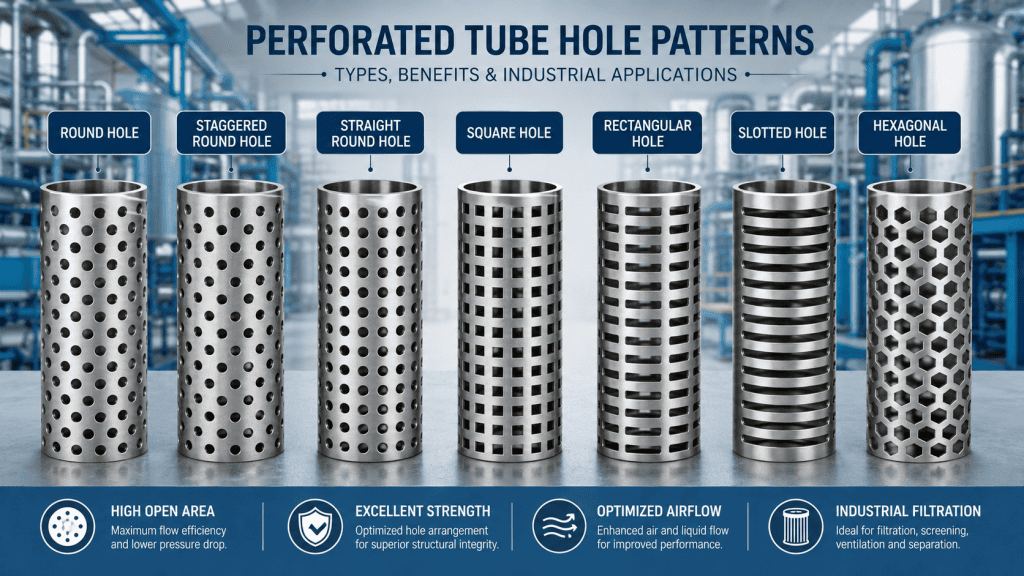
Common Types of Perforated Tube Hole Patterns
Round Hole Pattern
Round holes are the most widely used perforation design.
Features
- Circular holes
- Consistent manufacturing
- Excellent strength distribution
Advantages
- Cost-effective production
- High versatility
- Suitable for numerous industries
Best Applications
- Filter support tubes
- Dust collectors
- HVAC systems
- General industrial filtration
Staggered Round Hole Pattern
The staggered pattern positions holes in offset rows.
Features
- Maximum open area
- Uniform load distribution
- Improved flow performance
Advantages
- Higher airflow capacity
- Better structural integrity
- Lower pressure drop
Best Applications
- Industrial filtration
- Water treatment
- Dust collection
- Chemical processing
This is often the most popular perforation pattern in industrial filtration systems.
Straight Round Hole Pattern
Straight round holes align vertically and horizontally.
Features
- Uniform appearance
- Simplified manufacturing
- Precise alignment
Advantages
- Easy fabrication
- Consistent spacing
- Good mechanical performance
Typical Applications
- Filter cores
- Ventilation systems
- Screening equipment
Square Hole Pattern
Square perforations provide larger openings than round holes.
Features
- High open area
- Improved screening capability
- Strong directional flow characteristics
Advantages
- Enhanced material separation
- Better screening performance
- Efficient bulk material handling
Industrial Applications
- Mining
- Aggregate processing
- Material handling
- Screening systems
Rectangular Hole Pattern
Rectangular perforations are designed for specialized flow and screening requirements.
Features
- Extended opening dimensions
- High flow rates
- Directional control
Advantages
- Excellent throughput
- Effective separation performance
- Customized flow control
Applications
- Industrial screening
- Bulk solids processing
- Specialized filtration systems
Slotted Hole Pattern
Slotted perforations consist of elongated openings.
Features
- Continuous flow channels
- High directional flow
- Excellent particle retention
Advantages
- Reduced clogging
- Enhanced filtration
- Superior sand control
Applications
- Oil & gas filtration
- Water treatment
- Well screens
- Sand control systems
Hexagonal Hole Pattern
Hexagonal perforations maximize open area while maintaining good structural performance.
Features
- Honeycomb-style layout
- Lightweight construction
- Exceptional airflow
Advantages
- Maximum ventilation
- Reduced material weight
- Modern appearance
Applications
- Air handling systems
- Architectural applications
- Industrial ventilation
- Cooling equipment
Custom Perforation Patterns
Many industries require specialized designs.
Customization Options
- Unique hole shapes
- Custom spacing
- Mixed perforation designs
- Variable open areas
- Industry-specific configurations
OEM Applications
Custom perforated tubes are widely used in:
- Industrial filtration
- Pharmaceutical systems
- Aerospace
- Energy production
- Advanced manufacturing
Comparison of Perforation Patterns
| Hole Pattern | Open Area | Mechanical Strength | Flow Rate | Filtration Performance | Manufacturing Cost | Common Applications |
| Round Hole | Medium | High | Good | Good | Low | General filtration |
| Staggered Round | High | High | Excellent | Excellent | Moderate | Industrial filtration |
| Straight Round | Medium | High | Good | Good | Low | Ventilation systems |
| Square Hole | High | Medium | High | Excellent screening | Moderate | Mining and screening |
| Rectangular Hole | High | Medium | Very High | Specialized | Higher | Material handling |
| Slotted Hole | High | Medium | Excellent | Outstanding | Higher | Oil & gas filtration |
| Hexagonal Hole | Very High | Medium | Excellent | Moderate | Higher | Ventilation and cooling |
| Custom Pattern | Variable | Variable | Variable | Optimized | Highest | Specialized industries |
Factors to Consider When Choosing a Hole Pattern
Application Requirements
Different industries require different performance characteristics.
Hole Diameter
Smaller holes improve particle retention.
Larger holes improve flow capacity.
Open Area Percentage
The ideal balance depends on:
- Filtration requirements
- Strength requirements
- Flow conditions
Material Type
The chosen material influences performance and durability.
Common materials include:
- Stainless steel
- Carbon steel
- Galvanized steel
- Aluminum
Flow Rate Requirements
High-flow systems benefit from:
- Staggered round holes
- Slotted holes
- Hexagonal patterns
Pressure Conditions
High-pressure applications require stronger perforation designs with adequate material support.
Structural Strength
Applications exposed to vibration or heavy loads require patterns that maintain tube integrity.
Operating Environment
Consider:
- Corrosion exposure
- Temperature
- Chemicals
- Humidity
Industry Standards
Ensure compliance with ASTM, ISO, and ASME requirements where applicable.
Common Materials Used for Perforated Tubes
Selecting the right hole pattern is only one part of designing an efficient perforated tube. The material also plays a critical role in determining corrosion resistance, strength, durability, and overall service life. Different industries require different materials based on operating conditions, chemical exposure, temperature, and budget.
Below are the most commonly used materials for manufacturing perforated tubes.
304 Stainless Steel
304 stainless steel is the most widely used material for industrial perforated tubes because it provides an excellent balance of strength, corrosion resistance, and affordability.
Advantages
- Excellent corrosion resistance
- Good weldability
- Hygienic surface
- Easy fabrication
- Long service life
Best Applications
- Water filtration
- Food processing
- Industrial filtration
- HVAC systems
- Pharmaceutical equipment
316 Stainless Steel
316 stainless steel contains molybdenum, giving it superior resistance to chlorides, saltwater, and aggressive chemicals.
Advantages
- Outstanding corrosion resistance
- High chemical resistance
- Excellent high-temperature performance
- Longer lifespan in harsh environments
Best Applications
- Marine engineering
- Chemical processing
- Oil & gas
- Offshore platforms
- Pharmaceutical manufacturing
Carbon Steel
Carbon steel remains one of the most economical choices for perforated tubes used in structural and dry industrial environments.
Advantages
- High mechanical strength
- Easy fabrication
- Cost-effective
- Good wear resistance
Best Applications
- Dust collection
- Structural support
- Mining equipment
- Material handling
- Industrial ventilation
Galvanized Steel
Galvanized steel combines the strength of carbon steel with a protective zinc coating that improves corrosion resistance.
Advantages
- Better rust protection
- Affordable
- Durable
- Suitable for outdoor use
Best Applications
- Agricultural equipment
- Outdoor ventilation
- Construction
- General industrial use
Aluminum
Aluminum perforated tubes are valued for their lightweight design and natural corrosion resistance.
Advantages
- Lightweight
- Easy machining
- Good corrosion resistance
- Attractive appearance
Best Applications
- HVAC systems
- Automotive
- Aerospace
- Architectural projects
Duplex Stainless Steel
Duplex stainless steel combines the benefits of austenitic and ferritic stainless steels.
Advantages
- Extremely high strength
- Superior corrosion resistance
- Excellent fatigue resistance
- Long service life
Best Applications
- Offshore oil & gas
- Desalination plants
- Marine engineering
- Chemical processing
Material Comparison Table
| Material | Corrosion Resistance | Strength | Weight | Cost | Best Applications |
| 304 Stainless Steel | Excellent | High | Medium | Moderate | Food processing, filtration |
| 316 Stainless Steel | Outstanding | High | Medium | High | Chemical and marine industries |
| Carbon Steel | Moderate | Very High | Heavy | Low | Structural and dust collection |
| Galvanized Steel | Good | High | Heavy | Moderate | Outdoor industrial use |
| Aluminum | Good | Medium | Light | Moderate | HVAC and automotive |
| Duplex Stainless Steel | Exceptional | Very High | Medium | Highest | Offshore and chemical plants |
Industrial Applications of Different Hole Patterns
Different industries require unique perforation designs to achieve the desired balance of airflow, strength, and filtration efficiency.
Oil & Gas
Oil and gas operations often involve abrasive particles, corrosive fluids, and high-pressure systems.
Best Hole Pattern
- Slotted hole pattern
- Staggered round hole pattern
These patterns offer excellent sand control, high flow rates, and reliable structural support.
Water Treatment
Water treatment systems require efficient flow with minimal pressure loss.
Best Hole Pattern
- Staggered round holes
This design maximizes open area while maintaining strength and improving filtration performance.
Chemical Processing
Chemical plants demand perforated tubes capable of handling corrosive fluids and aggressive operating conditions.
Best Hole Pattern
- Round holes
- Slotted holes
These designs provide uniform flow and support for filter media.
Food & Beverage
Food-grade systems require hygienic surfaces and smooth flow paths.
Best Hole Pattern
- Straight round holes
- Staggered round holes
Typically manufactured using 304 or 316 stainless steel.
Pharmaceutical Industry
Cleanliness and contamination control are essential.
Best Hole Pattern
- Precision round holes
These provide consistent flow and are easy to clean and sanitize.
Mining
Mining equipment must withstand heavy loads and abrasive materials.
Best Hole Pattern
- Square holes
- Round holes
These designs provide excellent screening and structural strength.
Dust Collection Systems
Filter cartridges rely on perforated tubes for internal support.
Best Hole Pattern
- Staggered round holes
This pattern offers:
- High airflow
- Strong support
- Reduced pressure drop
HVAC Systems
Ventilation equipment benefits from maximum airflow.
Best Hole Pattern
- Hexagonal holes
- Round holes
These designs improve air circulation and reduce airflow resistance.
Automotive Industry
Automotive systems require lightweight yet durable perforated tubes.
Best Hole Pattern
- Round holes
- Slotted holes
Used in exhaust systems, silencers, and filtration components.
Industrial Filtration Equipment
Industrial filtration systems require optimized support for filter media while maintaining high flow rates.
Best Hole Pattern
- Staggered round holes
This is considered the industry standard because it balances strength, open area, and filtration efficiency.
Advantages of Choosing the Right Perforation Pattern
Choosing the correct perforated tube hole pattern provides significant operational and economic benefits.
Improved Filtration Efficiency
Proper hole spacing ensures uniform fluid distribution and better support for filter media.
Better Airflow and Liquid Flow
Optimized patterns reduce resistance and improve system efficiency.
Enhanced Structural Stability
Well-designed perforation layouts maintain tube strength while maximizing open area.
Lower Pressure Drop
Efficient hole patterns reduce energy consumption by minimizing pressure losses.
Longer Service Life
Balanced designs reduce stress concentrations, improving durability and extending equipment life.
Reduced Maintenance
Improved flow characteristics reduce clogging, lowering maintenance requirements and downtime.
Increased Productivity
Efficient filtration and flow improve process performance and overall system productivity.
Cost Savings Over Time
The right perforation pattern reduces maintenance, replacement frequency, and operating costs, resulting in a lower total cost of ownership.
Common Mistakes to Avoid
Selecting an inappropriate perforation pattern can negatively impact system performance.
Avoid these common errors:
Selecting the Wrong Hole Diameter
Holes that are too large or too small can compromise filtration efficiency or restrict flow.
Ignoring Open Area Requirements
Too much open area may weaken the tube, while too little can reduce flow and increase pressure drop.
Choosing an Unsuitable Material
Match the tube material to the operating environment to prevent premature corrosion or failure.
Overlooking Operating Pressure
High-pressure applications require perforation designs that preserve structural integrity.
Prioritizing Cost Over Performance
The least expensive option may result in higher maintenance costs and shorter service life.
Not Consulting an Experienced Manufacturer
A knowledgeable manufacturer can recommend the optimal combination of material, hole pattern, and dimensions for your application.
How Manufacturers Customize Perforated Tube Hole Patterns
Leading perforated tube manufacturers offer extensive customization to meet specific project requirements.
Customization options include:
Custom Hole Sizes
Diameters can be tailored for precise filtration or flow control.
Custom Hole Spacing
Adjusting spacing changes the open area percentage and structural performance.
Staggered vs. Straight Layouts
Manufacturers recommend layouts based on the desired balance of strength and flow.
Tube Diameter Customization
Perforated tubes are available in a wide range of diameters and lengths for OEM and replacement applications.
Material Selection
Choose from:
- 304 Stainless Steel
- 316 Stainless Steel
- Carbon Steel
- Galvanized Steel
- Aluminum
- Duplex Stainless Steel
Surface Finishing
Available finishes include:
- Polished
- Electropolished
- Pickled and passivated
- Galvanized
- Powder-coated
OEM Manufacturing Capabilities
Manufacturers can also provide:
- Custom perforation layouts
- Laser-cut designs
- Welded assemblies
- End caps
- Flanges
- Filter support tubes
- Complete filtration components
Frequently Asked Questions
1. What are perforated tube hole patterns?
Perforated tube hole patterns refer to the arrangement, size, shape, and spacing of holes in a perforated metal tube. These patterns are engineered to optimize airflow, liquid flow, filtration efficiency, and structural strength for specific industrial applications. The right pattern improves overall system performance while maintaining the tube’s mechanical integrity.
2. Which hole pattern provides the highest open area?
The staggered round hole pattern generally offers one of the highest open area percentages while maintaining excellent structural strength. Hexagonal hole patterns can also provide a very high open area, making them ideal for applications requiring maximum airflow and ventilation.
3. What is the best perforation pattern for filtration?
For most industrial filtration systems, the staggered round hole pattern is considered the best choice. It provides:
- High open area
- Excellent mechanical strength
- Uniform flow distribution
- Reduced pressure drop
- Strong support for filter media
This pattern is commonly used in perforated filter tubes, filter cartridges, and filter elements.
4. What is the difference between staggered and straight hole patterns?
The primary difference lies in the hole arrangement:
- Staggered hole patterns position each row offset from the previous one, resulting in greater open area, improved strength, and better flow characteristics.
- Straight hole patterns align holes in uniform rows and columns, offering a cleaner appearance and easier manufacturing but slightly lower open area.
For most filtration applications, staggered layouts are preferred because they provide better overall performance.
5. How do hole patterns affect airflow?
Hole patterns directly influence:
- Air velocity
- Pressure drop
- Flow distribution
- Ventilation efficiency
- Cooling performance
Patterns with larger open areas, such as staggered round or hexagonal designs, generally allow higher airflow with lower resistance, improving system efficiency.
6. Can perforation patterns be customized?
Yes. Most professional perforated tube manufacturers offer complete customization, including:
- Custom hole diameters
- Custom spacing
- Round, square, slotted, rectangular, or hexagonal holes
- Mixed perforation layouts
- Variable open area percentages
- OEM-specific designs
Custom perforation patterns ensure the tube meets the exact performance requirements of your application.
7. Which material is best for perforated tubes?
The ideal material depends on the operating environment:
- 304 Stainless Steel – General industrial filtration and food processing
- 316 Stainless Steel – Marine, chemical, and corrosive environments
- Carbon Steel – Structural applications and dry environments
- Galvanized Steel – Outdoor applications requiring moderate corrosion resistance
- Aluminum – Lightweight systems and HVAC
- Duplex Stainless Steel – High-pressure and offshore applications
Material selection should always consider corrosion resistance, strength, temperature, and budget.
8. Which industries use different perforation patterns?
Perforated tubes with specialized hole patterns are widely used in:
- Oil & Gas
- Water Treatment
- Chemical Processing
- Food & Beverage
- Pharmaceutical Manufacturing
- Mining
- Dust Collection
- HVAC Systems
- Automotive Industry
- Industrial Filtration Equipment
Each industry selects a hole pattern based on its specific flow, filtration, and structural requirements.
9. How do I choose the right hole pattern?
When selecting a perforation pattern, consider:
- Flow rate requirements
- Filtration efficiency
- Pressure conditions
- Open area percentage
- Structural strength
- Material type
- Corrosion exposure
- Operating temperature
- Industry standards
- Maintenance requirements
Working with an experienced manufacturer can help optimize performance while reducing long-term operating costs.
10. What standards apply to perforated tube manufacturing?
High-quality perforated tubes are typically manufactured in accordance with internationally recognized standards such as:
- ASTM – Material specifications and testing
- ISO – Quality management systems
- ASME – Mechanical engineering and pressure vessel requirements
Compliance with these standards helps ensure consistent quality, safety, and performance.
Conclusion
Selecting the right perforated tube hole pattern is essential for achieving the best performance, durability, and efficiency in industrial filtration, ventilation, screening, and processing systems. The shape, size, spacing, and layout of perforations directly affect airflow, liquid flow, pressure drop, mechanical strength, and filtration effectiveness.
While round and staggered round hole patterns remain the most widely used options for industrial filtration due to their excellent balance of strength and open area, square, rectangular, slotted, and hexagonal patterns each provide unique advantages for specialized applications. Combining the appropriate hole pattern with the right material such as 304 stainless steel, 316 stainless steel, carbon steel, or duplex stainless steel ensures optimal performance and a longer service life.
Every application has unique operating conditions, including pressure, temperature, corrosion exposure, and flow requirements. Evaluating these factors alongside relevant ASTM, ISO, and ASME standards will help you select the most effective solution.
If your project requires a customized design, partnering with an experienced perforated tube manufacturer allows you to optimize hole size, open area, spacing, tube dimensions, and material selection. A tailored solution can improve filtration efficiency, reduce maintenance, lower operating costs, and maximize equipment reliability over the long term.