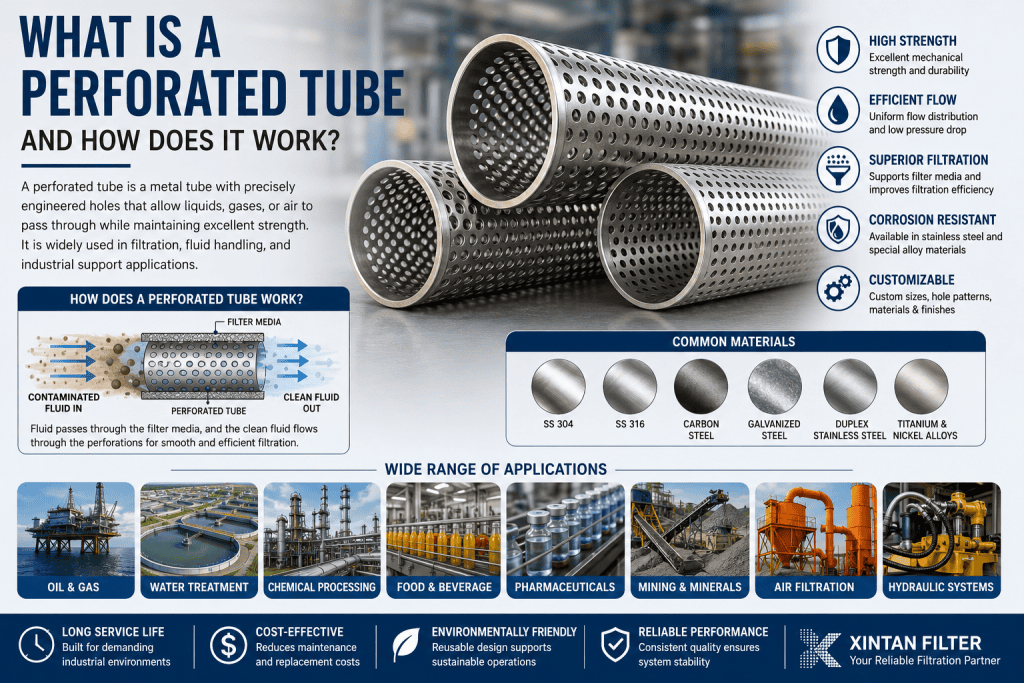
A perforated tube is an essential component used in industrial filtration, fluid handling, and structural support systems. Manufactured with precisely engineered holes across its surface, it allows liquids, gases, or air to pass through while maintaining excellent mechanical strength. Industries such as oil and gas, water treatment, chemical processing, food production, pharmaceuticals, and power generation rely on perforated tubes to improve filtration efficiency, protect filter media, and ensure smooth flow distribution.
Unlike a standard metal pipe, a perforated metal tube combines durability with controlled permeability. Engineers design these tubes by carefully selecting hole patterns, materials, wall thickness, and dimensions to achieve the ideal balance between strength and flow. Whether used as a filter support tube, stainless steel filter tube, or industrial perforated tube, this versatile product plays a critical role in improving equipment performance and extending service life.
What Is a Perforated Tube?
A perforated tube is a cylindrical metal tube manufactured with evenly distributed holes or slots. These openings are created using precision punching, laser cutting, or CNC perforation techniques before the metal sheet is rolled into a tube and welded. The result is a strong yet highly permeable structure that supports filtration media while allowing fluids to flow freely.
Perforated tubes are available in various diameters, lengths, wall thicknesses, and hole patterns to suit different industrial applications. Common materials include stainless steel, carbon steel, galvanized steel, duplex stainless steel, nickel alloys, and titanium.
Although people often use the terms perforated tube and perforated metal tube interchangeably, both refer to the same type of engineered product. Depending on the application, they may also be called perforated steel tubes, filter support tubes, perforated cylinders, or perforated tubing.
The primary purpose of a perforated tube is to provide structural strength while maintaining excellent fluid flow. This unique combination makes it indispensable in filtration systems, hydraulic equipment, dust collectors, silencers, and many OEM industrial products.
How Does a Perforated Tube Work?
The working principle of a perforated tube is simple but highly effective. It acts as a support structure while allowing liquids, gases, or air to move through its perforations with minimal resistance.
In a filtration system, contaminated fluid first passes through the filter media, which captures unwanted particles. The cleaned fluid then flows through the holes in the perforated tube before exiting the system. Because the perforations are evenly distributed, pressure remains balanced across the filter element, reducing stress and improving filtration efficiency.
Perforated tubes also prevent filter media from collapsing under high differential pressure. This support function is especially important in industrial systems operating under demanding conditions, such as hydraulic filtration, compressed air systems, and chemical processing equipment.
The size, spacing, and pattern of the holes influence flow rate, pressure drop, and structural performance. Engineers carefully optimize these parameters to meet specific application requirements.
Main Components of a Perforated Tube
Every perforated tube consists of several important design elements.
Hole Pattern
Hole patterns determine the open area and influence how fluids move through the tube. Common patterns include round, square, slotted, and hexagonal holes. Round staggered holes are the most popular because they provide excellent strength and balanced flow.
Tube Body
The tube body forms the structural framework of the component. It must withstand internal pressure, external loads, vibration, and long-term operation without deformation.
Wall Thickness
Wall thickness directly affects the tube’s pressure rating and durability. Thicker walls increase strength, while thinner walls reduce weight and manufacturing costs.
Diameter and Length
Manufacturers produce perforated tube sizes in a wide range of dimensions. Custom sizes are also available to match OEM equipment and specialized filtration systems.
Open Area
Open area refers to the percentage of the tube surface occupied by holes. A larger open area generally improves flow capacity but may reduce structural strength.
Common Materials Used
Stainless Steel 304
Stainless Steel 304 is the most widely used material because it offers excellent corrosion resistance, strength, and weldability. It is commonly used in water treatment, food processing, and industrial filtration.
Stainless Steel 316
SS316 contains molybdenum, providing improved resistance to chlorides and aggressive chemicals. It is ideal for marine, pharmaceutical, and chemical applications.
Carbon Steel
Carbon steel provides high strength at a lower cost. It is suitable for mining, construction equipment, and general industrial use where corrosion is less severe.
Galvanized Steel
Galvanized steel offers additional rust protection through a zinc coating. It is commonly used in ventilation systems and outdoor industrial equipment.
Duplex Stainless Steel
Duplex stainless steel combines excellent corrosion resistance with higher mechanical strength, making it suitable for offshore and high-pressure environments.
Titanium and Nickel Alloys
These premium materials are used in highly corrosive or high-temperature applications where maximum durability is required.
Manufacturing Process
High-quality perforated tube manufacturing involves several carefully controlled steps.
- Raw Material Selection – Metal sheets are selected based on customer specifications and application requirements.
- Perforating – CNC punching or laser cutting creates the required hole pattern with high precision.
- Rolling – The perforated sheet is rolled into a cylindrical shape.
- Welding – The seam is welded using TIG, laser, or resistance welding techniques.
- Sizing and Straightening – The tube is calibrated to achieve accurate dimensions and roundness.
- Surface Finishing – Processes such as passivation, polishing, or galvanizing improve corrosion resistance and appearance.
- Inspection and Testing – Manufacturers verify dimensions, weld quality, hole consistency, and material certifications before shipment.
High manufacturing standards ensure consistent performance, long service life, and reliable operation in demanding industrial environments.
Types of Perforated Tubes
Perforated tubes are available in several designs, each engineered to meet specific flow, filtration, and structural requirements. Choosing the right type depends on the operating environment, fluid characteristics, pressure conditions, and equipment design.
Round Hole Perforated Tube
Round hole perforated tubes are the most commonly used option in industrial filtration. They provide an excellent balance between open area and structural strength, making them suitable for applications such as filter cartridges, water treatment systems, and dust collectors.
Square Hole Perforated Tube
Square hole designs offer a slightly larger open area than round holes, making them suitable for screening, ventilation, and material handling systems where increased airflow is required.
Slotted Perforated Tube
Slotted tubes feature elongated openings that improve directional flow and are commonly used for drainage, sand control, and well screen applications. Their design allows higher flow rates while retaining larger particles.
Hexagonal Hole Perforated Tube
Hexagonal perforations maximize the open area without significantly compromising strength. These tubes are often used in air filtration systems, acoustic panels, and specialized industrial equipment.
Custom Perforated Tube
Many OEM manufacturers require custom solutions tailored to their equipment. A custom perforated tube can be produced with specific diameters, lengths, wall thicknesses, hole sizes, materials, and surface finishes to meet unique operational requirements.
Applications of Perforated Tubes
The versatility of a perforated tube makes it an essential component across many industries.
Oil and Gas
Perforated tubes are widely used in drilling equipment, sand control systems, separators, and filtration assemblies. Stainless steel and duplex stainless steel are often selected because they withstand harsh chemicals and high pressures.
Water Treatment
Municipal and industrial water treatment plants use perforated tubes as filter support structures in multimedia filters, activated carbon systems, and pre-filtration units. Their corrosion resistance and consistent flow distribution improve filtration efficiency.
Chemical Processing
Chemical plants rely on perforated tubes for catalyst support, filtration equipment, and fluid distribution systems. Material selection is critical to resist aggressive chemicals and elevated temperatures.
Food and Beverage
Food-grade stainless steel perforated tubes are used in beverage production, dairy processing, edible oil filtration, and brewing. Smooth surfaces and corrosion resistance help maintain hygiene and simplify cleaning.
Pharmaceutical Manufacturing
Pharmaceutical processes demand high cleanliness and precision. Electropolished stainless steel perforated tubes provide reliable support for sterile filtration systems while meeting strict sanitary requirements.
Mining and Mineral Processing
Mining equipment operates under abrasive conditions. Heavy-duty perforated steel tubes provide structural strength in slurry filtration, dewatering equipment, and screening systems.
Air Filtration and Dust Collection
Industrial air filters and dust collectors use perforated tubes to support filter media while maintaining uniform airflow. This improves collection efficiency and extends filter life.
Hydraulic Systems
Hydraulic filters depend on perforated support tubes to prevent filter media collapse while allowing unrestricted oil flow through the system.
Advantages of Perforated Tubes
Perforated tubes offer numerous advantages that make them a preferred choice for industrial filtration and fluid handling systems.
- High Mechanical Strength: They provide excellent support for filter media under high pressure.
- Efficient Flow Distribution: Evenly spaced perforations reduce pressure drop and improve fluid flow.
- Corrosion Resistance: Stainless steel and specialty alloys perform well in aggressive environments.
- Customizable Design: Manufacturers can produce tubes in a wide range of materials, hole patterns, and dimensions.
- Long Service Life: Durable construction minimizes maintenance and replacement costs.
- Versatile Applications: Suitable for filtration, ventilation, structural support, and drainage systems.
- Cost-Effective: Their durability and performance help reduce long-term operating expenses.
Limitations of Perforated Tubes
Although perforated tubes provide many benefits, understanding their limitations helps engineers make informed decisions.
- Complex perforation patterns can increase manufacturing costs.
- Larger open areas may reduce structural strength.
- Fine perforations can become clogged if maintenance is neglected.
- Specialty materials such as titanium and nickel alloys increase project costs.
- Custom designs may require longer production lead times.
Careful design and proper material selection can minimize these challenges.
Perforated Tube vs. Slotted Tube
| Feature | Perforated Tube | Slotted Tube |
| Opening Shape | Round, square, hexagonal | Long narrow slots |
| Structural Strength | Excellent | Good |
| Flow Distribution | Uniform | Directional |
| Pressure Resistance | High | Moderate |
| Filtration Support | Excellent | Good |
| Manufacturing Cost | Moderate | Moderate to High |
| Common Applications | Industrial filters, dust collectors, water treatment | Sand control, drainage, wells |
| Customization | Extensive | Extensive |
Both designs perform well, but the best choice depends on the application’s flow characteristics, pressure requirements, and filtration objectives.
How to Choose the Right Perforated Tube
Selecting the correct perforated tube requires evaluating several technical factors:
- Material: Match the material to the operating environment and corrosion risks.
- Hole Size: Ensure the perforation supports the filter media while allowing sufficient flow.
- Open Area: Balance flow capacity with structural strength.
- Diameter and Length: Verify compatibility with the filtration housing or equipment.
- Wall Thickness: Choose a thickness that withstands operating pressure.
- Temperature: Confirm the material performs reliably at expected temperatures.
- Pressure: Consider both internal and external pressure conditions.
- Application: Define whether the tube will support filtration, distribute flow, or provide structural reinforcement.
- Budget: Consider lifecycle costs rather than only the initial purchase price.
Working with an experienced perforated tube manufacturer can help optimize the design for performance and cost.
Maintenance Tips
Proper maintenance extends the service life of perforated tubes and improves filtration performance.
- Inspect tubes regularly for wear, corrosion, or deformation.
- Remove debris and deposits using approved cleaning methods.
- Replace damaged tubes before they affect system performance.
- Store spare tubes in a clean, dry environment to prevent corrosion.
- Follow manufacturer recommendations for inspection intervals and maintenance procedures.
Routine maintenance helps reduce downtime and protects surrounding filtration components.
Industry Standards
Quality perforated tubes should comply with recognized international standards where applicable.
- ASTM: Material specifications and mechanical properties.
- ASME: Design and fabrication requirements for pressure-related applications.
- ISO: Quality management and manufacturing consistency.
- Food-Grade Requirements: Stainless steel materials used in food and pharmaceutical industries should meet applicable hygiene standards.
- Material Certifications: Mill test certificates and traceability documentation provide confidence in material quality.
Purchasing products manufactured to recognized standards ensures consistent performance and regulatory compliance.
Key Takeaways
- A perforated tube combines structural strength with controlled fluid flow.
- It is widely used in filtration, water treatment, chemical processing, oil and gas, food production, mining, and air filtration.
- Material selection, hole pattern, and manufacturing quality have a direct impact on performance.
- Stainless steel remains the most popular choice due to its corrosion resistance and durability.
- Proper maintenance and compliance with recognized standards help maximize service life and system reliability.
Conclusion
A perforated tube is far more than a simple metal cylinder with holes. It is a carefully engineered component that supports filtration media, distributes fluid evenly, withstands demanding operating conditions, and improves the overall efficiency of industrial systems. Whether used in water treatment, oil and gas production, food processing, pharmaceutical manufacturing, or dust collection, the right perforated tube can enhance performance while reducing maintenance and operating costs.
When selecting a perforated tube, consider the operating environment, material, hole pattern, open area, wall thickness, and manufacturing quality. Working with an experienced supplier ensures that the final product meets your technical requirements and delivers reliable long-term performance.
Frequently Asked Questions
1. What is a perforated tube used for?
A perforated tube is used to support filter media, distribute fluid flow, provide structural reinforcement, and improve filtration efficiency in industrial systems.
2. Which material is best for a perforated tube?
Stainless Steel 304 is suitable for many general applications, while Stainless Steel 316 is recommended for corrosive environments. Carbon steel, duplex stainless steel, titanium, and nickel alloys are selected for specialized applications.
3. How are perforated tubes manufactured?
They are manufactured by perforating a flat metal sheet, rolling it into a cylindrical shape, welding the seam, sizing, finishing, and performing quality inspections.
4. Can perforated tubes be customized?
Yes. Manufacturers can produce custom perforated tubes with specific materials, diameters, lengths, hole patterns, wall thicknesses, and surface finishes to meet project requirements.
5. How do I choose the right perforated tube?
Consider the application, operating pressure, temperature, corrosion resistance, material, hole size, open area, and required dimensions. Consulting an experienced manufacturer can help you select the best solution.
Call to Action
If you’re looking for high-quality perforated tubes, filter support tubes, or custom filtration components, partnering with an experienced manufacturer is essential. Whether your project requires standard stainless steel perforated tubes or fully customized solutions, choosing a supplier with strong engineering expertise and strict quality control can improve system performance and reduce long-term costs.
Explore Xintan Filter’s perforated tube solutions, filter elements, filter cartridges, filter mesh, sintered filters, wire mesh filters, and filter housings to find products tailored to your industrial filtration requirements. Request a quote or contact the engineering team to discuss a custom solution that matches your application.