Industrial perforated tubes play a critical role in filtration, separation, and processing systems across manufacturing, chemical processing, water treatment, and food production industries. These components support filter media, direct flow, and protect downstream equipment from damage caused by particles or debris. When they work properly, perforated tubes operate quietly in the background but when maintenance is neglected, the results can be costly.
Poor maintenance is one of the leading causes of clogging, corrosion, wear, and deformation in perforated tubes. Over time, these issues reduce filtration efficiency, restrict flow, and can lead to unplanned equipment shutdowns. That’s why perforated tube maintenance should be treated as a routine part of any filtration or processing system’s upkeep, not an afterthought addressed only after a failure occurs.
Waiting until a tube shows visible damage is far more expensive than preventing that damage in the first place. Preventive maintenance combining regular cleaning, careful inspection, correct material selection, and sound operating practices helps industrial teams avoid unexpected downtime, extend service life, and get the most value from every perforated tube in their system.
This guide walks through the practical steps engineers, maintenance professionals, and procurement teams can take to keep perforated tubes performing reliably for years.
Why Perforated Tube Maintenance Matters
A consistent maintenance routine does more than keep a tube looking clean. It directly affects how well a filtration or processing system performs day to day. Regular perforated tube maintenance can help:
- Maintain filtration efficiency by keeping perforations clear and functioning as designed
- Prevent blockages that restrict flow and strain pumps or blowers
- Reduce corrosion before it compromises structural integrity
- Minimize unexpected downtime caused by sudden tube failure
- Improve equipment reliability across the entire filtration system
- Reduce replacement costs by catching problems while they’re still repairable
- Extend service life, protecting the investment made in quality perforated tubing
Systems that rely on perforated steel tube, perforated aluminum tube, or stainless steel perforated tube components all benefit from the same core principle: small, consistent maintenance efforts prevent large, expensive problems.
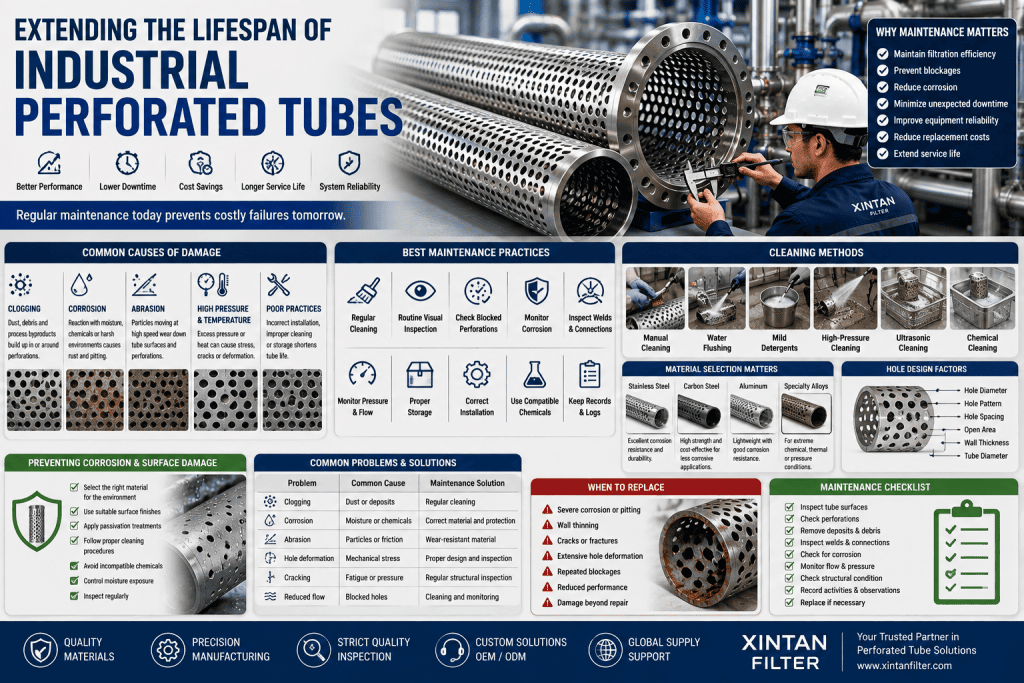
Common Causes of Perforated Tube Damage
Understanding what damages perforated tubes makes it easier to prevent that damage. Most tube problems trace back to one or more of the following causes.
Clogging happens when dust, debris, or process byproducts accumulate in or around the perforations, gradually restricting flow and reducing filtration performance.
Corrosion occurs when a tube’s material reacts with moisture, chemicals, or environmental conditions it wasn’t suited for. This is especially common when the wrong grade of perforated steel or perforated metal tube is used in a corrosive environment.
Abrasion results from particles moving across the tube surface at speed, gradually wearing down the material and enlarging or deforming perforations over time.
Chemical exposure can degrade certain materials faster than expected, particularly if the tube wasn’t selected with the process chemistry in mind.
High pressure can stress welds, connection points, and thin-walled sections, sometimes leading to cracking or deformation.
High temperature can affect material strength and, depending on the alloy, accelerate oxidation or warping.
Mechanical impact from installation mishaps, nearby equipment, or handling — can dent or deform a tube, affecting flow and structural integrity.
Incorrect installation puts unnecessary stress on tubes from day one, whether through misalignment, improper support, or incompatible fittings.
Poor cleaning practices, including using abrasive tools or incompatible chemicals, can damage the tube surface rather than protect it.
Improper storage leaving tubes exposed to moisture, dust, or physical damage when not in use can shorten service life before a tube is even installed.
Best Perforated Tube Maintenance Practices
A structured maintenance routine addresses each of the risk factors above. The following practices form the foundation of effective industrial perforated tube maintenance.
Regular Cleaning
Cleaning frequency and method should match the tube’s material and application. Tubes exposed to heavy particulate loads or sticky residues typically need more frequent cleaning than those in cleaner processes. Choosing a cleaning method compatible with the tube material rather than defaulting to the most aggressive option available helps avoid unnecessary surface damage.
Routine Visual Inspection
Maintenance teams should regularly check tubes for discoloration, pitting, deformation, cracking, and any signs of blocked or damaged perforations. Catching these signs early makes it far easier to address them before they affect performance.
Check for Blocked Perforations
Blocked holes reduce the tube’s effective open area, which lowers flow rates and filtration efficiency. Even partial blockage across many perforations can add up to a meaningful performance loss, so this should be checked as part of every inspection.
Monitor Corrosion
Rust, pitting, discoloration, and surface degradation are all early indicators of corrosion. Monitoring these signs regularly especially in humid, chemically active, or high-temperature environments allows teams to intervene before corrosion compromises the tube’s structure.
Inspect Welds and Connections
Welds and connection points are often the first areas to show stress-related damage. Regular inspection of these areas can reveal cracking, fatigue, or loosening before it leads to a larger failure.
Monitor Pressure and Flow
Unexpected changes in pressure or flow rate are often the earliest operational sign that something is wrong whether that’s a partial blockage, a developing leak, or structural damage. Tracking these metrics over time makes it easier to catch problems early.
Store Tubes Properly
When perforated tubes are not in use, they should be stored in a dry, clean, and protected location. Proper storage prevents corrosion, contamination, and physical damage before a tube is even put into service.
How to Clean Industrial Perforated Tubes
Cleaning method should always be matched to the tube’s material, the type of contaminant involved, and the manufacturer’s recommendations. Using the wrong method can damage the tube surface or reduce its corrosion resistance.
Common cleaning approaches include:
- Manual cleaning for light debris and routine upkeep
- Soft brushes that clear perforations without scratching the surface
- Water flushing to remove loose particles and residues
- Mild detergents for general cleaning without damaging surface finishes
- High-pressure cleaning, used carefully and only where the tube material and design can tolerate it
- Ultrasonic cleaning, effective for removing fine particles from complex geometries
- Chemical cleaning, used only when the cleaning agent is confirmed compatible with the tube material
For a closer look at cleaning stainless steel components specifically, see our guide on [How to Clean Stainless Steel Perforated Tubes].
Choosing the Right Material for Longer Service Life
Material selection has a major influence on how well a perforated tube holds up over time. No single material is universally the best choice the right option depends on the specific operating environment.
Stainless Steel Perforated Tubes
Widely used where corrosion resistance and durability are priorities, stainless steel perforated tube options are common in food processing, chemical handling, and other demanding environments.
Carbon Steel Perforated Tubes
Often chosen for applications where high corrosion resistance isn’t the primary requirement, carbon steel can offer strength and cost efficiency in the right setting.
Perforated Aluminum Tubes
Valued for being lightweight while still offering reasonable corrosion resistance, perforated aluminum tube products are often used where weight is a design consideration.
Specialty Alloy Perforated Tubes
For particularly harsh chemical, thermal, or pressure conditions, specialty alloys may be necessary to achieve the required performance and longevity.
When selecting a material, consider:
- Corrosion exposure
- Operating temperature
- Pressure conditions
- Abrasion levels
- Chemical compatibility
- Overall operating environment
How Hole Design Affects Tube Lifespan
The design of the perforations themselves has a direct impact on how long a tube lasts and how well it performs. Key design factors include:
- Hole diameter — affects both filtration performance and structural strength
- Hole pattern — influences flow distribution and stress points
- Hole spacing — too little spacing between holes can create weak points
- Open area — the ratio of open to solid surface affects both flow and strength
- Wall thickness — thicker walls generally offer more resistance to deformation and wear
- Tube diameter — affects flow capacity and structural behavior under pressure
Incorrect hole design can create unnecessary weak points in the tube structure or fail to deliver the filtration performance a system requires. This is one of the reasons working with an experienced perforated tube manufacturer matters; proper design from the start reduces long-term maintenance needs.
Preventing Corrosion and Surface Damage
Corrosion prevention starts before a tube is ever installed and continues throughout its service life. Effective strategies include:
- Selecting a material appropriate for the operating environment
- Choosing suitable surface finishes for the application
- Applying passivation treatments where appropriate
- Following proper cleaning procedures consistently
- Avoiding chemicals incompatible with the tube material
- Controlling moisture exposure where possible
- Performing regular inspections to catch early signs of damage
For environments with significant corrosion risk, specifying a corrosion resistant perforated tube from the outset can reduce long-term maintenance demands and extend service life considerably.
Preventing Common Perforated Tube Problems
The table below summarizes common perforated tube problems, their typical causes, and the maintenance response that addresses them.
| Problem | Common Cause | Maintenance Solution |
| Clogging | Dust or deposits | Regular cleaning |
| Corrosion | Moisture or chemicals | Correct material and protection |
| Abrasion | Particles or friction | Wear-resistant material |
| Hole deformation | Mechanical stress | Proper design and inspection |
| Cracking | Fatigue or pressure | Regular structural inspection |
| Reduced flow | Blocked holes | Cleaning and monitoring |
How Often Should Perforated Tubes Be Maintained?
Maintenance frequency isn’t one-size-fits-all. It depends on a combination of factors specific to each application, including:
- Industry and application type
- Type of filtration media used
- Operating temperature
- System pressure
- Contaminant levels in the process
- Chemical exposure
- Tube material
- Total operating hours
Rather than following a fixed interval that may not suit every system, maintenance teams should establish a schedule based on these operating conditions and adjust it as they observe how tubes perform over time. Systems with heavier contaminant loads or harsher chemical exposure generally need more frequent attention than cleaner, low-stress applications.
When Should an Industrial Perforated Tube Be Replaced?
Even with excellent maintenance, perforated tubes eventually reach the end of their useful service life. Signs that replacement may be necessary include:
- Severe corrosion affecting structural integrity
- Significant wall thinning
- Structural cracks
- Extensive deformation of the perforations
- Repeated blockages despite regular cleaning
- Noticeably reduced filtration performance
- Damage that cannot be safely or reliably repaired
For critical systems, replacement decisions should involve a professional inspection rather than relying on visual assessment alone. Safety should always take priority over extending a tube’s use past what’s structurally sound.
How a Perforated Tube Manufacturer Can Help
Working with an experienced perforated tube manufacturer can make a meaningful difference in how long a tube lasts and how well it performs. A knowledgeable perforated tube supplier can assist with:
- Material selection suited to the specific operating environment
- Hole pattern design for the required flow and filtration performance
- Open area optimization
- Wall thickness recommendations
- Custom dimensions to fit existing systems
- Surface finishing options
- Quality inspection throughout manufacturing
- Full custom manufacturing for unique applications
- Meeting specific OEM requirements
Choosing a custom perforated tube solution designed around the actual operating conditions rather than a generic option often reduces maintenance demands and extends service life from the start.
Maintenance Checklist for Industrial Perforated Tubes
Use this checklist as a starting point for a routine perforated tube maintenance program:
- [ ] Inspect tube surfaces for discoloration, pitting, or damage
- [ ] Check perforations for blockage or deformation
- [ ] Remove deposits and debris
- [ ] Inspect welds and connection points
- [ ] Check for signs of corrosion
- [ ] Monitor flow rates for unexpected changes
- [ ] Monitor system pressure for irregularities
- [ ] Check overall structural condition
- [ ] Record maintenance activities and observations
- [ ] Replace damaged components when repair isn’t safe or practical
Frequently Asked Questions
- What is perforated tube maintenance?
Perforated tube maintenance refers to the ongoing cleaning, inspection, and care practices used to keep perforated tubes functioning properly and to extend their service life in filtration and processing systems.
- How often should perforated tubes be cleaned?
Cleaning frequency depends on factors like contaminant levels, operating conditions, and tube material. Systems with heavier particulate loads generally require more frequent cleaning than cleaner applications.
- How can I extend the lifespan of a perforated tube?
Consistent cleaning, routine inspection, correct material selection, proper installation, and appropriate storage all contribute to a longer service life.
- What causes perforated tubes to fail?
Common causes include corrosion, clogging, abrasion, chemical exposure, mechanical impact, incorrect installation, and poor maintenance practices.
- How can corrosion be prevented?
Corrosion prevention involves selecting the right material for the environment, using suitable surface finishes, applying passivation where appropriate, maintaining proper cleaning practices, and controlling moisture exposure.
- Can blocked perforated tubes be cleaned?
In many cases, yes. The appropriate cleaning method depends on the tube material and the type of blockage, so it’s important to choose a method that won’t damage the tube surface.
- When should a perforated tube be replaced?
Replacement is generally warranted when a tube shows severe corrosion, significant wall thinning, structural cracks, extensive hole deformation, or damage that can’t be safely repaired.
- Which material provides better durability for industrial applications?
It depends on the application. Stainless steel, carbon steel, aluminum, and specialty alloys each offer different advantages depending on factors like corrosion exposure, temperature, and chemical compatibility.
Conclusion
Extending the lifespan of industrial perforated tubes comes down to consistent, preventive care. Regular cleaning, routine inspection, thoughtful material selection, corrosion prevention, sound tube design, and ongoing monitoring of operating conditions all work together to keep filtration and processing systems running reliably.
A well-maintained perforated tube whether it’s a perforated steel tube, perforated aluminum tube, or stainless steel perforated tube performs more consistently, requires fewer emergency repairs, and delivers more value over its service life. Investing in perforated tube maintenance today helps avoid costly downtime and premature replacement down the road.
Contact Xintan Filter to discuss your industrial perforated tube requirements, custom specifications, maintenance needs, and filtration applications.