Water treatment plants depend on filtration to remove sediment, particulates, and contaminants before water reaches homes, industrial processes, or discharge points. Behind every reliable filtration system are structural and mechanical components that keep the process running smoothly, and one of the most versatile of these is the water treatment perforated tube.
A perforated tube isn’t always the component that captures particles directly. Instead, it often works alongside filtration media to provide structural support, guide flow, or screen out larger debris before finer filtration takes place. Because these tubes sit in continuous contact with water, chemicals, and varying pressure conditions, the material, hole size, open area, and corrosion resistance of the tube all directly affect how well the surrounding filtration equipment performs.
This guide explains what a water treatment perforated tube is, how it’s used across different filtration applications, which materials are typically chosen, and what factors should guide selection, customization, and maintenance.
What Is a Water Treatment Perforated Tube?
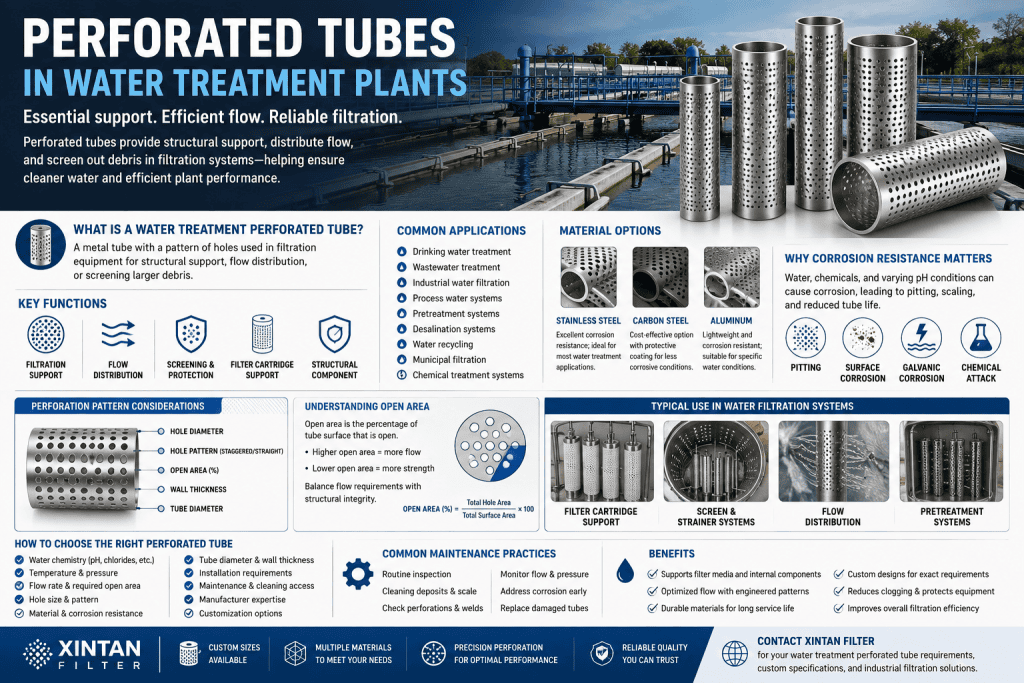
A perforated tube is a length of metal tubing with a pattern of holes punched, drilled, or laser-cut through its wall. In water treatment settings, these tubes are typically manufactured from corrosion-resistant metals and shaped into cylindrical forms that can be installed inside filter housings, vessels, or flow lines.
Construction generally starts with a solid or welded metal tube, which is then perforated according to a specified hole diameter, spacing, and pattern. Depending on the application, the tube may be left as a simple open cylinder, capped at one or both ends, or welded into a larger assembly with flanges, fittings, or support rings.
Common materials for water treatment perforated tubes include stainless steel, carbon steel, and aluminum, each selected based on the water chemistry and operating environment. Perforation patterns vary from straight-line (aligned) rows to staggered patterns, with hole shapes typically round, though slotted or square perforations also appear in certain filtration designs.
It’s important to distinguish a perforated support tube from primary filter media. A perforated tube’s holes are generally too large to remove fine particulates on their own. Instead, the tube typically functions as a support tube for water filter elements, such as filter cartridges, membranes, or filter media beds, or as a coarse screen that protects downstream components from large debris. The actual fine filtration is usually performed by dedicated media, such as cartridges, sand beds, membranes, or woven screens, that the perforated tube supports or surrounds.
How Perforated Tubes Are Used in Water Treatment Plants
Perforated tubes serve several distinct roles within water treatment and filtration equipment. The specific function depends on where the tube is positioned and how the surrounding system is engineered.
Filtration Support
One of the most common uses of a perforated tube is providing structural support for filtration elements. In many filter housings, a perforated tube forms the internal core around which filter media, cartridges, or bag filters are wrapped or mounted. This support prevents the filter media from collapsing under pressure while still allowing water to pass through the tube wall.
Flow Distribution
Perforation patterns can be engineered to help distribute incoming water evenly across a filter bed or collect filtered water uniformly as it exits. A well-designed hole pattern can help reduce localized high-velocity zones that might otherwise cause uneven media wear or channeling within a filter vessel.
Screening Applications
In some systems, perforated metal tubes function as coarse screens, catching larger solids, debris, or particulates before water reaches more delicate filtration stages. This screening role protects downstream pumps, membranes, or fine filter media from premature fouling or mechanical damage.
Filter Cartridge Support
Cartridge-style filtration systems often rely on a perforated inner core to keep the cartridge’s pleated or wound media from deforming under differential pressure. The perforated tube maintains the cartridge’s shape while allowing water to flow freely through the perforations into the collection chamber.
Protective and Structural Components
Perforated tubes can also serve a protective function, shielding internal components such as sensors, diffusers, or piping from physical impact, sediment accumulation, or turbulence, while still permitting continuous water flow through the perforations.
Water Treatment Applications of Perforated Tubes
Perforated tubes appear across a range of water treatment contexts, though their role and suitability vary by application. Some of the settings where perforated tubes are commonly used include:
- Drinking water treatment – as support components within filter vessels and cartridge housings
- Wastewater treatment – for screening, flow distribution, and structural support in filtration and aeration equipment
- Industrial water treatment – supporting filtration equipment used in manufacturing and processing facilities
- Process water filtration – protecting equipment and supporting filter media in production lines
- Pretreatment systems – screening out coarse debris before water reaches finer filtration stages
- Desalination systems – supporting pre-filtration components ahead of membrane systems
- Water recycling – supporting filtration in reclaimed or reused water systems
- Chemical treatment systems – where corrosion resistance is especially important
- Municipal filtration – within larger-scale filtration and screening equipment
- Industrial filtration equipment – across various filter housing and vessel designs
It’s worth noting that perforated tubes are not a universal solution for every stage of water treatment. Fine particulate removal, disinfection, and chemical treatment stages typically rely on dedicated media, membranes, or chemical dosing systems rather than perforated tubes alone. The tube’s role is generally structural, distributive, or screening in nature, working in coordination with these other treatment methods.
Materials Used for Water Treatment Perforated Tubes
Material selection is one of the most important decisions in specifying a water treatment perforated tube, since the tube is continuously exposed to water, moisture, and often aggressive chemical conditions.
Stainless Steel Perforated Tubes
A stainless steel perforated tube is one of the most widely used options in water treatment applications because of its combination of corrosion resistance, mechanical strength, and durability. Grades such as 304 and 316 stainless steel are common choices, with 316 typically offering improved resistance in higher-chloride or more chemically aggressive environments. Stainless steel perforated tubes are often specified in filtration equipment that must withstand long-term exposure to water, cleaning chemicals, and variable pH conditions.
Carbon Steel Perforated Tubes
A perforated steel tube made from carbon steel can be a cost-effective option in applications where the tube is not in constant contact with corrosive water or where a protective coating can be applied. Because carbon steel is more susceptible to rust and corrosion than stainless steel, it typically requires a protective coating, lining, or galvanization when used in water treatment environments, and it may not be suitable for continuous submersion or aggressive chemical exposure.
Perforated Aluminum Tubes
A perforated aluminum tube offers a lighter-weight alternative to steel, which can be beneficial where reduced structural weight is a priority. Aluminum forms a natural oxide layer that provides some corrosion resistance, but its suitability depends heavily on the specific water chemistry involved. Aluminum may not be appropriate for highly alkaline or certain chemically treated water conditions, so application-specific evaluation is important.
Specialty Alloys
For particularly aggressive water or chemical environments, such as those involving high chloride concentrations, strong acids, or elevated temperatures, specialty alloys may be considered. These can include higher-nickel stainless steels or other corrosion-resistant alloys designed for demanding service conditions. No material, including specialty alloys, should be considered universally corrosion-proof; the correct choice depends on a careful assessment of the specific water chemistry and operating environment.
Why Corrosion Resistance Matters in Water Treatment
Water treatment perforated tubes are in near-constant contact with water, moisture, chemicals, salts, cleaning agents, and fluctuating pH conditions. This combination of factors makes corrosion resistance a central consideration in material selection.
Several forms of corrosion can affect perforated tubes in water treatment service:
- Pitting – localized corrosion that can create small holes or weak points in the tube wall, often accelerated by chloride exposure
- Surface corrosion – general degradation of the metal surface over time due to prolonged moisture contact
- Galvanic corrosion – accelerated corrosion that can occur when dissimilar metals are in contact within a water environment
- Chemical attack – degradation caused by exposure to acids, alkalis, or treatment chemicals used in disinfection or cleaning
- Material degradation – general loss of structural integrity from long-term exposure to any of the above mechanisms
Selecting a corrosion resistant perforated tube appropriate to the specific water chemistry can help reduce the risk of premature failure, unplanned maintenance, and equipment downtime. For a deeper look at prevention strategies, see our related guide, “How to Prevent Corrosion in Perforated Tubes.”
Perforation Patterns for Water Treatment Applications
The perforation pattern of a water treatment perforated tube is defined by several interrelated specifications:
- Hole diameter – the size of individual perforations
- Hole shape – typically round, though slotted or other shapes may be used
- Hole spacing – the distance between adjacent holes
- Staggered patterns – rows of holes offset from one another, often used to increase open area while maintaining structural strength
- Straight-line patterns – holes aligned in consistent rows and columns
- Open area – the total percentage of the tube surface occupied by holes
- Tube diameter – the overall diameter of the cylindrical tube
- Wall thickness – the thickness of the metal forming the tube wall
These specifications work together to influence flow characteristics, pressure drop across the tube, structural strength, and screening performance. A tube with a higher open area generally allows greater flow but may have reduced structural rigidity, while a lower open area increases strength at the cost of flow capacity. Wall thickness also plays a role in how much pressure and mechanical stress the tube can withstand without deforming.
Because these variables interact, perforation pattern design should be matched to the specific filtration equipment and operating conditions rather than selected generically. For more detail on how different patterns affect performance, see “Perforated Tube Hole Patterns Explained.”
Understanding Open Area in Water Treatment Perforated Tubes
Open area refers to the percentage of a perforated tube’s total surface that consists of holes rather than solid metal. It is a key specification because it directly affects both flow capacity and structural performance.
A higher open area percentage generally allows more water to pass through the tube wall with less resistance, which can be beneficial in applications where flow rate is a priority. However, increasing open area typically reduces the tube’s structural strength, since more of the metal surface has been removed.
Hole size and open area are closely related: larger holes spaced further apart can achieve a similar open area to smaller, more densely spaced holes, but the resulting flow and screening characteristics will differ. For this reason, open area should be engineered according to the specific requirements of the application, balancing flow needs against the mechanical strength required to support filter media or withstand operating pressure.
For a more detailed explanation of this concept, see “Understanding Open Area in Perforated Tubes.”
Perforated Tubes for Different Water Filtration Systems
Water Filter Cartridges
Within cartridge filtration systems, a perforated tube often forms the central core that supports the cartridge’s filter media, helping maintain its shape under differential pressure while allowing filtered water to flow through to the outlet.
Screen and Strainer Systems
Perforated tubes are frequently used as the screening element in strainer assemblies, catching debris above a certain size while allowing water to pass through the perforations.
Wastewater Filtration
In wastewater treatment, perforated tubes can support screening and pre-filtration equipment, helping manage solids before water proceeds to further treatment stages.
Industrial Water Filtration
Industrial filtration systems often incorporate perforated tubes as structural or flow-distribution components within larger filter housings and process equipment.
Pretreatment Systems
Ahead of finer filtration or membrane stages, perforated tubes can serve a coarse screening role, reducing the load of larger particulates on downstream components.
Desalination Equipment
In desalination pretreatment, perforated tubes may support filtration components that protect membrane systems from fouling caused by larger suspended solids.
Process Water Systems
Within manufacturing and industrial process water systems, perforated tubes can support filtration equipment tailored to the specific water quality requirements of the process.
Across these applications, the perforated tube’s role is generally supportive or complementary to the primary filtration mechanism rather than a replacement for it.
How to Choose the Right Perforated Tube for Water Treatment
Selecting the right water treatment perforated tube requires evaluating several interconnected factors:
- Water chemistry – dissolved solids, chlorides, and other constituents that may affect material compatibility
- pH – acidic or alkaline conditions that influence corrosion risk
- Temperature – operating temperature range, which can affect material performance
- Pressure – system pressure that the tube must withstand structurally
- Flow rate – required throughput, which affects open area and hole sizing decisions
- Tube diameter – sized to fit the filtration equipment and flow requirements
- Wall thickness – selected for structural strength under operating conditions
- Hole diameter – matched to the screening or flow-distribution requirement
- Hole pattern – straight-line or staggered, based on strength and flow needs
- Open area – balanced between flow capacity and structural integrity
- Material – stainless steel, carbon steel, aluminum, or specialty alloy based on water chemistry
- Surface finish – which can affect cleanability and corrosion resistance
- Corrosion resistance – matched to the specific chemical and moisture exposure
- Installation requirements – fit, connections, and mounting within existing equipment
- Maintenance requirements – access for cleaning and inspection over the tube’s service life
Because these factors interact, working with an experienced industrial perforated tube manufacturer can help ensure the selected tube matches both the filtration equipment’s design and the plant’s operating conditions. In many cases, a custom perforated tube is the most practical way to meet application-specific requirements precisely.
Custom Perforated Tubes for Water Treatment Plants
Standard perforated tube dimensions don’t always align with the specific requirements of water treatment equipment, which is why many plants and OEM manufacturers turn to custom-manufactured tubes. Manufacturers can typically customize:
- Tube diameter
- Tube length
- Wall thickness
- Hole diameter
- Hole pattern
- Open area
- Material
- Surface finish
- Connection requirements (threading, flanges, welded fittings)
Custom dimensions are often particularly important for OEM water treatment equipment, where the perforated tube must integrate precisely with existing housings, fittings, or system geometry. Working with a qualified perforated tube manufacturer or perforated tube supplier allows engineers and procurement teams to specify tubes that match exact performance and fit requirements rather than adapting equipment designs around standard stock sizes.
Manufacturing Perforated Tubes for Water Treatment
While specific processes vary by manufacturer and equipment, producing a water treatment perforated tube generally involves the following stages:
- Material selection – choosing a metal grade suited to the intended water chemistry and application
- Tube preparation – sourcing or forming the base tube to the required diameter and wall thickness
- Perforation – creating the hole pattern through punching, drilling, or laser cutting
- Cutting – trimming the tube to the required length
- Welding or forming – where applicable, joining or shaping the tube to meet assembly requirements
- Deburring – removing sharp edges left by the perforation process
- Surface finishing – treating the surface to improve corrosion resistance or cleanability
- Dimensional inspection – verifying that the tube meets specified dimensions and tolerances
- Quality control – checking the finished tube against application requirements
- Packaging – preparing the tube for shipment or installation
For a more detailed walkthrough of the perforated tube production process, see “How Perforated Tubes Are Manufactured.”
Common Problems With Perforated Tubes in Water Treatment
Like any component exposed to continuous water flow and variable conditions, perforated tubes can experience operational issues over time. The table below outlines common problems, potential causes, and general approaches to addressing them. The correct solution in each case depends on the specific application and should be evaluated by qualified personnel.
| Problem | Possible Cause | Potential Solution |
| Clogged holes | Sediment or deposits | Appropriate cleaning |
| Corrosion | Water chemistry or chemicals | Suitable material |
| Scaling | Mineral deposits | Cleaning and water treatment |
| Hole deformation | Mechanical stress | Correct design |
| Reduced flow | Blockage | Inspection and cleaning |
| Cracking | Fatigue or excessive stress | Inspection and replacement |
These are general guidelines rather than universal fixes; the appropriate response depends on factors such as the specific water chemistry, operating conditions, and equipment design involved. For a more detailed discussion, see “Common Problems with Perforated Tubes and Their Solutions.”
Maintenance of Perforated Tubes in Water Treatment Plants
Routine maintenance helps extend the service life of a perforated tube and supports consistent filtration equipment performance. Key maintenance practices typically include:
- Routine inspection – checking the tube for visible signs of wear, corrosion, or damage
- Cleaning – removing sediment, scale, or other deposits from the tube surface and perforations
- Checking perforations – verifying that holes remain clear and undeformed
- Monitoring corrosion – tracking any signs of pitting, surface corrosion, or material degradation
- Checking welds – inspecting welded joints or connections for integrity
- Monitoring flow – watching for changes in flow rate that may indicate blockage or wear
- Monitoring pressure – tracking pressure differentials that could signal clogging or damage
- Removing deposits – addressing scaling or sediment buildup before it affects performance
- Replacing severely damaged tubes – swapping out tubes that show significant corrosion, deformation, or cracking
A consistent maintenance schedule, tailored to the specific water treatment application, can help identify issues before they lead to unplanned downtime. For more guidance, see “Extending the Lifespan of Industrial Perforated Tubes.”
Benefits of Using Perforated Tubes in Water Treatment
When properly specified and maintained, perforated tubes offer several practical benefits in water treatment equipment:
- Structural support for filter media, cartridges, and internal components
- Controlled flow through engineered hole patterns and open area
- Customizable open area to match specific flow and strength requirements
- Material flexibility across stainless steel, carbon steel, aluminum, and specialty alloys
- Mechanical durability suited to demanding industrial environments
- Application-specific design tailored to individual filtration systems
- Compatibility with different filtration systems, from cartridges to screening equipment
These benefits are application-dependent, and actual performance outcomes will vary based on system design, water chemistry, and installation quality. Perforated tubes should be evaluated as one component within a broader filtration system rather than as a standalone solution.
Perforated Tube vs Perforated Sheet for Water Treatment
Perforated tubes and perforated sheets are both used in filtration equipment, but they serve different structural and functional purposes.
| Feature | Perforated Tube | Perforated Sheet |
| Shape | Cylindrical | Flat |
| Flow Direction | Surrounding/radial depending on design | Through-plane |
| Structural Use | Tubular support and screening | Panels and screens |
| Customization | Diameter, length, holes | Width, length, holes |
| Typical Use | Filter supports, screens, flow components | Screens, guards, panels |
The appropriate format depends on the specific equipment design. Cylindrical filtration components, such as cartridge cores or in-line strainers, typically require a perforated tube, while flat screening or paneling applications are more suited to perforated sheet.
Frequently Asked Questions
What is a water treatment perforated tube?
A water treatment perforated tube is a metal tube with a pattern of holes through its wall, used in filtration equipment to provide structural support, distribute flow, or screen out larger debris in water treatment applications.
How are perforated tubes used in water treatment plants?
They are commonly used as support structures for filter cartridges and media, as flow-distribution components, and as coarse screening elements that protect downstream filtration equipment.
Which material is best for water treatment perforated tubes?
The best material depends on the specific water chemistry and operating conditions. Stainless steel is widely used for its corrosion resistance, while carbon steel and aluminum may be suitable for less aggressive environments with appropriate protection.
Are stainless steel perforated tubes suitable for water filtration?
Yes, stainless steel perforated tubes are commonly used in water filtration due to their corrosion resistance and mechanical strength, particularly grades such as 304 and 316 stainless steel.
What hole size is suitable for water treatment?
Suitable hole size depends on the application, including the required flow rate, the size of particulates to be screened, and the structural role of the tube. There is no single hole size appropriate for all water treatment uses.
Why is open area important in a perforated tube?
Open area affects both flow capacity and structural strength. A higher open area generally increases flow but reduces mechanical strength, so it should be balanced according to application requirements.
Can perforated tubes be customized for water treatment equipment?
Yes, perforated tubes can typically be customized in diameter, length, wall thickness, hole pattern, open area, material, and surface finish to match specific equipment and application needs.
How do I choose a perforated tube manufacturer?
Look for a manufacturer with experience in water treatment applications, the ability to produce custom specifications, and quality control processes that verify dimensional accuracy and material compliance.
Conclusion
Perforated tubes play a supportive but important role in water treatment plants, providing structural support, flow distribution, and screening functions across a range of filtration equipment. Material selection, corrosion resistance, hole pattern, and open area all directly influence how well a perforated tube performs within its intended application, while customization allows the tube to be matched precisely to specific equipment designs. Ongoing maintenance, including inspection, cleaning, and timely replacement, helps support consistent performance over time.
The right water treatment perforated tube should be selected based on water chemistry, flow conditions, operating pressure, filtration equipment design, and the performance the application requires, rather than treated as a one-size-fits-all component.
Contact Xintan Filter to discuss your water treatment perforated tube requirements, custom specifications, material options, and industrial filtration applications.