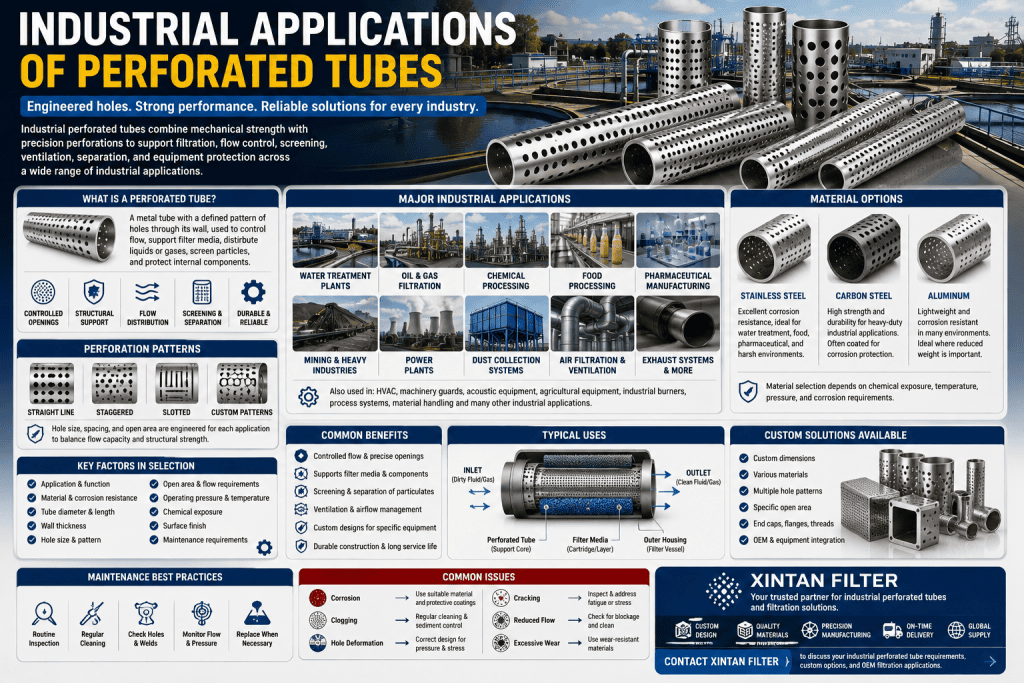
An industrial perforated tube is a metal tube with a defined pattern of holes cut through its wall, used across manufacturing, processing, and equipment design wherever controlled openings, structural support, or airflow and liquid flow management are needed. These tubes show up in far more places than most buyers expect, from filtration housings and dust collectors to exhaust systems and machinery guards.
Perforated tubes are widely used because they combine mechanical strength with engineered openings, allowing them to serve filtration, screening, flow control, structural support, ventilation, separation, and equipment protection roles, often within the same piece of equipment. The right tube for a given job depends on more than just having holes in it. Material, hole pattern, open area, tube dimensions, and the operating environment all determine whether a perforated tube will perform reliably over time.
This guide walks through what an industrial perforated tube is, where it’s used across major industries, which materials and hole patterns are typically specified, and how to choose or customize a tube for a specific application.
What Is an Industrial Perforated Tube?
An industrial perforated tube is a cylindrical metal tube manufactured with a consistent pattern of holes through its wall. The perforation process typically involves punching, drilling, or laser cutting holes into a pre-formed tube, though in some cases flat sheet is perforated first and then rolled and welded into a tube shape.
Common materials include stainless steel, carbon steel, and aluminum, selected based on the mechanical, chemical, and thermal demands of the application. Tube shapes are most often round, though square and rectangular perforated tubing, including perforated steel square tubing and perforated square steel tubing, are also used where flat mounting surfaces or specific structural profiles are required.
Hole patterns vary by application and can include straight-line (aligned) rows, staggered rows, or slotted openings. The proportion of the tube’s surface occupied by holes, known as open area, is a key design variable that affects both flow capacity and structural strength.
Because perforated tubes can be manufactured with such a wide range of materials, dimensions, and hole configurations, their function changes significantly depending on how they’re specified. The same basic product category can serve as a filter cartridge core in one application and a structural exhaust component in another, so understanding the intended function is essential before specifying a tube.
Why Are Perforated Tubes Used in Industry?
Perforated tubes are used across industrial settings because they offer several practical advantages that are difficult to achieve with solid tubing or non-tubular components:
- Controlled openings that allow precise management of airflow, liquid flow, or particle passage
- Customizable open area, letting engineers balance flow capacity against structural strength
- Structural support for filter media, cartridges, insulation, or other internal components
- Flow distribution, helping direct liquids or gases evenly through equipment
- Screening, separating larger particles or debris from a process stream
- Separation of solids from liquids or gases in various process applications
- Ventilation, allowing airflow through equipment housings or enclosures
- Protection of internal components from impact, debris, or turbulence while maintaining flow
- Mechanical durability, since perforated metal generally retains meaningful structural strength despite the removed material
- Material flexibility, with options ranging from lightweight aluminum to corrosion-resistant stainless steel
- Custom dimensions, allowing tubes to be engineered for specific equipment rather than adapted from generic stock sizes
These advantages make perforated tubes a practical choice in many settings, though actual performance depends heavily on how well the tube’s specifications match the application. A tube well-suited to one process may be poorly suited to another with different flow, pressure, or chemical conditions.
Major Industrial Applications of Perforated Tubes
Industrial Filtration Systems
Perforated tubes are widely used across liquid, air, gas, oil, and general process filtration systems. In many filter housings, a perforated filter tube forms the internal core that supports filter cartridges, keeping the media from collapsing under differential pressure while allowing filtered fluid to pass through to the outlet. These support structures are common in industrial filter housings across a wide range of process applications.
Water Treatment Plants
In water treatment facilities, perforated tubes support water filtration and wastewater treatment processes, often functioning as screening components or structural supports within filter vessels. A water treatment perforated tube typically works alongside dedicated filter media rather than replacing it, providing the structural framework that keeps filtration equipment operating reliably. For a deeper look at this application, see our related article, “Perforated Tubes in Water Treatment Plants.”
Oil and Gas Filtration
Oil and gas processing relies on perforated tubes for filtration support, separation systems, and process equipment components. An oil filter perforated tube commonly supports filter media within housings designed to remove particulates or contaminants from oil or gas streams before further processing. Learn more in “Perforated Tubes in Oil & Gas Filtration.”
Chemical Processing
Chemical processing facilities use perforated tubes in liquid separation equipment, gas handling systems, and protective screening components. A chemical industry perforated tube must be selected with particular attention to chemical compatibility, since exposure to aggressive substances can significantly affect material performance and service life. See “Perforated Tubes in Chemical Processing Plants” for more detail.
Food Processing
In food processing environments, perforated tubes support liquid filtration, screening, and sanitary process equipment. A food grade perforated tube is typically manufactured from stainless steel and finished to meet sanitary design considerations common in food-contact equipment. For more on this application, see “Perforated Tubes for Food Processing Equipment.”
Pharmaceutical Manufacturing
Pharmaceutical manufacturing equipment may incorporate perforated tubes in filtration systems, process equipment, and separation applications where supporting filter media reliably is essential. A pharmaceutical perforated tube generally requires careful material selection and surface finishing appropriate to the process environment. Learn more in “Pharmaceutical Applications of Stainless Steel Perforated Tubes.”
Mining and Heavy Industries
Mining and other heavy industrial operations use perforated tubes in slurry processing, screening, and material separation equipment, often in abrasion-prone environments. A mining perforated tube typically requires robust wall thickness and wear-resistant material selection to withstand the mechanical demands of these settings. See “Perforated Tubes Used in Mining and Heavy Industries” for further detail.
Power Plants
Power generation facilities use perforated tubes across water treatment, cooling systems, fuel and oil filtration, and air filtration equipment. A power plant perforated tube may need to meet varied requirements depending on which system it supports, from corrosion resistance in water treatment to thermal stability in fuel handling. Read more in “Power Plant Applications of Perforated Tubes.”
Dust Collection Systems
Dust collection equipment commonly uses perforated tubes as filter support cages, helping maintain the shape of filter bags or cartridges while distributing airflow evenly through the system. A dust collector perforated tube supports the filter media without itself performing fine particulate filtration. For more detail, see “Industrial Dust Collection Using Perforated Tubes.”
Air Filtration Systems
Beyond dust collection, perforated tubes are used more broadly in industrial air filtration and ventilation equipment to support filter media and manage airflow. An air filter perforated tube typically functions similarly to its liquid-filtration counterparts, providing structural support while allowing air to pass through the perforations. Learn more in “Perforated Tubes for Air Filtration Applications.”
Other Applications of Industrial Perforated Tubes
Beyond filtration-focused uses, perforated tubes appear in a variety of other industrial and mechanical applications, including:
- HVAC equipment, where perforated tubes can support airflow distribution or ductwork components
- Machinery guards, allowing visibility and ventilation while protecting personnel from moving parts
- Ventilation systems, supporting controlled airflow through industrial spaces or equipment
- Acoustic equipment, where perforated tubing can contribute to sound attenuation designs
- Exhaust systems, where perforated tube exhaust components can help manage sound and gas flow in certain equipment designs
- Agricultural equipment, including screening and material handling components
- Automotive components, particularly in exhaust or filtration-related parts
- Industrial burners, where perforated tubes may support combustion air distribution
- Heat management equipment, where perforation can support airflow around heat-generating components
- Material handling systems, where perforated tubes may support screening or conveying equipment
Not every one of these applications is appropriate for every perforated tube design. The suitability of a perforated tube for a given use depends on its material, dimensions, and hole pattern, and should be evaluated against the specific mechanical, thermal, and chemical demands of the equipment.
Materials Used for Industrial Perforated Tubes
Stainless Steel Perforated Tubes
A stainless steel perforated tube is one of the most common choices across industrial applications due to its combination of corrosion resistance, strength, and durability. Stainless steel is frequently specified in water treatment, food processing, and pharmaceutical applications, where hygiene and long-term exposure to moisture or cleaning agents make corrosion resistance especially important. Grades such as 304 and 316 stainless steel are widely used, with 316 often preferred in higher-chloride or more chemically demanding environments.
Carbon Steel Perforated Tubes
A perforated steel tube made from carbon steel offers strength suited to many heavy-duty industrial applications, often at a lower material cost than stainless steel. Because carbon steel is more prone to corrosion, it typically requires protective coatings, galvanization, or careful application matching in environments involving significant moisture or chemical exposure.
Perforated Aluminum Tubes
A perforated aluminum tube provides a lightweight alternative that can be beneficial in applications where reduced weight matters, such as certain ventilation or equipment guard designs. Aluminum offers some natural corrosion resistance through its oxide layer, but its suitability still depends on the specific chemical and environmental conditions involved.
Specialty Materials
Certain industrial environments, such as those involving high temperatures, aggressive chemicals, or severe corrosion exposure, may call for specialty alloys beyond standard stainless steel, carbon steel, or aluminum. These materials are typically considered on a case-by-case basis, since no single material, specialty or otherwise, is universally suitable for every industrial environment. Material selection should always be matched to the specific operating conditions of the application.
Perforation Patterns Used in Industrial Applications
Perforated tubes are manufactured with a range of hole patterns, each suited to different performance requirements:
- Round holes – the most common perforation shape, suitable for a wide range of flow and screening applications
- Staggered holes – rows of holes offset from adjacent rows, often used to increase open area while helping maintain structural integrity
- Straight-line patterns – holes aligned in consistent rows and columns, offering a more uniform appearance and flow pattern
- Slot patterns – elongated openings used in certain screening or flow applications where slot geometry offers an advantage
- Hole diameter – the size of individual perforations, selected based on flow and screening requirements
- Hole spacing and pitch – the distance between hole centers, which influences both open area and structural strength
- Open area – the overall percentage of the tube surface occupied by holes
These variables influence flow characteristics, screening performance, filtration support capability, structural strength, and pressure resistance. A pattern optimized for maximum flow may not provide sufficient strength for a heavy-duty structural application, so pattern selection should always be matched to the specific demands of the equipment. For more detail, see “Perforated Tube Hole Patterns Explained.”
Understanding Open Area in Industrial Perforated Tubes
Open area refers to the percentage of a perforated tube’s surface that consists of holes rather than solid metal, and it’s one of the most important specifications in industrial perforated tube design.
Larger or more densely spaced holes increase open area, which generally allows greater flow capacity but reduces the tube’s structural strength, since more material has been removed from the wall. Conversely, a lower open area preserves more structural strength but limits flow capacity. Hole size and spacing both affect the resulting open area, and different combinations can achieve similar open area percentages with different flow and screening characteristics.
Because industrial applications vary widely in their flow, pressure, and strength requirements, open area should always be selected according to the specific needs of the equipment rather than assumed from a generic standard. For further explanation, see “Understanding Open Area in Perforated Tubes.”
How to Choose an Industrial Perforated Tube
Selecting the right tube to choose perforated tube specifications for a given application involves evaluating multiple interrelated factors:
- Application – the specific function the tube will serve, such as filtration support, screening, or structural protection
- Material – stainless steel, carbon steel, aluminum, or specialty alloy, based on the operating environment
- Tube diameter – sized to fit the equipment and required flow characteristics
- Tube length – matched to the equipment’s dimensional requirements
- Wall thickness – selected for the structural strength needed under operating conditions
- Hole diameter – matched to flow and screening requirements
- Hole pattern – straight-line, staggered, or slotted, based on flow and strength needs
- Open area – balanced between flow capacity and mechanical strength
- Operating temperature – which can affect material selection and performance
- Operating pressure – which the tube must withstand structurally
- Chemical exposure – requiring careful material compatibility evaluation
- Corrosion resistance – matched to the moisture and chemical conditions involved
- Surface finish – which can affect cleanability, appearance, and corrosion resistance
- Maintenance requirements – access for inspection and cleaning over the tube’s service life
An experienced industrial perforated tube manufacturer can help evaluate these factors together, and in many cases a custom perforated tube offers the most reliable way to meet application-specific requirements precisely. For a deeper walkthrough of the selection process, see “How to Choose the Right Perforated Tube for Your Project.”
Custom Industrial Perforated Tubes
Standard tube dimensions don’t always match the specific requirements of industrial equipment, which is why custom manufacturing is common in this category. Manufacturers can typically customize:
- Diameter
- Length
- Wall thickness
- Hole size
- Hole pattern
- Open area
- Material
- Surface finish
- Connections (threaded, flanged, or welded fittings)
- Special dimensions for unique equipment designs
Custom tubes are particularly valuable for OEM equipment manufacturers and specialized industrial applications, where a perforated tube must integrate precisely with existing housings, fittings, or system geometry rather than being adapted from stock sizing. Working with an established perforated tube manufacturer or perforated tube supplier allows engineers and procurement teams to specify tubes matched exactly to their equipment’s performance and fit requirements. See “Custom Perforated Tubes: Everything You Need to Know” for more information.
Manufacturing Industrial Perforated Tubes
While specific methods vary between manufacturers and applications, producing an industrial perforated tube generally involves the following stages:
- Material selection – choosing a metal grade suited to the application’s mechanical, chemical, and thermal demands
- Tube preparation – sourcing or forming the base tube to the required diameter and wall thickness
- Perforation – creating the hole pattern through punching, drilling, or laser cutting
- Cutting – trimming the tube to the required length
- Forming or welding – where applicable, shaping or joining the tube to meet assembly requirements
- Deburring – removing sharp edges created during the perforation process
- Surface finishing – treating the surface to improve corrosion resistance, cleanability, or appearance
- Dimensional inspection – verifying the tube meets specified dimensions and tolerances
- Quality control – checking the finished tube against application requirements
- Packaging – preparing the tube for shipment or installation
For a more detailed look at how these tubes are produced, see “How Perforated Tubes Are Manufactured.”
Common Problems With Industrial Perforated Tubes
Perforated tubes can experience a range of operational issues depending on their application and operating environment. The table below summarizes common problems, potential causes, and general approaches to resolving them. The best solution in any given case depends on the specific application and should be assessed by qualified personnel.
| Problem | Possible Cause | Potential Solution |
| Corrosion | Material/environment mismatch | Review material selection |
| Clogging | Dirt or deposits | Appropriate cleaning |
| Hole deformation | Mechanical stress | Review tube design |
| Cracking | Fatigue or excessive stress | Inspect and replace if necessary |
| Reduced flow | Blocked perforations | Clean and inspect |
| Excessive wear | Abrasive material | Consider suitable material/design |
These general guidelines are not universal fixes, since the appropriate response depends on the specific operating conditions, material, and equipment design involved. For further discussion, see “Common Problems with Perforated Tubes and Their Solutions.”
Maintenance of Industrial Perforated Tubes
Ongoing maintenance helps extend the service life of an industrial perforated tube and supports consistent equipment performance. Common maintenance practices include:
- Routine inspection for visible wear, corrosion, or damage
- Cleaning to remove dirt, deposits, or buildup from the tube surface and perforations
- Corrosion monitoring to catch pitting or surface degradation early
- Checking hole condition to confirm perforations remain clear and undeformed
- Checking welds on any welded joints or connections
- Checking dimensions to confirm the tube remains within its intended tolerances
- Monitoring flow for changes that may indicate blockage or wear
- Monitoring pressure for differentials that could signal clogging or damage
- Replacing damaged tubes that show significant corrosion, deformation, or cracking
A maintenance schedule tailored to the specific application and operating environment can help identify issues before they cause unplanned downtime. See “Extending the Lifespan of Industrial Perforated Tubes” for further guidance.
Benefits of Using Industrial Perforated Tubes
When properly specified and maintained, industrial perforated tubes offer a range of practical benefits:
- Customizable design matched to specific application requirements
- Controlled flow through engineered hole patterns and open area
- Structural support for filter media, cartridges, and internal equipment components
- Screening capability for separating debris or larger particulates
- Material flexibility across stainless steel, carbon steel, aluminum, and specialty alloys
- Durable construction suited to demanding industrial environments
- Wide industrial applicability across filtration, screening, ventilation, and structural uses
- Easy integration into equipment, particularly when custom-manufactured to exact specifications
- Custom manufacturing options for OEM and specialized applications
Actual performance outcomes depend on how well the tube’s design matches its intended application, and results will vary based on system design, material selection, and installation quality.
Perforated Tube vs Perforated Sheet
Perforated tubes and perforated sheets both play important roles in industrial equipment, but their structural form and typical applications differ.
| Feature | Perforated Tube | Perforated Sheet |
| Shape | Cylindrical | Flat |
| Typical Use | Tubular screening, filtration support | Panels and screens |
| Flow | Radial/surrounding depending on design | Through-plane |
| Customization | Diameter, length, hole pattern | Width, length, hole pattern |
| Structural Applications | Tubular components | Flat components |
The right choice between a perforated tube and a perforated sheet depends on the equipment’s design and functional requirements. Cylindrical components, such as filter cores or in-line screens, generally call for a perforated tube, while flat screening, paneling, or guarding applications are typically better suited to perforated sheet.
Frequently Asked Questions
What are industrial perforated tubes used for?
Industrial perforated tubes are used for filtration support, screening, flow distribution, ventilation, structural protection, and separation across a wide range of equipment and processes.
Which industries use perforated tubes?
Industries that commonly use perforated tubes include water treatment, oil and gas, chemical processing, food processing, pharmaceuticals, mining, power generation, and general industrial manufacturing.
What is an industrial perforated tube?
An industrial perforated tube is a metal tube manufactured with a defined pattern of holes through its wall, used to support filtration, control flow, or provide structural and protective functions in industrial equipment.
Which material is best for industrial perforated tubes?
The best material depends on the specific application and operating environment. Stainless steel is widely used for its corrosion resistance, carbon steel offers strength in less corrosive settings, and aluminum provides a lightweight option where appropriate.
Are stainless steel perforated tubes suitable for industrial filtration?
Yes, stainless steel perforated tubes are commonly used in industrial filtration due to their corrosion resistance and mechanical durability, particularly in water treatment, food, and pharmaceutical applications.
Can industrial perforated tubes be customized?
Yes, industrial perforated tubes can typically be customized in diameter, length, wall thickness, hole pattern, open area, material, and surface finish to match specific equipment requirements.
How does hole size affect perforated tube performance?
Hole size affects flow capacity, screening performance, and structural strength. Larger holes generally increase flow but may reduce structural integrity, while smaller holes provide more strength with reduced flow capacity.
What is open area in a perforated tube?
Open area is the percentage of a perforated tube’s surface that consists of holes rather than solid metal. It directly affects both flow capacity and mechanical strength.
How do I choose an industrial perforated tube?
Choosing an industrial perforated tube involves evaluating the application, material, dimensions, hole pattern, open area, operating conditions, and maintenance requirements to ensure the tube matches its intended function.
Where can I buy custom industrial perforated tubes?
Custom industrial perforated tubes can be sourced from experienced perforated tube manufacturers and suppliers who can produce tubes to specific dimensional, material, and performance requirements.
Conclusion
Industrial perforated tubes support a wide range of applications, from filtration and screening to structural protection, ventilation, and flow control, across industries including water treatment, oil and gas, chemical processing, food and pharmaceutical manufacturing, mining, and power generation. Material selection, hole pattern, and open area all play a direct role in how well a tube performs, while customization allows the tube to be matched precisely to specific equipment designs. Ongoing inspection and maintenance help support reliable performance over the tube’s service life.
The right industrial perforated tube ultimately depends on the operating environment, required flow, mechanical loads, material compatibility, and equipment design, rather than a one-size-fits-all specification.
Contact Xintan Filter to discuss your industrial perforated tube requirements, custom dimensions, material options, filtration components, and OEM applications.