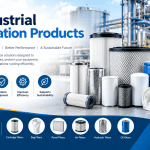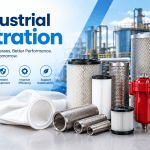
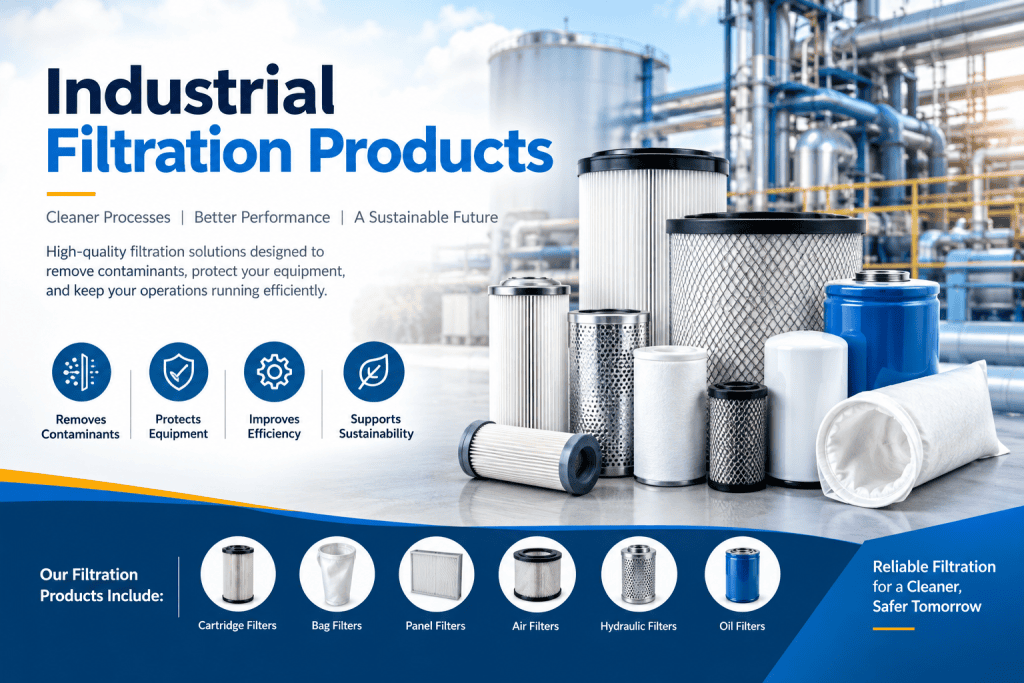
Sourcing the right industrial filtration products starts with knowing what’s actually available and which category fits a given application. Buyers new to filtration procurement often default to whatever a single supplier offers, without realizing there are several distinct product categories, each engineered for different flow, pressure, and corrosion requirements. This overview breaks down the main types of industrial filtration products, the materials behind them, and what to check before placing an order.
Why Product Type Matters as Much as Material
Two filtration components can be made from identical stainless steel and still perform completely differently depending on their structural design. A buyer focused only on material grade while ignoring product type risks specifying the wrong component for the job — a mistake that often only becomes obvious once the part is already installed and underperforming.
Main Types of Industrial Filtration Products
Filter Core Frames
The internal skeleton of a cartridge filter, designed to hold filter media in shape and support it against fluid pressure. Common designs include wire-wound, nozzle, and spiral-welded core frames, each suited to different flow rates and pressure ratings.
Perforated Metal Filter Cores
Similar in function to standard core frames, perforated metal filter cores use a punched or laser-cut hole pattern in solid metal rather than wound wire. This construction offers more structural rigidity, making it a common choice in higher-pressure applications where a wire-wound design might flex or distort over time.
Perforated Tubes
Hollow cylindrical components with a controlled pattern of holes, used both as standalone filtration or screening elements and as structural supports inside larger filtration assemblies. Hole size and open-area percentage are engineered specifically for the flow rate and particle retention each application requires.
Wire Mesh Filter Baskets
Basket-style structures that hold bag filters or loose filter media in place, widely used in liquid filtration systems where operators need to replace media periodically without disassembling the entire housing.
Perforated Metal Sheets and Panels
Flat perforated material used in screening and separation applications, and often the raw material that gets rolled and welded into cylindrical form for tube-based filtration components.
Choosing the Right Material and Corrosion Resistance
Material selection is just as important as choosing the correct product type. Most industrial filtration hardware is built from stainless steel because of its corrosion resistance tube properties under continuous exposure to water, chemicals, or oil:
- Grade 304 stainless steel, reliable general-purpose corrosion resistance, suited to most water treatment and standard industrial environments
- Grade 316 stainless steel, stronger resistance to chlorides and aggressive chemicals, preferred for chemical processing and coastal or marine installations
- Carbon steel, occasionally used where cost outweighs the need for long-term corrosion resistance, though with a shorter expected service life
Choosing a lower-grade material to save on upfront cost is one of the most common procurement mistakes, since premature corrosion failures typically cost far more in downtime and replacement than the initial savings.
Standard Catalog Products vs Custom Fabrication
Standard catalog components cover most common applications, but a significant share of industrial buyers are working with older equipment, non-standard dimensions, or unusual flow requirements that a catalog part simply won’t fit. In these cases, sourcing from a metal perforated cylinder supplier capable of custom fabrication, rather than being limited to fixed catalog sizes, becomes necessary to keep aging equipment properly supplied with compatible replacement parts.
What to Check Before Purchasing
- Material certification confirming the exact stainless steel grade used
- Dimensional tolerances, especially for components that need to fit precisely into existing housings
- Weld quality on rolled and welded components, since seam integrity is often the first point of failure under pressure
- Whether the supplier manufactures in-house or resells from unspecified third-party sources
- Customization capability for buyers with legacy or non-standard equipment
Matching Product Type to Application
- High-pressure filtration with structural demands, perforated metal filter cores or spiral-welded core frames
- Standalone screening or filtration in flow lines, perforated tubes sized to the required open-area percentage
- Systems needing periodic media replacement, wire mesh filter baskets
- Panel-based screening or architectural filtration, flat perforated sheet material
Frequently Asked Questions
What is the difference between a perforated metal filter core and a wire-wound core?
A perforated metal filter core is cut from solid sheet material, giving it more rigidity, while a wire-wound core is built from wound wire, which offers more flexibility in fine-tuning open area but generally less structural stiffness under high pressure.
How do I know which stainless steel grade to specify?
It comes down to the corrosiveness of the environment; general water treatment usually works with grade 304, while chemical processing or high-chloride conditions typically call for grade 316 for adequate corrosion resistance.
Can a metal perforated cylinder supplier match an existing part exactly?
Most manufacturers offering custom fabrication can replicate an existing component’s dimensions and hole pattern, provided you can supply accurate measurements or a sample of the original part.
Why does weld quality matter on perforated tube products?
The seam weld on a rolled and welded tube is typically its weakest structural point, a poorly finished weld can crack under repeated pressure cycling well before the rest of the component shows wear.
Final Thoughts
Industrial filtration products span several distinct categories, core frames, perforated metal filter cores, perforated tubes, mesh baskets, and flat perforated sheet, each suited to different flow, pressure, and structural requirements.
Matching product type and material grade to the actual application, rather than defaulting to whatever’s on hand, is what separates filtration systems that run reliably for years from ones that become a recurring maintenance headache.
Looking for precision-manufactured industrial filtration products, including custom perforated metal filter cores and tubes? Explore our full product range here: https://xintanfilter.com