If you manufacture filtration equipment, industrial screens, or architectural components, choosing the right perforated stainless steel tube directly affects product performance, service life, and total cost of ownership. This guide breaks down what a 2 perforated stainless steel tube actually is, how it’s made, where it’s used, and exactly how to specify one correctly, so you avoid the common sourcing mistakes that lead to premature failure or wasted material cost.
What is a 2 Perforated Stainless Steel Tube?
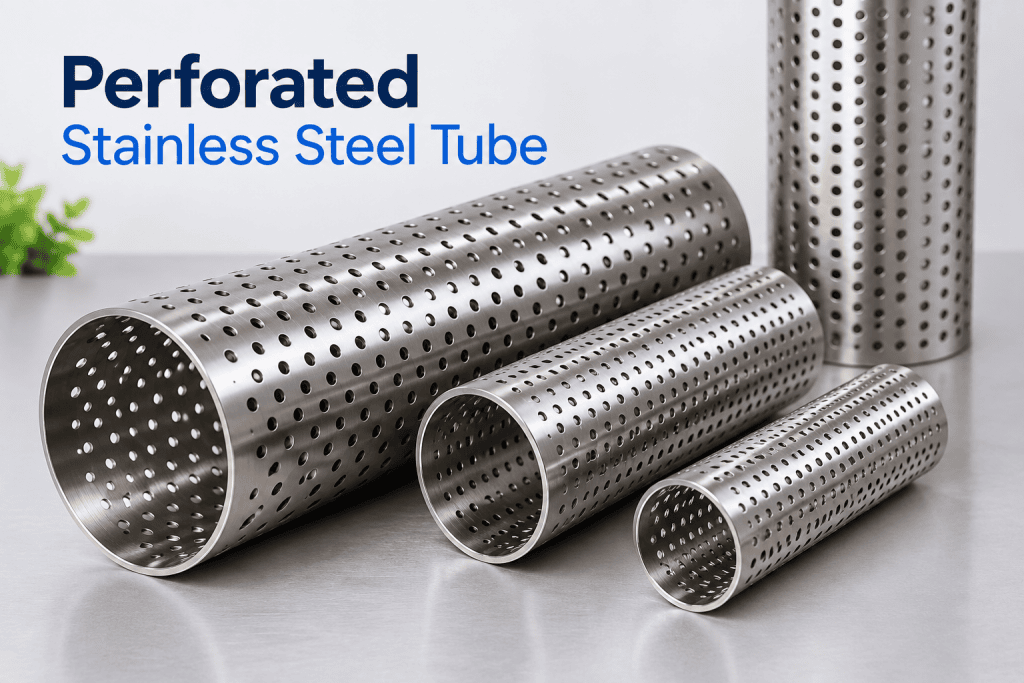
A perforated stainless steel tube is a seamless or welded stainless steel pipe with a precisely engineered pattern of holes punched, drilled, or laser-cut into its wall. Unlike a solid tube, it is designed to let liquids, gases, or particles pass through the tube wall in a controlled way while the tube itself retains its structural rigidity.
This combination of open area and mechanical strength is what makes stainless steel perforated tubes so widely used across filtration, screening, separation, and structural applications. The perforation pattern hole size, shape, spacing, and open-area percentage is engineered around the specific flow rate, particle size, and pressure requirements of the end application.
Key Features and Benefits
Corrosion and Temperature Resistance
Because it is produced from austenitic stainless steel grades such as 304, 304L, 316, and 316L, a perforated stainless steel tube resists rust, oxidation, and chemical attack far better than perforated carbon steel or aluminum alternatives. This matters most in filtration systems exposed to water, oil, acids, or high-temperature process gases, where material degradation directly shortens equipment life.
Structural Strength Under Continuous Flow
Perforation reduces wall mass but not structural integrity when the hole pattern is engineered correctly. A well-designed perforated tube maintains hoop strength and resists collapse under differential pressure critical for filter core frames that support pleated filter media under constant flow and periodic backwash cycles.
High Customization for Precise Filtration Needs
Hole diameter, pitch, staggering pattern, and open-area ratio can all be customized. This flexibility allows engineers to fine-tune flow resistance and particle retention for a specific process, rather than compromising with an off-the-shelf standard.
Types of Stainless Steel Perforated Tubes
By Hole Pattern
Round hole perforation — the most common pattern, offering a balanced ratio of open area to strength for general-purpose filtration and screening.
Slotted hole perforation — provides a higher open-area percentage and is often used where directional flow control matters, such as in oil and gas screen pipes.
Square and hexagonal perforation — selected for specialized screening and separation tasks that require precise, uniform particle sizing.
By Stainless Steel Grade
304 / 304L: Good general corrosion resistance, most cost-effective, suitable for water filtration and food-grade applications.
316 / 316L: Added molybdenum gives superior resistance to chlorides and acidic environments, making it the standard choice for marine, chemical processing, and pharmaceutical filtration.
Duplex and 310S: Specified for high-temperature or high-strength industrial applications where standard austenitic grades fall short.
Common Applications of Stainless Steel Perforated Tubes
Filtration and Filter Core Frames
This is the largest application category. Stainless steel filter core frames, the perforated inner tube that supports pleated filter cartridges — rely on perforated tubes to provide mechanical backing without restricting flow. In liquid and gas filtration systems, the perforated core prevents media collapse under pressure while maintaining a high effective filtration area.
Industrial Mesh and Screening Systems
A stainless steel mesh tube, often combined with a perforated base tube, is used in oil and gas well screens, chemical processing screens, and dewatering equipment. The perforated tube acts as the structural support, while a wrapped or welded mesh layer controls the exact particle cut point.
Architectural, Acoustic, and Decorative Uses
Beyond industrial filtration, 2 perforated stainless steel tube is increasingly specified in architectural facades, acoustic panels, and decorative railings, valued for its clean aesthetic, light-diffusing perforation patterns, and long-term weather resistance without repainting or coating.
How to Choose the Right Perforated Stainless Steel Tube
Specifying the correct perforated tube comes down to five variables. Getting any one of them wrong typically means reduced flow efficiency, premature clogging, or structural failure under pressure.
- Material grade — match the grade to the chemical and temperature environment (316L for aggressive media, 304 for general use).
- Hole size and open-area percentage — determines flow rate and particle retention; higher open area increases flow but can reduce structural rigidity.
- Wall thickness — must be sufficient to maintain strength after perforation, especially for high-pressure or backwashing applications.
- Tube diameter and length — dictated by the housing or equipment specification; custom lengths reduce the need for additional welded joints.
- Surface finish — a polished or passivated finish improves cleanability and corrosion resistance in food, pharmaceutical, and high-purity applications.
Manufacturing Process Overview
Reputable manufacturers produce 2 perforated stainless steel tube through a controlled sequence: the base tube is first formed (seamless or longitudinally welded), then precision-punched or laser-perforated to the specified hole pattern, followed by deburring, cleaning, and passivation to restore the chromium oxide layer damaged during perforation. Passivation is a step some low-cost suppliers skip, and it’s the single biggest factor in whether a perforated tube resists corrosion long-term or starts rusting at the hole edges within months.
Maintenance and Longevity Tips
Regular cleaning: Remove particulate buildup from perforations regularly to maintain rated flow capacity.
Avoid chloride exposure on 304 grade: Switch to 316L if the tube will be exposed to saltwater or chlorinated cleaning agents.
Inspect weld seams: On welded perforated tubes, periodically check seam integrity, especially under cyclic pressure loads.
Frequently Asked Questions
What is the difference between a perforated stainless steel tube and a stainless steel mesh tube?
A perforated tube has holes cut directly into a solid tube wall, giving it high structural strength. A stainless steel mesh tube is woven or welded from wire and offers a finer, more flexible filtration barrier, the two are often combined, with mesh wrapped around a perforated core for both strength and precision filtration.
Which stainless steel grade is best for filter core frames?
316L is generally preferred for stainless steel filter core frames in chemical, pharmaceutical, and marine filtration due to its superior resistance to pitting and chloride attack. 304 remains a cost-effective choice for water treatment and less aggressive environments.
Can perforated stainless steel tubes be custom-made to size?
Yes. Diameter, wall thickness, length, hole pattern, and open-area percentage can all be customized to match specific filtration housings or engineering drawings, which is standard practice among specialized filtration component manufacturers.
How long does a 2 perforated stainless steel tube last?
With the correct grade selection and proper passivation, 2 perforated stainless steel tubes routinely last 10–20 years in industrial filtration service, far outperforming carbon steel or plastic alternatives in corrosive environments.
Conclusion
A perforated stainless steel tube is far more than a piece of punched metal pipe, it’s an engineered component where hole pattern, grade selection, and manufacturing quality directly determine how well a filtration or screening system performs over its service life.
Whether you need stainless steel perforated tubes for filter core frames, a stainless steel mesh tube assembly, or a custom industrial screening solution, getting the specification right the first time saves significant cost in downtime and replacement parts.
Looking for a precision-engineered, corrosion-resistant 2 perforated stainless steel tube built to your exact specifications? Xintan Filter designs and manufactures custom stainless steel filter core frames, mesh tubes, and perforated tube components engineered for demanding industrial filtration applications. Contact Xintan Filter today to get a tailored quote and technical recommendation for your project.