Good filter cartridge suppliers publish tested micron ratings, hold a current ISO 9001 certificate, make cartridges that fit your existing housings, and keep lot-level quality records. Check those four things before you compare prices.
This guide is for plant engineers and procurement managers who buy industrial replacement cartridge filters for water, chemical, food, or oil lines. After reading, you can screen a supplier in one afternoon, request the right documents, and avoid the most common ordering mistake: buying on nominal micron rating alone.
What should you look for in filter cartridge suppliers?
Look for four things: documented micron ratings with a named test method, a current ISO 9001 certificate, dimensional compatibility with your housings, and traceable lot records. A supplier missing any one of these is a risk at any price. Together they show whether a cartridge will filter to the stated size, arrive consistently, and seal without bypass.
Ask for the datasheet before the quote. A real datasheet lists media, micron rating, maximum differential pressure, maximum temperature, and end cap material. Ask for a sample certificate of conformance too. Suppliers that cannot produce both within two working days rarely improve after the purchase order is signed.
Should you buy from cartridge filters manufacturers or distributors?
Buy from a manufacturer when you need custom lengths, special media, or repeat volume. Buy from a distributor when you need small quantities fast or a branded OEM part. Manufacturers control welding, media, and end caps. Distributors control stock and delivery speed.
| Pros | Cons | |
| Manufacturer | Custom specifications; lower unit cost at volume, direct access to test data and process records | Higher minimum order quantities; longer lead times on international orders; you manage import and freight |
| Distributor | Stock on the shelf; small orders accepted; one invoice across several brands | Markup on every unit; little room to change specifications; test data passes through a middle layer |
Many plants split their filter cartridge suppliers into two tiers. They buy a safety stock of fast-moving sizes from a local distributor and place scheduled orders with cartridge filters manufacturers for the rest. You can review one manufacturer catalog at Xintan Filter.
What is an industrial cartridge filter?
An industrial cartridge filter is a replaceable cylindrical element that sits inside a housing and removes particles from a liquid or gas as it passes through the media. Operators change the element when differential pressure rises or the downstream quality drops.
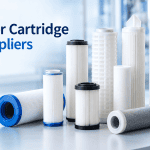
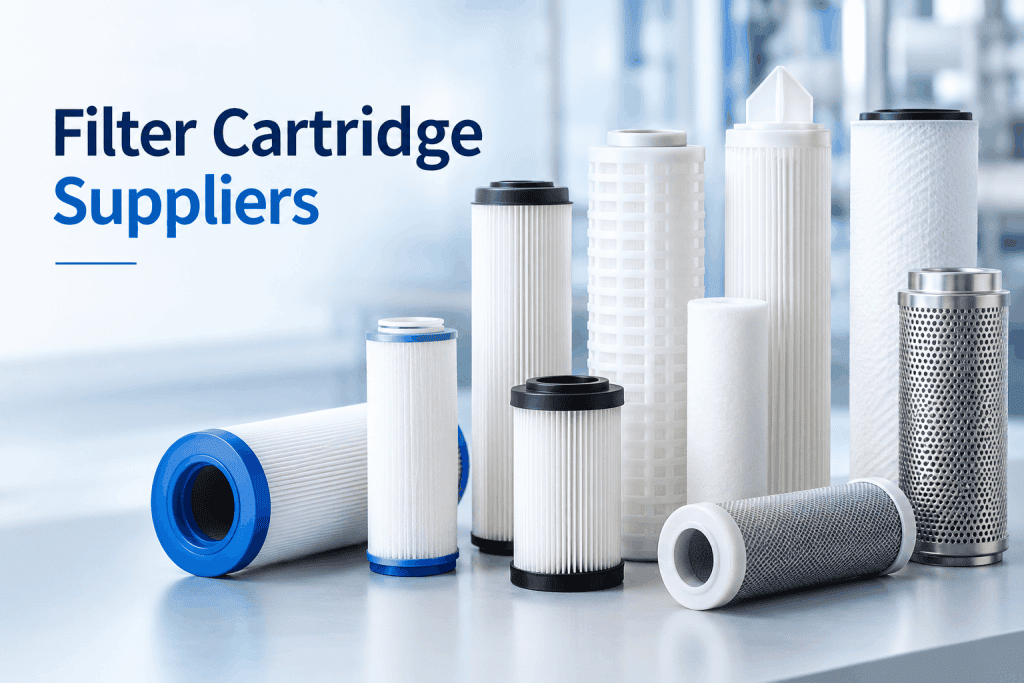
Two designs dominate. Depth cartridges, such as melt-blown polypropylene and string wound, trap particles throughout the thickness of the media. Pleated cartridges capture particles on a folded surface with more filter area, which usually gives longer life in low-solids service. A cartridge filter industrial setup serves water treatment, chemical processing, food and beverage, electronics, and oil and gas lines. Housings hold from one cartridge to over a hundred.
Which cartridge media suits which fluid?
Match media to the fluid chemistry first, then to particle size. Polypropylene suits most water and mild chemicals. Pleated polyester suits high-flow, low-solids service. Glass fiber handles fine filtration with heavy solids. PTFE membrane suits solvents, and PES membrane suits aqueous sterile filtration.
| Media | Typical use | Chemical fit | Main trade-off |
| Melt-blown polypropylene | Water, RO pre-filtration, mild chemicals | Wide pH range; weaker against some solvents | Single use; temperature limit, check datasheet |
| String wound | Sediment, high flow, general process | Depends on yarn: cotton, polypropylene, or glass fiber | Some grades shed fibers |
| Pleated polyester | High-flow pre-filtration | Water and many chemicals | Costs more per unit than melt-blown |
| Glass fiber | Fine filtration, high solids loading | Good with acids; attacked by strong alkali | Brittle if poorly bonded |
| PTFE or PES membrane | Solvents (PTFE); sterile aqueous (PES) | PTFE resists nearly all chemicals | High cost; low dirt-holding capacity |
Check the seal material as well. Reliable filter cartridge suppliers state it on the datasheet, because an EPDM O-ring fails in some oils where a Viton or silicone seal holds.
How do you read micron ratings and beta ratios?
A micron rating states the particle size a cartridge targets. A beta ratio states how reliably it catches that size. Beta equals the particle count upstream divided by the count downstream at one size. A beta of 1000 equals 99.9% efficiency, so a nominal rating without beta data guarantees very little.
The math is simple: efficiency equals 1 minus 1 divided by beta. Beta 75 gives 98.7%. Beta 200 gives 99.5%. Beta 1000 gives 99.9%. Nominal ratings carry no standard efficiency, so two “10 micron nominal” cartridges from different manufacturers can retain different amounts of 10 micron particles.
Test methods matter, and filter cartridge suppliers that publish beta data should name the one they used. ISO 16889 is the multi-pass test for hydraulic fluid filter elements. ASTM F316 measures pore size in membrane filters by bubble point. Ask which method produced the number on the datasheet.
Which certifications should industrial replacement cartridge filters carry?
Every one of your filter cartridge suppliers should hold ISO 9001. Beyond that, the required certificate depends on the fluid. Drinking water contact calls for NSF/ANSI/CAN 61 or a local equivalent. Food and beverage calls for materials compliant with FDA 21 CFR Part 177 or EU Regulation 1935/2004. Pharmaceutical use calls for USP Class VI plastics testing and validation support.
One non-obvious point: ISO 9001 certifies a quality management system at a factory. It does not certify that a given cartridge meets a product standard. Product certificates are issued per part number, so ask for the one that lists your exact model. Verify the certificate number with the issuing body. Forged certificates exist, and a two-minute lookup catches most of them.
How do you verify a supplier before placing a large order?
Vet new filter cartridge suppliers with a seven-step check: documents, certificate lookup, sample batch, dimensional check, a full-cycle trial, cost per cubic meter, and lot traceability. The whole process takes one filter cycle. It costs a few cartridges and prevents a bad container of a thousand.
- Request the datasheet and a certificate of conformance for the exact part number you plan to buy.
- Verify the supplier’s ISO 9001 certificate number with the issuing body, or through IAF CertSearch.
- Order a small sample batch of the same part number, not a catalog sample of a similar one.
- Measure length, outer diameter, inner diameter, and end cap fit against your current OEM cartridge with calipers.
- Run one sample in one housing for a full cycle. Record start-up differential pressure, change-out differential pressure, run hours, and downstream turbidity or particle count.
- Calculate cost per cubic meter filtered, not cost per cartridge.
- Confirm that each cartridge carries a date or lot code, and that the supplier can trace that code to media and weld records.
For OEM replacements, match four attributes: length, outer diameter, inner diameter, and end cap style. The common styles are double open end, 222 O-ring seat, and 226 O-ring seat.
What drives the price of industrial replacement cartridge filters?
Media, length, micron rating, end cap material, and certification drive price. Tighter ratings and membrane media cost more per unit. Filter cartridge suppliers quote unit price, and that number misleads. Divide the cartridge price by the cubic meters it filters before change-out, and the cheaper option often loses.
Here is an illustrative example, not market data. Cartridge A costs $4 and filters 800 m³ before change-out: $0.005 per m³. Cartridge B costs $6 and filters 1,500 m³: $0.004 per m³. Cartridge B costs 50% more per unit and 20% less to operate. Add labor and downtime per change-out, and the gap widens. Typical price ranges by media: [INSERT STAT — source needed].
Who is this guide not for?
This guide does not cover residential under-sink filters, bag filters, or spiral-wound membrane modules. It also does not replace process validation in regulated pharmaceutical manufacturing, which needs extractables data and a validated protocol. Buyers of single-brand OEM parts under a service contract should follow the OEM warranty terms first.
Frequently Asked Questions
How long does an industrial cartridge filter last?
Until differential pressure across the housing rises about 1 bar (15 psi) above the clean start-up reading, or until the datasheet limit, whichever comes first. Life depends on solids loading, flow rate, and micron rating. Log differential pressure at each change-out to find your real interval.
What is the difference between nominal and absolute micron ratings?
A nominal rating means the cartridge removes a stated percentage of particles at that size, and each manufacturer picks its own percentage. An absolute rating means at least 99.9% removal under a defined test. Ask for beta ratio data whenever the downstream particle limit matters.
Can I mix cartridges from two filter cartridge suppliers in one housing?
Use one supplier per housing at a time. Different brands can differ by a few millimeters in length or end cap seat, which causes bypass. Switch suppliers at a scheduled change-out, then check differential pressure and downstream quality over the first cycle.
Can industrial cartridge filters be cleaned and reused?
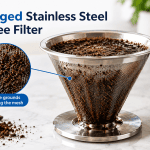
Stainless steel mesh and some pleated cartridges tolerate backwashing or ultrasonic cleaning. Melt-blown polypropylene, string wound, and membrane cartridges are single use. Cleaning a depth cartridge pushes trapped particles deeper into the media and does not restore its rating.
What is the minimum order quantity for cartridge filters?
Minimum order quantities vary by supplier, media, and whether the cartridge is standard or custom. Ask for the MOQ in writing for your exact part number.
Do filter cartridge suppliers ship internationally?
Most manufacturers ship by sea or air freight worldwide, but lead times and inconveniences differ. Confirm the ship-from country, packaging, and customs documents before ordering.
What should you do next?
Choosing among filter cartridge suppliers comes down to evidence you can check: datasheets, product certificates, a measured sample, and a cost per cubic meter. Pick two candidates, request the same documents from both, and run one sample from each through the same housing. To start with a manufacturer, request a quote and datasheets from Xintan Filter for your part number.