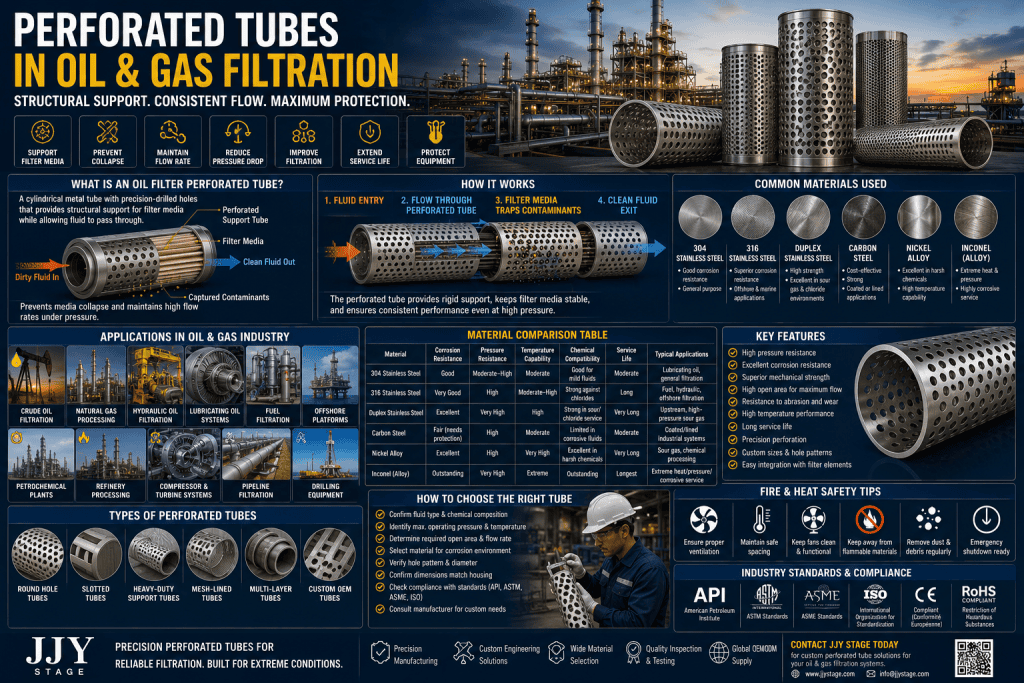
In oil and gas processing, filtration systems face constant exposure to high pressure, abrasive particles, and corrosive fluids. At the core of many of these systems sits a component that rarely gets attention but does essential work: the oil filter perforated tube. This cylindrical, precision-drilled metal component provides the structural backbone that keeps filter media intact, maintains steady flow rates, and allows filtration equipment to perform reliably even under extreme operating conditions. Whether used in upstream drilling operations, midstream pipeline systems, or downstream refinery processes, perforated tubes are a quiet but critical part of keeping oil, gas, and hydraulic fluids clean and equipment running smoothly.
This guide covers what oil filter perforated tubes are, how they work, the materials and designs available, where they’re used across the oil and gas industry, and how to select the right tube for your filtration application.
What Is an Oil Filter Perforated Tube?
An oil filter perforated tube is a cylindrical metal tube with a pattern of holes or slots drilled or punched into its surface. It’s typically installed inside or around a filter cartridge, acting as a rigid core or outer shell that supports the filter media while allowing fluid to pass freely through the perforations.
Construction and design: These tubes are manufactured from rolled and welded sheet metal or seamless pipe, then perforated using automated punching or laser-drilling equipment to achieve consistent hole size, spacing, and pattern across the full length of the tube. The finished tube is sized to fit precisely inside a filter housing, cartridge, or vessel.
Working principle: As fluid flows through a filtration system, the perforated tube provides a mechanical framework that keeps the filter media (paper, wire mesh, or synthetic fabric) in its proper shape. Without this support, filter media would collapse or rupture under the pressure differential created as contaminants build up on its surface.
Role in oil and gas filtration systems: Perforated tubes are used as inner cores (supporting pleated filter media from collapsing inward), outer cages (preventing media from bursting outward under pressure), or standalone strainer elements in coarse filtration stages.
Perforated support tube vs. other filtration components: Unlike wire mesh screens or sintered filters, which are themselves designed to trap particles, a perforated support tube’s primary job is structural it’s not usually the filtration medium itself, but rather the framework that lets the actual filter media do its job without failing mechanically.
Why Perforated Tubes Are Essential in Oil & Gas Filtration
Perforated tubes play several interconnected roles that directly affect filtration performance and equipment uptime:
- Support filter cartridges — providing a rigid shape that prevents distortion under flow pressure.
- Prevent filter media collapse — especially important during high differential pressure events, such as when a filter becomes partially clogged.
- Maintain high flow rates — a well-designed open area allows fluid to pass with minimal restriction.
- Reduce pressure drop — an efficient hole pattern minimizes the energy loss across the filtration stage.
- Improve contaminant removal — by keeping filter media properly seated and undamaged, the media can do its job of trapping particulates more effectively.
- Increase equipment reliability — downstream pumps, compressors, and turbines are protected from debris that could otherwise pass through a failed filter.
- Extend filter service life — proper structural support reduces media fatigue and physical damage over repeated pressure cycles.
How Oil Filter Perforated Tubes Work
The filtration process involving a perforated tube generally follows these steps:
- Crude oil, fuel, natural gas, or hydraulic fluid enters the filtration housing under system pressure.
- The fluid passes through the perforated support tube, which channels flow evenly across the filter element.
- The filter media captures contaminants, solid particles, and debris as fluid moves through it.
- Clean, filtered fluid exits the system and continues downstream to pumps, turbines, or storage.
- Throughout this cycle, the perforated tube provides continuous structural support, keeping the filter media stable even as pressure differential increases with contaminant buildup.
Suggested visual: A process flow diagram showing fluid entry → perforated tube → filter media → contaminant capture → clean fluid exit would help readers visualize this sequence.
Common Materials Used
The choice of material significantly affects a perforated tube’s corrosion resistance, pressure capability, and service life in oil and gas environments.
304 Stainless Steel
A cost-effective, general-purpose grade with good corrosion resistance for mildly corrosive fluids. Commonly used in lubricating oil and general industrial filtration where extreme sour service isn’t a factor.
316 Stainless Steel
Offers superior resistance to chlorides and more aggressive fluids thanks to its molybdenum content. Widely specified for offshore and marine-adjacent applications, as well as fuel and hydraulic filtration.
Duplex Stainless Steel
Combines high strength with excellent resistance to stress corrosion cracking, making it a strong choice for high-pressure, chloride-rich, or sour gas environments common in upstream operations.
Carbon Steel
Economical and mechanically strong, suited to applications where corrosion exposure is limited or where the tube will be coated or lined for protection. Often used in general industrial and lower-corrosivity filtration systems.
Nickel Alloy
Provides outstanding resistance to both corrosion and high temperatures, making it suitable for harsh chemical processing and sour gas service where stainless steel may not hold up long-term.
Inconel (for Extreme Environments)
Reserved for the most severe conditions — extreme heat, high pressure, and highly corrosive sour gas streams — where standard stainless or nickel alloys would degrade prematurely.
Material Comparison Table
| Material | Corrosion Resistance | Pressure Resistance | Temperature Capability | Chemical Compatibility | Service Life | Typical Applications |
| 304 Stainless Steel | Good | Moderate–High | Moderate | Good for mild fluids | Moderate | Lubricating oil, general filtration |
| 316 Stainless Steel | Very Good | High | Moderate–High | Strong against chlorides | Long | Fuel, hydraulic, offshore filtration |
| Duplex Stainless Steel | Excellent | Very High | High | Strong in sour/chloride service | Very Long | Upstream, high-pressure sour gas |
| Carbon Steel | Fair (needs protection) | High | Moderate | Limited in corrosive fluids | Moderate | Coated/lined industrial systems |
| Nickel Alloy | Excellent | High | Very High | Excellent in harsh chemicals | Very Long | Sour gas, chemical processing |
| Inconel | Outstanding | Very High | Extreme | Outstanding | Longest | Extreme heat/pressure/corrosive service |
Key Features of Oil Filter Perforated Tubes
- High Pressure Resistance — engineered to withstand repeated pressure cycling without deforming.
- Excellent Corrosion Resistance — material selection tailored to the fluid and environment (e.g., sour gas, seawater exposure).
- Superior Mechanical Strength — maintains rigidity under load, protecting the filter media it supports.
- High Open Area for Maximum Flow — perforation patterns are engineered to maximize open area without compromising structural integrity.
- Resistance to Abrasion and Wear — important in applications where sand or particulates are present in the fluid stream, such as drilling operations.
- High Temperature Performance — critical in refinery and petrochemical processes where fluid temperatures can be elevated.
- Long Service Life — reduces the frequency and cost of equipment replacement.
- Precision Perforation — consistent hole size and spacing ensure uniform flow distribution and filtration performance.
- Custom Sizes and Hole Patterns — tubes can be engineered to match specific filter housing dimensions and flow requirements.
- Easy Integration with Filter Elements — designed to fit seamlessly with existing cartridge, mesh, or sintered filter assemblies.
Types of Perforated Tubes Used in Oil & Gas Filtration
- Round Hole Perforated Tubes — the most common pattern, offering a good balance of open area and structural strength for general filtration.
- Slotted Perforated Tubes — slots provide higher open area and are often used where finer particle retention combined with high flow is needed.
- Heavy-Duty Support Tubes — thicker wall construction for high-pressure or abrasive-service applications, such as drilling mud filtration.
- Mesh-Lined Perforated Tubes — combine a perforated structural core with an integrated wire mesh layer for added filtration capability.
- Multi-Layer Filter Support Tubes — layered construction that combines structural support with graduated filtration performance.
- Custom OEM Perforated Tubes — engineered to exact specifications for specialized filter housings and proprietary equipment designs.
Each type performs best in different scenarios — round hole tubes suit general-purpose filtration, while heavy-duty and mesh-lined tubes are reserved for more demanding or abrasive-service conditions.
Applications in the Oil & Gas Industry
Crude Oil Filtration
Perforated tubes support filter elements that remove sediment, water, and particulate contamination from crude oil before processing or transport.
Natural Gas Processing
In gas filtration and separation systems, perforated tubes help maintain flow consistency while supporting elements that remove liquids and particulates from the gas stream.
Hydraulic Oil Filtration
Hydraulic systems demand tight contamination control; perforated tubes support high-efficiency filter media that protect sensitive hydraulic components from wear.
Lubricating Oil Systems
Perforated tubes support filters that keep lubricating oil free of metal particles and debris, protecting rotating equipment such as compressors and turbines.
Fuel Filtration
Fuel filtration systems rely on perforated tubes to maintain filter shape and performance, ensuring clean fuel delivery to engines and combustion equipment.
Offshore Platforms
Harsh marine environments demand corrosion-resistant perforated tubes capable of withstanding saltwater exposure and constant high-pressure operation.
Petrochemical Plants
Filtration systems in petrochemical processing must handle a wide range of aggressive chemicals, requiring perforated tubes made from corrosion-resistant alloys.
Refinery Processing
Refineries use perforated tube-supported filtration at multiple process stages to protect equipment and maintain product quality.
Compressor and Turbine Systems
Clean fluid and gas streams, maintained with the help of perforated tube-supported filters, are essential to protecting sensitive compressor and turbine components from damage.
Pipeline Filtration
Perforated tubes support strainers and filters that remove debris and particulates from fluids moving through pipeline systems, protecting downstream equipment.
Drilling Equipment
Drilling fluid filtration systems rely on heavy-duty perforated tubes to withstand abrasive sand and solids while maintaining consistent flow during operations.
How to Choose the Right Oil Filter Perforated Tube
Selecting the correct perforated tube requires evaluating several technical factors:
- Material Grade — matched to the corrosivity and chemical makeup of the fluid.
- Hole Diameter — affects both open area and the size of particles that can pass through.
- Hole Pattern — round, slotted, or custom patterns affect flow characteristics and structural strength.
- Open Area Percentage — higher open area generally means lower pressure drop, but must be balanced against strength requirements.
- Wall Thickness — thicker walls provide more strength for high-pressure or abrasive applications.
- Tube Diameter and Length — must match the filter housing and cartridge specifications precisely.
- Pressure Rating — the tube must be rated to handle the system’s maximum operating and surge pressures.
- Operating Temperature — material selection should account for both normal and peak process temperatures.
- Corrosion Environment — sour gas, seawater, and chemical exposure all demand different material considerations.
- API, ASTM, ASME, and ISO Standards — compliance ensures the tube meets recognized industry benchmarks for quality and performance.
Practical Selection Checklist
- [ ] Confirm fluid type and chemical composition
- [ ] Identify maximum operating pressure and temperature
- [ ] Determine required open area and flow rate
- [ ] Select material grade based on corrosion environment
- [ ] Verify hole pattern and diameter against contaminant size
- [ ] Confirm tube dimensions match housing specifications
- [ ] Check compliance with relevant industry standards
- [ ] Consult manufacturer for custom engineering needs if standard sizes don’t fit
Common Challenges and Solutions
| Challenge | Engineering Solution |
| Corrosion from sour gas | Specify duplex stainless, nickel alloy, or Inconel materials |
| High-pressure operation | Increase wall thickness and select heavy-duty tube designs |
| Sand and abrasive particles | Use abrasion-resistant materials and heavy-duty wall construction |
| Wax and sludge buildup | Implement scheduled cleaning and select hole patterns that resist clogging |
| Filter media collapse | Ensure proper tube-to-media fit and adequate structural support |
| Incorrect hole size | Work with manufacturers to match hole diameter to contaminant profile |
| Material failure | Select alloys rated for the specific chemical and pressure environment |
Maintenance Best Practices
- Scheduled inspections — routinely check tubes for corrosion, deformation, or perforation blockage.
- Cleaning procedures — remove sludge, wax, and debris buildup to maintain flow efficiency.
- Corrosion monitoring — track material condition over time, particularly in sour or chloride-rich environments.
- Preventive maintenance — replace tubes before failure occurs, based on service history and inspection data.
- Proper storage — store spare tubes in dry, controlled conditions to prevent pre-installation corrosion.
- Extending service life — follow manufacturer guidelines for cleaning frequency and pressure limits to maximize tube longevity.
Why Choose a Professional Perforated Tube Manufacturer?
Working with an experienced manufacturer offers several advantages over generic or off-the-shelf components:
- Engineering expertise — helps match tube specifications to your exact filtration requirements.
- Precision manufacturing — ensures consistent hole size, spacing, and tolerances across every unit.
- Custom perforation options — supports non-standard hole patterns, diameters, and tube dimensions.
- Material traceability — provides documentation confirming the material grade and origin used.
- Quality inspections — verifies tubes meet dimensional and performance specifications before shipment.
- OEM production capabilities — supports large-scale or specialized manufacturing runs for equipment builders.
- Technical support — offers guidance on material selection, standards compliance, and application-specific design.
Frequently Asked Questions
What is an oil filter perforated tube?
It’s a precision-drilled metal tube that provides structural support for filter media in oil, gas, fuel, and hydraulic filtration systems, helping maintain shape and flow under pressure.
Why are perforated tubes used in oil and gas filtration?
They prevent filter media from collapsing or bursting under pressure, maintain consistent flow, and help extend the service life of filtration equipment.
Which material is best for oil filtration systems? It depends on the fluid and environment — 304 and 316 stainless steel work well for general and moderately corrosive service, while duplex, nickel alloy, or Inconel are better suited to sour gas or extreme conditions.
Can perforated tubes withstand high pressure?
Yes, when engineered with appropriate wall thickness and material grade, perforated tubes are designed to handle the high-pressure demands of oil and gas filtration systems.
What hole pattern is best for oil filter support tubes?
It depends on the application — round hole patterns are common for general-purpose use, while slotted or custom patterns may be specified for higher open area or specific flow requirements.
How do perforated tubes improve filtration efficiency?
By keeping filter media properly supported and undamaged, perforated tubes allow the media to consistently trap contaminants without failure, improving overall filtration performance.
Can oil filter perforated tubes be custom manufactured?
Yes, manufacturers can produce custom tube diameters, lengths, hole patterns, and materials to match specific filter housing and application requirements.
How long do perforated tubes last in oil and gas applications?
Service life varies based on material, operating conditions, and maintenance practices, but properly selected and maintained tubes can last many years in demanding environments.
What standards should oil filter perforated tubes meet?
Relevant standards may include API, ASTM, ASME, and ISO specifications, along with NACE guidelines for corrosion-resistant materials in oil and gas environments.
How do I choose the right perforated tube for my filtration system?
Consider fluid type, operating pressure and temperature, corrosion environment, required open area, and housing dimensions, then consult a manufacturer for guidance on material and design specifications.
Conclusion
Oil filter perforated tubes may operate out of sight, but they play a foundational role in the performance and reliability of oil and gas filtration systems. By providing structural support for filter media, maintaining consistent flow, and withstanding high pressure and corrosive conditions, these components directly influence filtration efficiency, equipment protection, and operational uptime. Selecting the right material, hole pattern, and specifications is critical, especially in the demanding, high-pressure, and often corrosive environments typical of upstream, midstream, and downstream oil and gas operations. For applications with specific pressure, chemical, or space requirements, consulting an experienced perforated tube manufacturer can help ensure a custom-engineered solution that performs reliably over the long term.