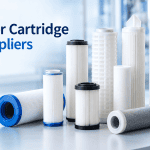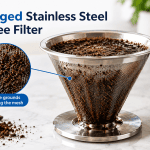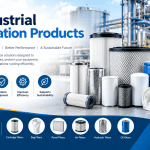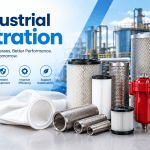
Industrial Filtration Products include many types of components that have been designed specifically to separate solid matter, liquid matter, or gas matter from a fluid stream. To make purchasing decisions easier for those who are just beginning to purchase these types of components, or to manage various suppliers of similar components used in different applications, knowing about the major product categories, how they are made, and what differentiates a component that performs well from a standard component will greatly assist with making better procurement decisions. The following is an explanation of the major product categories of industrial filtration products and what should be evaluated prior to purchasing.
What Counts as an Industrial Filtration Product?
The physical elements used in a manufacturing or processing process to eliminate undesirable particles, contaminants, or impurities from liquids, gasses, or slurries are known as industrial filtration products. Industrial filtration products are made to withstand continuous operation, higher pressure, and frequently harsh chemical or thermal conditions, in contrast to consumer-grade filters intended for light, sporadic use.
Core Categories of Industrial Filtration Products
Filter Core Frames
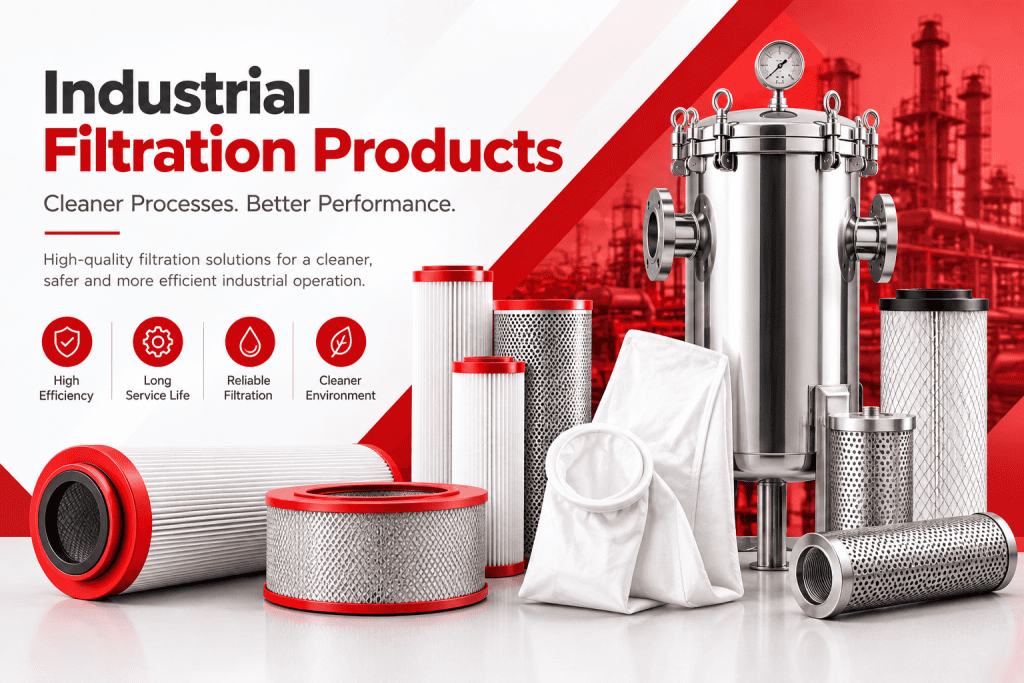
The cartridge filter’s structural framework, which supports the filter media against fluid pressure and keeps it in form. Wire-wound, nozzle, and spiral-welded core frames are common designs that are appropriate for various flow and pressure needs.
Perforated Filter Tube
A hollow cylindrical component with a controlled pattern of holes, used both as a structural support inside filtration assemblies and as a standalone filtration and screening component in oil, water, and chemical processing lines. A perforated tube’s whole size and open-area percentage are engineered specifically for the flow rate and particle retention needed in a given application.
Wire Mesh Filter Baskets
Basket-style structures that hold bag filters or loose filter media in place, commonly used in liquid filtration systems where periodic media replacement is needed without disassembling the entire housing.
Perforated Metal Sheets and Plates
Flat perforated material used in screening, separation, and structural filtration panels, often the raw starting material that gets rolled and welded into perforated tube form, or used flat in panel-style filtration equipment.
How Material Selection Affects Product Performance
Most industrial filtration products are made from stainless steel, chosen for its corrosion resistance and structural durability under continuous operating pressure. Within stainless steel, grade selection matters significantly:
- Grade 304 — general-purpose corrosion resistance, suitable for most water treatment and general industrial applications
- Grade 316 — higher resistance to chlorides and aggressive chemicals, preferred for chemical processing and marine or coastal installations
- Carbon steel — occasionally used in lower-corrosion applications where cost is the primary constraint, though with a shorter expected service life
Choosing the wrong grade for the application is one of the most common, and most expensive, sourcing mistakes, since a product that looks identical on delivery can fail years earlier than expected once exposed to real operating conditions.
Standard vs Custom Industrial Filtration Products
Standard catalog products cover the majority of common applications, but many industrial systems, particularly older equipment or specialized process lines, need custom specifications: non-standard dimensions, unique hole patterns on a perforated tube, or specific micron ratings that don’t match an off-the-shelf part. Working with a manufacturer capable of OEM customization, rather than being restricted to catalog sizes, becomes essential when replacing legacy equipment or designing a new process line around specific flow requirements.
What to Evaluate Before Purchasing
- Material grade certification — confirm the stainless steel grade matches your application’s corrosion and temperature requirements
- Dimensional tolerance — precise fit matters for components that need to seat correctly inside existing housings
- Weld and fabrication quality — particularly on rolled and welded components like perforated tubes, where seam quality determines long-term durability
- Manufacturer vs. reseller — buying directly from a manufacturer that controls its own production typically means tighter quality control than sourcing through a multi-brand reseller
- Customization capability — confirm the supplier can match non-standard specifications if your equipment isn’t built around catalog-standard parts
Why Sourcing Directly From a Manufacturer Matters
When purchasing industrial filtration products from the manufacturer itself as opposed to purchasing through multiple layers of distributors, you will most likely have more control over lead times, receive clearer communication regarding the materials being used in the manufacturing process and be able to ask for customized fabrication if none of the standard parts are suitable for your application. In addition, if a product is underperforming, a direct manufacturing relationship provides a much greater opportunity to identify the specific production run, materials certificate, or fabrication process that produced the part.
FAQs
Whats the difference between a filter core frame and a perforated filter tube?
A filter core frame is specifically designed to sit inside a cartridge filter and support filter media, while a perforated tube can serve that same structural role or function as a standalone filtration and screening component on its own, depending on the application.
How do I know which stainless steel grade my application needs?
It depends primarily on the corrosiveness of the fluid or environment involved, general water treatment typically works fine with grade 304, while chemical processing or high-chloride environments usually require grade 316 for adequate long-term resistance.
Can industrial filtration products be customized for older equipment?
Yes, manufacturers offering OEM customization can typically match legacy dimensions, hole patterns, and specifications even when the original part is no longer a standard catalog item.
Why does buying directly from a manufacturer matter for industrial buyers?
It generally provides tighter quality control, clearer material traceability, and the flexibility to request custom specifications, advantages that are harder to get through a reseller working with multiple unspecified sources.
Final Thoughts
Filtration products used in industry have many variations; they include filter core frames, perforated filter tube assemblies, mesh baskets, and perforated sheet materials, all developed to meet the demands of flow rates, pressure levels, and corrosion resistance.
It is critical to select the correct material grade, maintain tight dimensional tolerances, and produce high-quality fabrications at the beginning of the manufacturing process to ensure that each component will operate efficiently and effectively throughout its lifespan.
Whether you need standard catalog parts or a custom specification built around existing equipment, working with an experienced manufacturer makes that decision considerably easier.
Looking for precision-manufactured industrial filtration products, including custom filter core frames and perforated tubes? Explore our full product range here: https://xintanfilter.com/