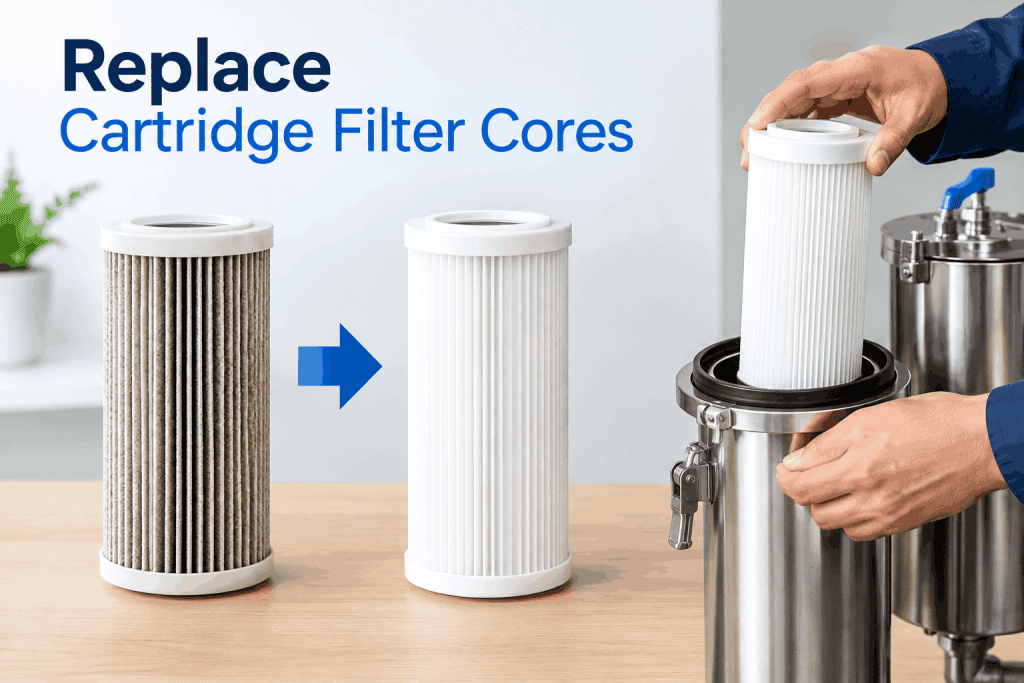
A cartridge filter core rarely fails all at once. Instead, it degrades gradually, flow slows down, pressure creeps up, and filtration quality drifts, until a plant is running on a component well past its useful life without anyone flagging it. For industrial buyers managing oil, water, or chemical filtration systems, knowing exactly when to schedule industrial replacement cartridge filters is the difference between planned, low-cost maintenance and an unplanned shutdown. This guide covers the signs, the timing, and the sourcing decisions that go into getting this right.
What a Cartridge Filter Core Actually Does
The core is the structural skeleton inside a cartridge filter, the frame that holds the filter media in shape and lets it withstand the pressure of fluid flowing through it. Depending on the design, it might be a wire-wound frame, a perforated tube, or a welded mesh structure. While the filter media itself captures particles, the core is what keeps that media from collapsing, tearing, or shifting out of position under continuous operating pressure. When the core degrades, even if the media around it still looks serviceable, filtration performance and system reliability both suffer.
Signs a Cartridge Filter Core Needs Replacing
- A steady rise in differential pressure across the filter housing, even after cleaning
- Visible deformation, bent wire, or bowing in the core’s structural frame
- Cracks or separation at weld points on wire-wound or welded core designs
- Filtered fluid quality declining despite the filter media appearing intact
- More frequent unscheduled cleanings needed just to maintain baseline flow rate
- Corrosion or pitting on the core surface, particularly in chemical or high-moisture environments
How Often Should Cartridge Filter Cores Be Replaced?
There’s no single universal number, replacement intervals depend heavily on the application. A core operating in a heavy-sediment oil extraction line will wear differently than one in a lower-load water treatment system. As a general guide:
- High-contamination industrial processes (oil extraction, heavy chemical processing): every 3 to 6 months, sometimes sooner
- Moderate-load systems (general water treatment, sewage filtration): every 6 to 12 months
- Lower-load or well-maintained systems: 12 months or longer, based on inspection findings rather than a fixed calendar
Rather than relying purely on a calendar, track differential pressure over time. A core that consistently needs cleaning more often than it used to, even when the schedule says it’s not due yet, is signaling that structural wear has begun.
Cleaning vs. Replacing: How to Decide
Not every maintenance cycle requires a full swap. A core with surface contamination but no structural damage can often be cleaned and returned to service, extending its usable life. The distinction comes down to whether the wear is on the surface or in the structure itself:
- Clean it if: contamination is present but the frame, welds, and mesh pattern are intact and undistorted
- Replace it if: there’s visible bending, cracked welds, corrosion pitting, or a mesh pattern that’s stretched out of its original spacing
Continuing to clean a structurally compromised core rather than replacing it is one of the more common ways plants end up with inconsistent filtration performance despite a seemingly proper maintenance schedule.
What to Look for When Sourcing Replacement Cores
Once a core is due for replacement, matching the original specification matters as much as the decision to replace it. A few factors determine whether a replacement performs as well as the original:
Exact Dimensional Match
A replacement core that’s even slightly off in diameter or length can create gaps that let unfiltered fluid bypass the filter media entirely, defeating the purpose of the replacement.
Material Grade Consistency
Stainless steel grade matters for corrosion resistance, particularly in chemical or high-moisture applications. A lower-grade substitute might fit physically but degrade far faster than the original specification called for.
Structural Design Match
Wire-wound, perforated, and welded core designs aren’t interchangeable, each is built for different flow and pressure characteristics. Matching the original design type, not just the general category, keeps performance consistent.
Working With a Cartridge Filter Manufacturer vs. a Generic Supplier
This is where the sourcing decision has real long-term impact. Buying from a dedicated cartridge filter manufacturer that controls its own production, rather than a generic reseller, typically means tighter tolerances, verified material grades, and the ability to get an exact match rather than a close approximation. A manufacturer that also handles custom specifications can produce a core to match legacy equipment even when the original design is no longer a standard catalog item.
By contrast, working through filter cartridge suppliers that resell parts from multiple unspecified sources introduces variability, two orders labeled the same way can come from different production runs with slightly different tolerances. For buyers managing multiple filtration systems across a facility, sourcing from the same cartridge filter industrial manufacturer consistently reduces this variability and simplifies inventory planning.
When evaluating cartridge filters manufacturers for an ongoing supply relationship, ask about material certification, tolerance specifications, and whether they can replicate an existing core exactly, including legacy designs no longer in mainstream production. These are the details that separate a manufacturer built for industrial reliability from one built purely around price.
Building a Replacement Schedule Instead of Reacting to Failures
The most cost-effective approach treats core replacement as scheduled maintenance rather than emergency response. That means logging differential pressure readings at each inspection, tracking how quickly that pressure climbs between cleanings, and flagging cores that show accelerating wear trends before they reach failure. A core that fails during production causes far more disruption, and often more collateral damage to surrounding components, than one replaced during a planned maintenance window.
Frequently Asked Questions
Can a cartridge filter core be repaired instead of replaced?
Minor cleaning can extend a core’s service life, but structural damage like cracked welds or bent framing generally cannot be repaired reliably enough for continued industrial use. Replacement is the safer option once structural wear appears.
Does a replacement core need to come from the original manufacturer?
Not necessarily, but it needs to match the original specification exactly, material grade, dimensions, and structural design. A qualified cartridge filter manufacturer can often replicate a core even if it wasn’t the original supplier, provided they can verify the specification.
How do I know if my system needs a custom core instead of a standard one?
If your equipment is older, uses non-standard dimensions, or was built around a design that’s no longer in common production, a standard catalog core likely won’t fit. This is where working with a manufacturer that offers custom fabrication becomes necessary rather than optional.
What happens if a worn core is not replaced in time?
Beyond declining filtration quality, a structurally failing core can shed debris into the fluid stream, potentially damaging pumps and downstream equipment, turning a routine replacement into a much larger repair.
Final Thoughts
Knowing when to replace a cartridge filter core comes down to watching the right signals, rising differential pressure, structural deformation, and declining filtration consistency, rather than waiting for outright failure. Just as important is where the replacement comes from: an exact match in dimensions, material grade, and structural design keeps performance consistent, while a generic near-fit quietly compounds problems over time.
If your facility is due for a core replacement or needs a custom specification matched to legacy equipment, work with a manufacturer that builds precision industrial filter components to exact tolerances.
Get a quote or explore filtration components at: https://xintanfilter.com/