Every industrial perforated tube eventually reaches the end of its useful service life. Corrosion, clogging, deformation, cracking, abrasion, and general wear all take a toll over time, gradually reducing flow, filtration efficiency, and structural integrity. The question most maintenance teams eventually face isn’t whether a tube will need attention, it’s when to replace perforated tube components rather than continuing to repair or clean them.
Continuing to run a severely damaged tube can quietly increase maintenance costs, reduce system efficiency, and raise the risk of unplanned downtime. In some cases, it can also introduce safety concerns. Deciding when to replace a perforated tube isn’t just about age it depends on the tube’s current condition, the operating environment it’s working in, safety requirements, and how much its performance has actually declined.
This guide breaks down the warning signs that indicate replacement is the right call, how to weigh repair against replacement, and what to consider when selecting a new tube.
How Long Do Perforated Tubes Typically Last?
There’s no single, universal lifespan that applies to every perforated tube. How long a tube lasts depends on a combination of factors, including:
- The tube material
- The operating environment
- Operating temperature
- System pressure
- Chemical exposure
- Abrasion from particles or media
- Cleaning frequency and method
- Overall maintenance practices
- The specific application
A stainless steel perforated tube in a mild, well-maintained environment may perform reliably for a long time, while a similar tube exposed to harsh chemicals, high abrasion, or inconsistent maintenance may need replacement much sooner. Rather than relying on a fixed timeline, it’s more effective to monitor tube condition directly and make decisions based on what the tube is actually showing.
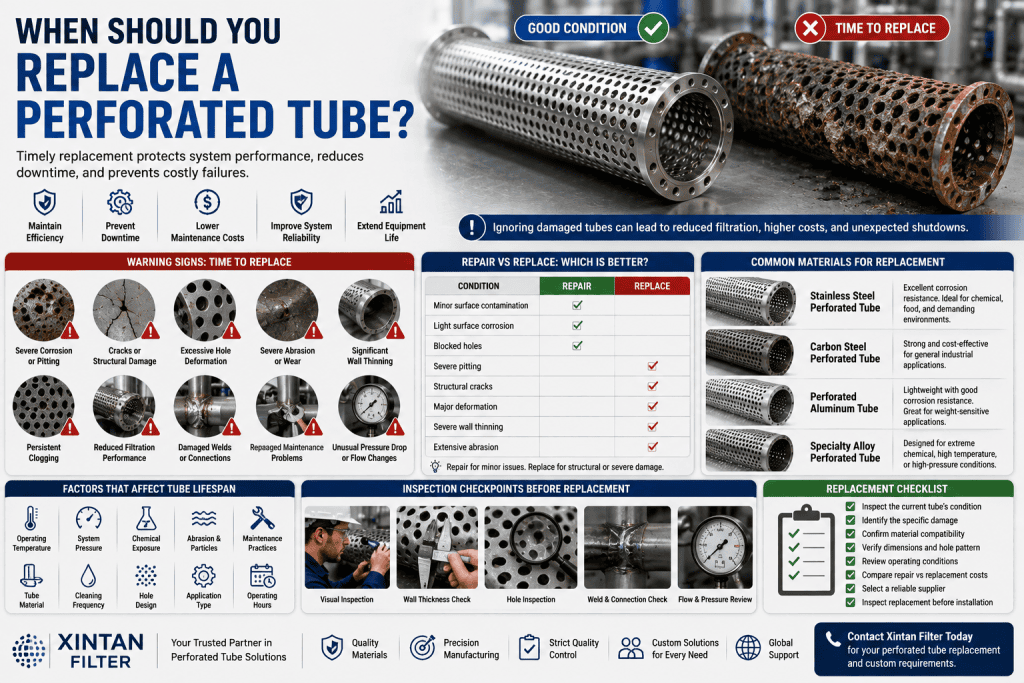
Signs That You Should Replace a Perforated Tube
Certain signs indicate that a tube has moved past the point where cleaning or minor repair will restore reliable performance.
Severe Corrosion or Pitting
Corrosion that has progressed beyond surface discoloration particularly pitting corrosion can significantly weaken a tube’s structure. Once corrosion has compromised the material at a structural level, cleaning won’t resolve the underlying problem, and replacement becomes the safer option.
Cracks or Structural Damage
Cracks, fractures, and fatigue-related damage are serious warning signs. These typically indicate the tube has been under repeated stress beyond what the material or design was intended to handle, and they generally cannot be reliably repaired for continued safe use.
Excessive Hole Deformation
When perforations become significantly distorted from their original shape, flow patterns and filtration performance suffer. Minor deformation may be tolerable in some applications, but excessive distortion usually means the tube is no longer performing as designed.
Severe Abrasion or Wear
Tubes exposed to abrasive particles, slurry, or repeated mechanical contact can wear down over time, thinning the material and enlarging perforations beyond their intended dimensions. Once wear reaches a significant level, structural reliability becomes a concern.
Significant Wall Thinning
Wall thickness is directly tied to a tube’s structural strength. When thinning becomes significant whether from corrosion, abrasion, or both the tube’s ability to handle normal operating pressure and stress is compromised.
Persistent Clogging
Occasional blockage is normal and usually resolved through cleaning. But when clogging becomes a recurring problem despite regular maintenance, it may indicate that the tube’s perforations have been permanently altered or damaged, making cleaning no longer an effective long-term solution.
Reduced Filtration Performance
Noticeable changes in flow rate, pressure drop, or particle separation efficiency often point to underlying tube damage even when the tube looks acceptable on the surface. These performance changes shouldn’t be ignored, since they usually reflect real degradation.
Damaged Welds or Connections
Welds and connection points are common failure areas. Depending on the application and how critical the connection is, damaged welds may be repairable, but in many cases particularly in high-pressure or safety-critical systems replacement is the more reliable choice.
Repeated Maintenance Problems
When a tube requires frequent repairs, repeated cleaning cycles, or ongoing attention just to maintain baseline performance, the cumulative cost of that maintenance can exceed the cost of replacement. At that point, replacement often becomes the more economical decision.
Repair vs Replace: Which Is Better?
Deciding between repair and replacement depends on the type and severity of the damage. The table below offers general guidance.
| Condition | Repair | Replacement |
| Minor surface contamination | ✓ | |
| Light surface corrosion | ✓ | |
| Blocked holes | ✓ | |
| Severe pitting | ✓ | |
| Structural cracks | ✓ | |
| Major deformation | ✓ | |
| Severe wall thinning | ✓ | |
| Extensive abrasion | ✓ |
This table offers general guidance, not a strict rule. The right decision ultimately depends on the specific application, safety requirements, and a professional inspection of the tube’s actual condition.
How Corrosion Affects Replacement Decisions
Corrosion is one of the most common reasons perforated tubes need replacement, but not all corrosion is equally serious. Several types can affect a tube differently:
- Surface rust — often cosmetic in early stages, but worth monitoring
- Pitting corrosion — localized and can weaken material faster than uniform corrosion
- Chemical corrosion — results from exposure to incompatible chemicals in the process
- Galvanic corrosion — occurs when dissimilar metals interact in the presence of an electrolyte
- Wall thinning — a common consequence of ongoing corrosion that reduces structural strength
- Corrosion around welds — welds can be more vulnerable to corrosion than the surrounding material
For environments where corrosion is a persistent challenge, specifying a corrosion resistant perforated tube for the replacement can reduce how often this issue arises in the future.
How to Inspect a Perforated Tube Before Replacement
A thorough inspection helps confirm whether replacement is truly necessary and provides useful information for specifying the new tube. A complete inspection typically includes:
- Visual inspection for obvious surface damage or deformation
- Hole inspection to check for blockage, distortion, or enlargement
- Surface inspection for corrosion, pitting, or discoloration
- Wall thickness checks to assess structural condition
- Weld inspection to identify cracking or fatigue at connection points
- Flow performance review to detect efficiency losses
- Pressure performance review to identify unusual pressure drops
- Corrosion assessment to determine severity and likely cause
For critical industrial systems, professional inspection or non-destructive testing may be warranted to confirm the tube’s condition before making a final replacement decision.
How to Choose a Replacement Perforated Tube
Selecting a replacement tube is an opportunity to correct any shortcomings in the original design rather than simply duplicating it. Key specifications to review include:
- Material grade
- Tube diameter
- Wall thickness
- Tube length
- Hole diameter
- Hole pattern
- Open area
- Surface finish
- Operating temperature
- System pressure
- Chemical environment
If the original tube’s design wasn’t well suited to the actual operating conditions, simply replacing it with an identical part may lead to the same problems recurring. A replacement should be matched to the real-world application not just the original specification.
Common Materials for Replacement Perforated Tubes
Stainless Steel Perforated Tube
Commonly selected for applications requiring strong corrosion resistance and durability, including food processing, chemical handling, and other demanding environments.
Carbon Steel Perforated Tube
Often used where high corrosion resistance isn’t the primary concern, offering a balance of strength and cost efficiency for suitable applications.
Perforated Aluminum Tube
A lighter-weight option that still provides reasonable corrosion resistance, useful in applications where weight is a meaningful design factor.
Specialty Alloy Perforated Tube
Selected for particularly demanding chemical, thermal, or pressure conditions where standard materials may not hold up as well.
How Proper Maintenance Can Delay Replacement
While every tube eventually reaches the end of its service life, consistent maintenance can meaningfully extend how long that takes. Regular attention to the following can help:
- Cleaning
- Inspection
- Corrosion prevention
- Flow monitoring
- Pressure monitoring
- Proper storage
- Preventive maintenance overall
For a closer look at maintenance practices that help delay replacement, see our guide on [Extending the Lifespan of Industrial Perforated Tubes].
When Should You Contact a Perforated Tube Manufacturer?
Certain situations call for direct input from an experienced perforated tube manufacturer rather than sourcing a generic replacement. Consider reaching out when you need:
- A custom replacement tube built to specific requirements
- Guidance on material selection for a challenging environment
- Unusual dimensions that don’t match standard sizing
- A revised hole pattern to improve performance
- Better filtration performance than the original design delivered
- A tube built to meet corrosion-resistant requirements
- A solution tailored to OEM application requirements
A knowledgeable perforated tube supplier can help ensure the replacement whether a standard part or a custom perforated tube is properly matched to your system from the start.
Replacement Checklist
Use this checklist to guide the replacement decision and process:
- [ ] Inspect the current tube’s condition
- [ ] Identify the specific damage present
- [ ] Determine the root cause of the damage
- [ ] Check material compatibility with the application
- [ ] Confirm required dimensions
- [ ] Confirm the required hole pattern
- [ ] Confirm the required open area
- [ ] Review current operating conditions
- [ ] Compare repair costs against replacement costs
- [ ] Select a suitable, experienced supplier
- [ ] Inspect the replacement tube before installation
Frequently Asked Questions
- When should you replace a perforated tube?
Replacement is generally warranted when a tube shows severe corrosion, structural cracks, significant wall thinning, excessive hole deformation, or performance issues that cleaning and repair can no longer resolve.
- How do I know if my perforated tube is damaged?
Look for visible corrosion, deformed or blocked perforations, cracks, wall thinning, changes in flow or pressure performance, and damaged welds during routine inspection.
- Can a corroded perforated tube be repaired?
Light surface corrosion may sometimes be addressed through cleaning and protective measures, but severe pitting or structural corrosion typically requires replacement rather than repair.
- How long does a perforated tube last?
There’s no universal lifespan. Service life depends on the material, operating environment, temperature, pressure, chemical exposure, and how consistently the tube is maintained.
- What causes perforated tubes to fail?
Common causes include corrosion, clogging, abrasion, mechanical damage, incorrect installation, and cumulative wear from ongoing operating conditions.
- Can clogged perforated tubes be reused?
Often, yes, if the clogging can be resolved through appropriate cleaning. However, if blockage is persistent and recurring despite regular cleaning, the underlying tube damage may require replacement instead.
- What material is best for replacement tubes?
It depends on the application. Stainless steel, carbon steel, aluminum, and specialty alloys each suit different combinations of corrosion exposure, temperature, and chemical environment.
- How do I order a custom replacement perforated tube?
Start by reviewing your operating conditions and required specifications, then contact an experienced perforated tube manufacturer who can help confirm material, dimensions, hole pattern, and other design details.
Conclusion
Recognizing the right time to replace a perforated tube comes down to reading the warning signs clearly: severe corrosion, structural cracks, significant wall thinning, excessive hole deformation, extensive abrasion, reduced filtration performance, and repeated maintenance problems all point toward replacement rather than continued repair.
Replacing a damaged perforated tube at the right time helps prevent unexpected downtime, protects overall filtration system performance, and often proves more cost-effective than continuing to maintain a tube that’s past its useful service life.
Contact Xintan Filter to discuss your perforated tube replacement requirements, custom specifications, material selection, and industrial filtration applications.