Understanding perforated tube price is essential for procurement managers, engineers, OEM manufacturers, and industrial buyers planning a purchase. Pricing isn’t a single fixed number — it shifts based on material, dimensions, perforation design, manufacturing process, order quantity, and finishing requirements.
Choosing the lowest quoted price doesn’t always deliver the best long-term value. A cheaper tube with the wrong material or looser tolerances can lead to premature failure, costly downtime, or expensive rework. This guide breaks down every factor that influences perforated tube cost so you can request accurate quotes and make a confident purchasing decision.
What Is a Perforated Tube?
A perforated tube is a hollow metal tube with a pattern of holes or slots cut into its surface, used for filtration, structural support, or controlled flow applications.
Manufacturing overview: Perforated tubes start as flat sheet metal or pre-formed tube stock, which is punched, laser-cut, or drilled before being rolled, welded, and finished.
Common industrial applications: These tubes support filtration systems, dust collection units, exhaust components, screening equipment, and structural assemblies across multiple industries.
Why pricing varies between products: Two tubes that look similar can carry very different price tags depending on material grade, hole pattern complexity, tolerances, and finishing requirements.
What Factors Affect Perforated Tube Price?
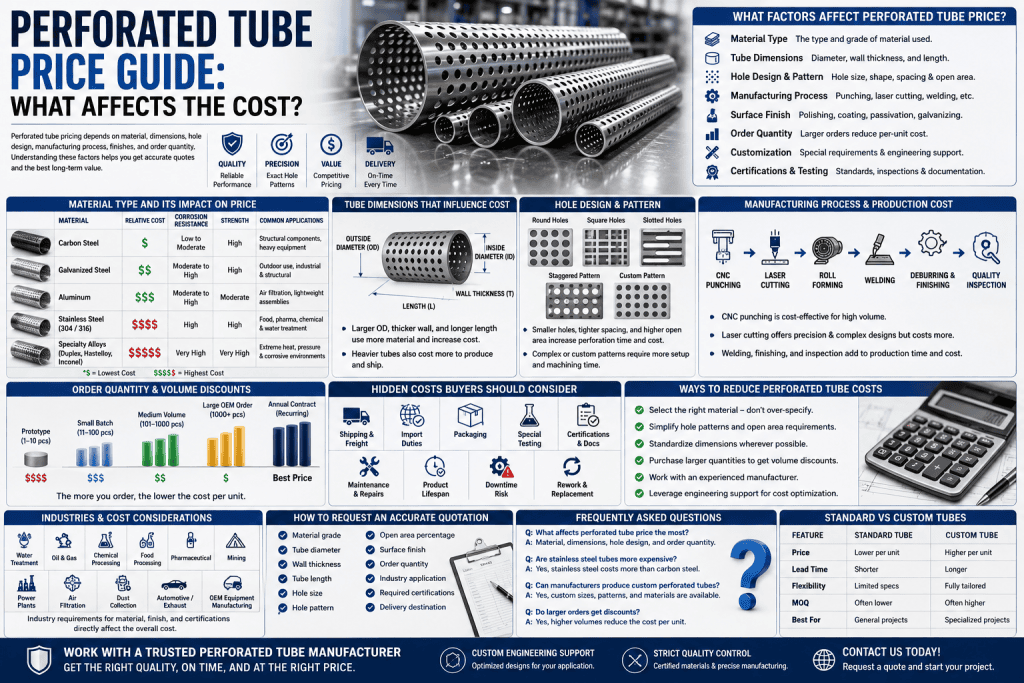
Perforated tube pricing is shaped by several interacting variables: the base material, tube dimensions, perforation design, manufacturing process, surface finish, order quantity, and any customization required. Understanding each factor helps you identify where costs can be optimized without compromising performance. The sections below break down exactly how each variable moves the final price.
Material Type and Its Impact on Price
Stainless Steel Perforated Tube
Stainless steel offers strong corrosion resistance and hygienic properties, placing it in the mid-to-upper price range depending on the grade selected.
Carbon Steel Perforated Tube
Carbon steel is typically the most cost-effective option, offering good strength for structural applications where corrosion resistance isn’t the top priority.
Perforated Aluminum Tube
Aluminum sits in a moderate price range, valued for its light weight and natural corrosion resistance in air filtration and low-load applications.
Galvanized Steel Perforated Tube
Galvanized steel costs more than bare carbon steel due to the added zinc coating process, but less than stainless steel, while offering solid corrosion protection.
Specialty Alloys (Duplex, Hastelloy, Inconel)
Specialty alloys carry the highest price point, reserved for extreme environments involving high heat, high pressure, or highly corrosive chemicals.
| Material | Relative Cost | Corrosion Resistance | Strength | Common Applications |
| Carbon Steel | Lowest | Low to moderate | High | Structural components, heavy equipment |
| Stainless Steel | Moderate to high | High | High | Food, pharmaceutical, chemical filtration |
| Aluminum | Moderate | Moderate to high | Moderate | Air filtration, lightweight assemblies |
| Galvanized Steel | Low to moderate | Moderate to high | High | Outdoor structural and industrial use |
| Specialty Alloys | Highest | Very high | Very high | Extreme heat, pressure, or chemical exposure |
Tube Dimensions That Influence Cost
Outside Diameter: Larger diameters require more raw material and often more processing time, increasing overall cost.
Inside Diameter: Affects wall thickness calculations and how much material is needed relative to the tube’s structural requirements.
Tube Length: Longer tubes use more material and may require additional handling during perforation and welding.
Wall Thickness: Thicker walls increase material cost and can slow down punching or cutting speed, adding to production time.
Weight: Heavier tubes cost more to produce, ship, and handle, which factors into both manufacturing and logistics pricing.
Larger and thicker tubes generally cost more simply because they consume more raw material and take longer to process through each manufacturing stage.
Hole Design and Perforation Pattern
Round Holes
Round holes are the most common and typically the most cost-effective pattern to produce using standard punching or laser equipment.
Square Holes
Square holes often require more precise tooling or laser cutting, which can add modest cost compared to round patterns.
Slotted Holes
Slotted perforations are useful for directional flow control but may take longer to cut, particularly at higher precision levels.
Decorative Patterns
Decorative or architectural patterns typically involve more complex, non-uniform designs that increase both design time and cutting time.
Custom Hole Designs
Fully custom patterns, especially those combining multiple hole shapes or unusual spacing, generally command the highest perforation costs.
Hole diameter: Smaller, tightly toleranced holes require more precise (and often slower) manufacturing processes.
Hole spacing: Denser hole spacing increases the number of cuts needed, extending production time.
Open area percentage: Higher open area often means more perforations per square inch, which can increase both cutting time and structural reinforcement needs.
Pattern complexity: Irregular or multi-shape patterns take longer to program and cut than simple, repeating patterns.
Manufacturing Process and Production Cost
CNC Punching: Cost-effective for high-volume runs with standard hole patterns, thanks to fast, repeatable tooling cycles.
Laser Cutting: Offers higher precision and design flexibility but generally costs more per unit than punching, especially for large orders.
Roll Forming: Shapes perforated sheet into tube form; more complex diameters or wall thicknesses add processing time and cost.
Welding: Seam welding adds labor and quality-control time, with cost varying based on weld type and required strength.
Deburring: Removing sharp edges after perforation adds a secondary processing step that affects both cost and lead time.
Quality Inspection: More rigorous inspection protocols, especially for regulated industries, add cost but reduce the risk of downstream failures.
Each of these processes contributes to the final price differently depending on order volume, complexity, and required precision.
Surface Finish and Secondary Processing
Mill Finish: The most basic and cost-effective finish, suitable for applications where appearance and extra corrosion protection aren’t priorities.
Polished Finish: Adds cost through additional labor but improves appearance and can support easier cleaning in hygienic applications.
Electropolishing: A more advanced and costly process that improves corrosion resistance and creates an ultra-smooth surface, often used in pharmaceutical or food-grade applications.
Passivation: Adds a modest cost but significantly improves the corrosion resistance of stainless steel components.
Galvanizing: Adds cost through the zinc coating process but extends service life in outdoor or humid environments.
Powder Coating: Increases cost through an additional coating step but improves both appearance and surface protection.
Additional finishing steps raise upfront production costs but often extend service life and reduce long-term maintenance expenses.
Custom vs Standard Perforated Tubes
| Feature | Standard Tube | Custom Tube |
| Price | Lower per unit | Higher per unit |
| Lead Time | Shorter | Longer |
| Flexibility | Limited to existing specs | Fully tailored to project needs |
| MOQ | Often lower | Often higher |
| Applications | General-purpose projects | Specialized or performance-critical projects |
Custom manufacturing offers better long-term value when your application has specific performance requirements such as unique flow rates, tight tolerances, or unusual dimensions that standard tubes can’t meet.
Order Quantity and Volume Discounts
Prototype orders: Typically carry the highest per-unit cost due to setup time relative to the small quantity produced.
Small batches: Still carry a cost premium but benefit slightly from reduced setup-to-output ratio compared to prototypes.
Medium-volume production: Begins to unlock more favorable per-unit pricing as setup costs are spread across a larger run.
Large OEM orders: Typically achieve the best per-unit pricing due to economies of scale and production efficiency.
Annual contracts: Can secure the most favorable long-term pricing by giving manufacturers predictable, recurring volume to plan around.
Economies of scale mean that unit price generally drops as order volume increases, since fixed setup costs are spread across more units.
Industry Applications and Cost Considerations
Water Treatment
Filtration components often require specific open area ratios and corrosion-resistant materials, which can affect pricing.
Oil & Gas
Downhole and process equipment applications often demand specialty alloys and strict certifications, increasing cost.
Chemical Processing
Corrosive environments often require higher-grade stainless steel or specialty alloys, raising material costs.
Food Processing
Hygienic finishing requirements, such as polishing or electropolishing, add to production cost.
Pharmaceutical Manufacturing
Strict cleanliness and documentation requirements can increase both material and certification-related costs.
Mining
Heavy-duty applications often prioritize strength and durability over premium finishes, which can moderate costs.
Power Plants
Applications involving high heat or pressure may require specialty materials, increasing overall price.
Air Filtration
Lightweight materials like aluminum are common, often keeping costs moderate compared to heavier alloys.
Dust Collection
Standard carbon steel or galvanized options are common, generally keeping this application on the more affordable end.
OEM Equipment Manufacturing
Custom specifications tailored to specific equipment designs often increase cost due to non-standard dimensions and patterns.
Pricing requirements vary by industry because each application prioritizes different combinations of material strength, corrosion resistance, hygiene, and certification requirements.
Hidden Costs Buyers Should Consider
Shipping: Weight and dimensions affect freight cost, especially for international orders.
Import Duties: Cross-border purchases may incur tariffs that add to the total landed cost.
Packaging: Protective packaging for long-distance shipping can add a modest cost, particularly for delicate finishes.
Quality Inspections: Additional inspection requests beyond standard checks may carry added fees.
Testing: Specialized testing, such as pressure or flow testing, adds cost but reduces risk of field failure.
Certifications: Material Test Certificates and compliance documentation may involve added administrative costs.
Maintenance Costs: Lower-quality tubes may require more frequent maintenance or replacement over time.
Product Lifespan: A cheaper tube with a shorter service life can cost more over time than a higher-quality alternative.
Downtime Due to Poor Quality: Production delays from tube failure often cost far more than the price difference between a quality and budget option.
Total cost of ownership not just the initial purchase price should guide your final purchasing decision.
How to Reduce Perforated Tube Costs Without Sacrificing Quality
Select the correct material: Avoid over-specifying expensive alloys when a more moderate material meets your actual performance needs.
Optimize hole patterns: Simpler, more uniform patterns are faster and cheaper to produce than highly complex custom designs.
Standardize dimensions: Using common diameters and lengths where possible avoids the added cost of fully custom tooling.
Purchase larger quantities: Consolidating orders into larger batches takes advantage of volume-based pricing.
Choose experienced manufacturers: Established manufacturers often have more efficient processes, translating to better pricing without sacrificing quality.
Request engineering support: A manufacturer’s engineering team can often suggest cost-saving design adjustments you might not have considered.
Reduce unnecessary customizations: Every non-standard requirement adds cost — evaluate whether each customization is truly necessary for performance.
How to Request an Accurate Perforated Tube Quotation
- [ ] Material grade
- [ ] Tube diameter
- [ ] Wall thickness
- [ ] Tube length
- [ ] Hole size
- [ ] Hole pattern
- [ ] Open area percentage
- [ ] Surface finish
- [ ] Order quantity
- [ ] Industry application
- [ ] Required certifications
- [ ] Delivery destination
Providing complete specifications upfront helps manufacturers deliver accurate quotes faster and reduces the risk of costly revisions later.
Frequently Asked Questions
What affects perforated tube price the most?
Material choice, tube dimensions, and hole pattern complexity typically have the largest impact on final pricing.
Which material is the most cost-effective?
Carbon steel is usually the most cost-effective option for applications that don’t require high corrosion resistance.
Are stainless steel perforated tubes more expensive than carbon steel?
Yes, stainless steel typically costs more than carbon steel due to its higher alloy content and corrosion resistance.
Does custom manufacturing increase the price?
Yes, custom tubes generally cost more per unit than standard tubes due to specialized tooling and setup requirements.
How does order quantity affect pricing?
Larger orders typically reduce per-unit cost by spreading fixed setup costs across more units.
What information is needed for a quotation?
Manufacturers typically need material grade, dimensions, hole specifications, quantity, and any required certifications to provide an accurate quote.
How can I reduce manufacturing costs?
Standardizing dimensions, simplifying hole patterns, and ordering larger quantities are among the most effective ways to lower costs.
Do surface finishes affect price?
Yes, finishes like electropolishing or galvanizing add cost but can improve corrosion resistance and extend service life.
What industries require premium perforated tubes?
Pharmaceutical, chemical processing, and oil and gas industries often require premium materials and finishes due to strict performance and safety requirements.
How do I compare quotations from different suppliers?
Compare quotes based on identical specifications, including material grade, tolerances, certifications, and lead time, rather than price alone.
Conclusion
Perforated tube price depends on far more than the cost of raw material. Material grade, dimensions, hole design, manufacturing process, surface finish, order quantity, and hidden costs like shipping and certifications all shape the final price.
Buyers who evaluate these factors together rather than focusing on the lowest quote are better positioned to choose a tube that performs reliably over its full service life. Contact a trusted perforated tube manufacturer today for a customized quotation, engineering consultation, and cost-effective solutions tailored to your project’s exact specifications.