A stainless steel fuel filter is designed to trap dirt, sediment, rust particles, and other debris before they reach an engine or fuel system component. Because stainless steel mesh is durable and corrosion-resistant, many of these filters are built to be cleaned and reused rather than thrown away after a single use. That said, learning how to clean a stainless steel fuel filter the right way matters done carelessly, cleaning can damage fine mesh, leave behind residue, or give a false sense of confidence in a filter that should actually be replaced. This guide walks through what these filters do, whether yours is actually meant to be cleaned, and a safe, general step-by-step process while pointing you back to your specific filter manufacturer’s instructions at every stage that matters.
Quick Answer: How to Clean a Stainless Steel Fuel Filter
In general terms, cleaning a reusable stainless steel fuel filter involves safely shutting down and isolating the fuel system, removing the filter, properly containing any residual fuel, inspecting the element for damage, cleaning it using a method approved by the filter’s manufacturer, letting it dry fully, inspecting it again, and reinstalling it correctly. If the filter is disposable, damaged, or its structural integrity can’t be confirmed after cleaning, replace it instead of reusing it.
What Is a Stainless Steel Fuel Filter?
A fuel filter’s job is simple: catch contaminants in the fuel before they reach sensitive components like injectors, carburetors, or pumps. It does this by forcing fuel through a filter media in this case, a stainless steel mesh or sintered element fine enough to physically trap particles while letting fuel pass through.
Stainless steel is a popular choice for filter media because it resists corrosion, holds up under repeated use, and depending on the mesh weave or micron rating can trap very fine contaminants. Because it’s a durable metal rather than a paper or fiber element, many stainless steel filters are marketed as reusable filters, designed to be periodically removed, cleaned, and put back into service instead of discarded.
Stainless steel fuel filters show up across a range of applications, including:
- Automotive fuel systems, both fuel-injected and carbureted setups
- Diesel systems, where fuel quality and sediment can vary significantly
- Industrial equipment, including generators, pumps, and stationary engines
- Marine applications, where moisture and corrosion resistance are especially important
- Fuel transfer systems, used when moving fuel between tanks or storage containers
Not every stainless steel filter is built the same way, and not every one is rated for every fuel type. Some are designed specifically for gasoline, others for diesel, and some for lower-pressure transfer applications rather than direct engine feed. Before cleaning or reusing any filter, confirm it’s actually approved for your specific fuel type and system.
Why Do Stainless Steel Fuel Filters Need Cleaning?
Every time fuel passes through the filter, it leaves behind whatever the mesh is designed to catch. Over time, that can include:
- Dirt and dust that entered the fuel system
- Sediment from fuel tanks or storage containers
- Rust particles, especially in older tanks or steel fuel lines
- Fine metal debris from wear elsewhere in the system
- General fuel-system contaminants that build up with normal use
As these particles accumulate on and in the mesh, they can begin to restrict fuel flow. That’s the whole point of a filter, but too much buildup creates its own problems including increased pressure drop across the filter, reduced filtration performance, and in some cases, a noticeable drop in engine or equipment performance. This is why periodic inspection and, where appropriate, cleaning is part of routine fuel filter maintenance.
It’s worth being clear about one thing: cleaning a filter reduces buildup, but it doesn’t always restore the filter to like-new condition. A filter that’s been cleaned several times, or one with mesh that’s been stretched, clogged, or subtly damaged, may not filter as effectively as it did when new even if it looks clean.
Can a Stainless Steel Fuel Filter Be Cleaned and Reused?
This depends entirely on the specific filter and how it was designed.
- Some stainless steel mesh filters are explicitly built for cleaning and reuse. These are typically marketed as reusable elements, and the manufacturer usually provides or can be asked to provide cleaning guidance.
- Some fuel filters, even ones with a metal housing, use a disposable internal element. In that case, the housing might be reusable but the actual filter media inside is not designed to be cleaned.
- Filter construction and application affect the right cleaning approach. A coarse, heavy-duty pre-filter mesh can typically tolerate more handling than a fine micron-rated element used for precision filtration.
- A damaged filter should generally be replaced, not cleaned. Cleaning cannot repair torn mesh, corrosion, or structural damage it can only remove contamination from a filter that’s otherwise intact.
The single most reliable way to know whether your filter is reusable is to check the manufacturer’s documentation or product listing. If you’re unsure, treat the filter as disposable rather than risk reinstalling a compromised element into your fuel system.
What You Need Before Cleaning a Stainless Steel Fuel Filter
Before you start, gather the following:
- The filter manufacturer’s cleaning instructions, if available
- Appropriate PPE (gloves and eye protection, at minimum)
- A suitable, sealable container for residual fuel
- A cleaning solution or solvent confirmed to be compatible with your filter and fuel type don’t substitute something untested
- A soft-bristle brush
- Non-abrasive cleaning tools (nothing sharp or metal-on-metal)
- A clean, well-ventilated workspace, away from ignition sources
- Replacement seals or O-rings, in case the originals are damaged during removal
Don’t assume a single “universal” cleaning solvent works for every stainless steel fuel filter. Compatibility depends on the filter’s construction, any coatings used, and the fuel type it’s rated for check with the manufacturer if this isn’t specified on the product itself.
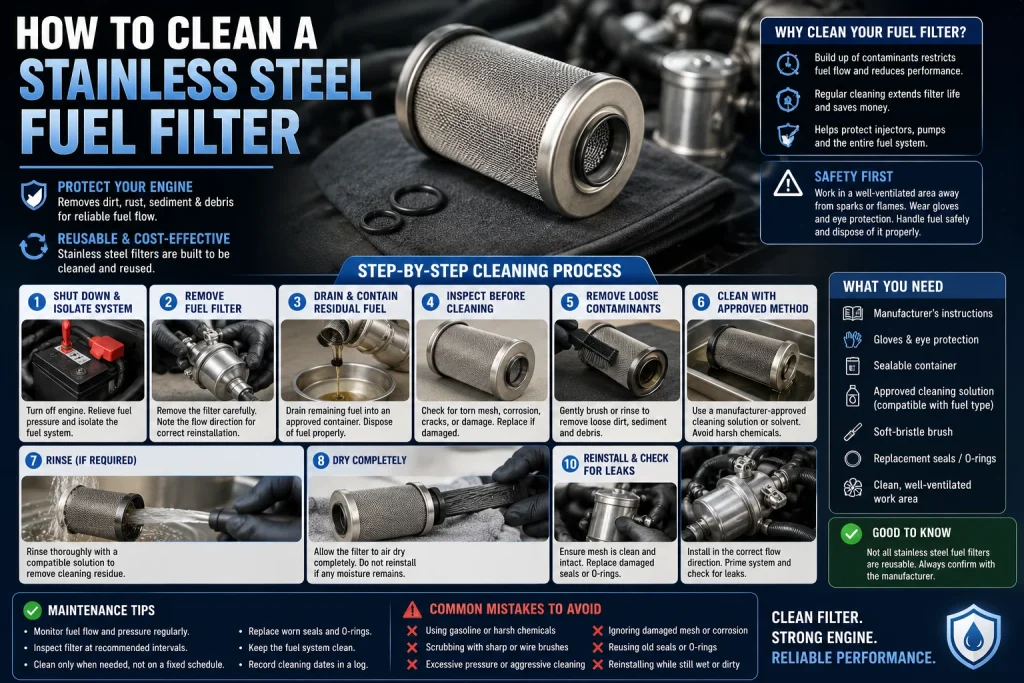
How to Clean a Stainless Steel Fuel Filter Step by Step
Step 1: Shut Down and Isolate the Fuel System
Turn off the engine or equipment completely before doing anything else. Follow your specific fuel system’s isolation procedure, and relieve any fuel pressure according to the manufacturer’s instructions before disconnecting anything. Fuel systems can contain flammable liquid and, in many designs, pressurized fuel treat both as real hazards, and don’t rush this step.
Step 2: Remove the Fuel Filter
Follow the removal instructions for your specific equipment or filter housing. Take note of the filter’s orientation and flow direction before pulling it out, since it will need to go back in the same way. Keep the surrounding area clean to avoid introducing new dirt into the fuel system, and handle any seals or O-rings carefully they’re often reused or need to be replaced with the correct replacement part.
Step 3: Drain and Contain Residual Fuel
There will typically be some residual fuel in the filter and housing. Drain it into an appropriate, sealed container rather than letting it spill. Handle and dispose of that fuel according to your local safety and environmental regulations. Never pour fuel onto the ground or down a drain.
Step 4: Inspect the Filter Before Cleaning
Before you clean anything, take a close look at the filter itself. Check for:
- Torn or damaged mesh
- Holes or enlarged mesh openings
- Visible corrosion
- Broken welds or seams
- Deformation of the filter body
- Damaged end caps
- Contamination that appears unusually heavy or unusual in color
Cleaning removes contamination and doesn’t repair structural damage. If you spot torn mesh, corrosion, or broken welds at this stage, the filter should generally be replaced rather than cleaned and reinstalled.
Step 5: Remove Loose Contaminants
Start by gently removing whatever loose material you can dirt, sediment, or rust particles that aren’t bonded to the mesh. Light brushing or a gentle rinse can dislodge this without needing a more aggressive cleaning method later. Avoid scraping the mesh with anything sharp, since that can distort or tear fine mesh openings.
Step 6: Clean the Filter Using an Approved Method
This is the step where the correct approach depends most heavily on your specific filter and its manufacturer’s guidance. Depending on the product, approved methods may include:
- A solvent confirmed compatible with the filter material and fuel type
- Soaking in an approved cleaning solution
- Gentle brushing with a soft, non-abrasive brush
- Ultrasonic cleaning, where the equipment and filter design support it
- Controlled backwashing, spraying cleaner through the element in the reverse of normal fuel flow
- Other methods specifically approved by the manufacturer
None of these methods should be treated as universally appropriate for every filter what works for one mesh weave or coating may not be suitable for another. Never use gasoline or another fuel as a cleaning solvent. It’s flammable, doesn’t reliably remove all contamination, and introduces unnecessary fire risk.
Step 7: Rinse the Filter if Required
If your cleaning method leaves residue behind, rinse the filter using a rinse medium confirmed compatible with both the filter and the cleaning product used. Follow the manufacturer’s guidance closely here, and take care not to reintroduce contamination during the rinse use a clean container and clean rinse medium.
Step 8: Dry the Filter Appropriately
How you dry the filter depends on its construction and what the manufacturer recommends. Avoid exposing the filter to excessive heat, which can affect stainless steel finishes or any coatings on the element. Most importantly, don’t reinstall the filter if there’s any chance residual cleaning fluid remains inside it that fluid could contaminate the fuel system once the equipment is back in operation.
Step 9: Inspect the Filter Again
Once the filter is clean and dry, inspect it a second time. Check:
- Mesh integrity and openings
- The filter frame and body
- Welds and seams
- Seals and gaskets
- Any signs of corrosion
- Whether contamination has actually been removed
If the filter still appears blocked, damaged, or you can’t confirm it’s back to a usable condition, it’s safer to replace it or have it evaluated by a professional than to reinstall it and hope for the best.
Step 10: Reinstall the Filter
Replace any seals or O-rings that show wear or damage rather than reusing questionable ones. Install the filter in the correct flow direction reversing it can significantly reduce filtration effectiveness or restrict flow entirely. Secure all connections properly, and follow the manufacturer’s torque or assembly specifications where they’re provided. Prime the fuel system according to your equipment’s instructions, and check carefully for leaks before returning the vehicle or equipment to normal operation.
How to Clean a Stainless Steel Mesh Fuel Filter
Fine stainless steel mesh needs a gentler touch than a heavier-duty pre-filter screen. A few specific considerations:
- Avoid sharp tools. Anything with an edge can snag or tear fine mesh strands.
- Avoid aggressive wire brushes. These can distort mesh openings or scratch the surface.
- Avoid excessive pressure, whether from a brush, a rinse stream, or compressed air too much force can stretch or deform delicate mesh.
- Protect mesh openings from deformation. Even mild bending or crushing can change the effective micron rating of the filter.
- Use the manufacturer’s recommended cleaning direction and pressure, where they’re specified cleaning against the normal flow direction is common for dislodging trapped particles, but only when the manufacturer confirms it’s appropriate for that filter.
Even small, seemingly minor changes to mesh openings can measurably affect how well the filter performs afterward. A mesh filter that looks visually clean but has been stretched or crushed in places may no longer filter to its original specification.
How to Remove Rust and Sediment From a Stainless Steel Fuel Filter
Rust and sediment are two of the most common things people are trying to clean off a stainless steel fuel filter, but they don’t always respond to the same treatment.
- Identify whether contamination is loose or bonded. Loose sediment often comes off with gentle brushing or rinsing. Rust or bonded deposits usually need a cleaning method specifically suited to that type of contamination.
- Use an approved cleaning process based on your filter manufacturer’s guidance, rather than reaching for whatever’s on hand.
- Avoid abrasive methods that could alter the filter’s surface finish or mesh structure while trying to remove rust.
- Investigate the source of recurring rust or sediment. If you’re cleaning heavy rust out of the same filter repeatedly, that often points to a problem elsewhere a rusting tank, degraded fuel lines, or contaminated fuel supply rather than something the filter itself is causing.
Common Mistakes When Cleaning Stainless Steel Fuel Filters
- Cleaning a disposable filter instead of replacing it as intended
- Skipping fuel-system isolation before starting work
- Using an incompatible solvent without confirming it’s safe for the filter material
- Using gasoline as a cleaning agent never do this
- Using sharp tools that can tear or distort the mesh
- Applying excessive pressure, whether by hand, brush, or air
- Using abrasive brushes not intended for fine mesh
- Ignoring visible mesh damage and reinstalling a compromised filter anyway
- Reusing damaged seals or O-rings instead of replacing them
- Reinstalling a filter that isn’t fully clean or dry, risking contamination or blockage
- Skipping the post-installation leak check
- Disposing of residual fuel incorrectly, such as pouring it out instead of containing it properly
When Should You Replace a Stainless Steel Fuel Filter?
Even a reusable filter has a lifespan. Consider replacement rather than cleaning when you see:
- Torn or damaged mesh
- Enlarged or deformed mesh openings
- Significant corrosion
- Cracks in the filter body
- A deformed or bent filter element
- Broken welds or seams
- Persistent blockage that cleaning doesn’t resolve
- Reduced filtration performance after cleaning
- Damaged seals that can’t be replaced with a proper match
- A filter that no longer meets the manufacturer’s specifications after being cleaned
If you can’t confirm a filter’s structural integrity or filtration performance after cleaning, replacing it is the safer, more reliable choice a compromised filter can allow contamination through, or restrict fuel flow at the wrong moment.
How Often Should You Clean a Stainless Steel Fuel Filter?
There’s no single interval that applies to every filter or every application. How often cleaning is needed depends on:
- Fuel quality and how much sediment or contamination it typically carries
- The operating environment (dusty, industrial, marine, and so on)
- How much contamination the filter has actually collected
- The type of equipment and how it’s used
- Fuel consumption and run time
- The manufacturer’s specific recommendations
- Observed pressure drop across the filter
- Any noticeable drop in fuel flow or engine/equipment performance
Rather than cleaning on a fixed calendar schedule, base your maintenance on the manufacturer’s guidance combined with what you’re actually observing contamination levels, pressure readings, and flow performance are better indicators than time alone.
Stainless Steel Fuel Filter Maintenance Tips
- Monitor fuel flow for gradual changes over time.
- Monitor fuel pressure where your system allows it.
- Inspect the filter during scheduled maintenance intervals, not just when a problem appears.
- Clean the filter only when inspection shows it’s actually needed.
- Stick to manufacturer-approved cleaning methods rather than experimenting.
- Replace seals and O-rings whenever they show wear.
- Keep the broader fuel system clean to reduce the load on the filter.
- Store cleaned filters in a clean, covered environment until they’re reinstalled.
- For industrial equipment, keep a maintenance log recording cleaning and replacement dates.
Frequently Asked Questions
- How do you clean a stainless steel fuel filter?
Safely isolate the fuel system, remove the filter, inspect it, clean it using a method approved for that specific filter, let it dry fully, inspect it again, and reinstall it correctly. Always follow the manufacturer’s specific instructions.
- Can stainless steel fuel filters be reused?
Many are designed to be reusable, but not all. Check the manufacturer’s documentation to confirm whether your specific filter is intended for cleaning and reuse or is a disposable element.
- How do you clean a stainless steel mesh fuel filter?
Use gentle, non-abrasive methods a soft brush and a manufacturer-approved cleaning solution while avoiding sharp tools or excessive pressure that could distort the fine mesh openings.
- What is the best solvent for cleaning a stainless steel fuel filter?
There isn’t a universal answer. Solvent compatibility depends on the specific filter’s construction and the fuel type it’s used with check the manufacturer’s guidance rather than assuming any solvent is safe to use.
- Can you clean a fuel filter with gasoline?
No. Gasoline is flammable and isn’t a reliable or safe cleaning method. Use an approved cleaning solution instead.
- How often should a stainless steel fuel filter be cleaned?
There’s no universal interval it depends on fuel quality, operating environment, and the manufacturer’s recommendations. Base cleaning frequency on inspection findings and observed performance, not a fixed schedule alone.
- How do you know if a stainless steel fuel filter is clogged?
Signs can include reduced fuel flow, increased pressure drop across the filter, or a noticeable drop in engine or equipment performance. Physical inspection can also reveal visible buildup on the mesh.
- When should a stainless steel fuel filter be replaced?
Replace it if you see torn or deformed mesh, significant corrosion, cracks, broken welds, persistent blockage, or if filtration performance doesn’t return to normal after cleaning.
- Can you use compressed air to clean a stainless steel fuel filter?
Compressed air is sometimes used to dislodge loose debris, but excessive pressure can damage fine mesh. If used at all, it should be applied gently and only in line with the manufacturer’s guidance for that specific filter.
- How do you remove rust and sediment from a stainless steel fuel filter?
Identify whether the contamination is loose or bonded, then use a cleaning method approved for that filter and contamination type. Avoid abrasive methods, and investigate the source if rust or sediment keeps recurring.
Conclusion
Cleaning a stainless steel fuel filter starts with one key question: is this specific filter actually designed to be cleaned and reused, or is it a disposable element? Once that’s confirmed, the process itself follows a fairly consistent path safely isolate the fuel system, remove and inspect the filter, handle residual fuel responsibly, use only a cleaning method approved for that filter’s construction, avoid damaging the mesh, inspect the filter again once it’s dry, and reinstall it correctly. When a filter shows damage, corrosion, or contamination that cleaning can’t resolve, replacing it is the safer choice for your fuel system’s long-term performance.
Looking for durable stainless steel fuel filters or custom filtration components? Contact Xintan Filter to discuss stainless steel mesh filters, reusable filter elements, and application-specific filtration solutions.