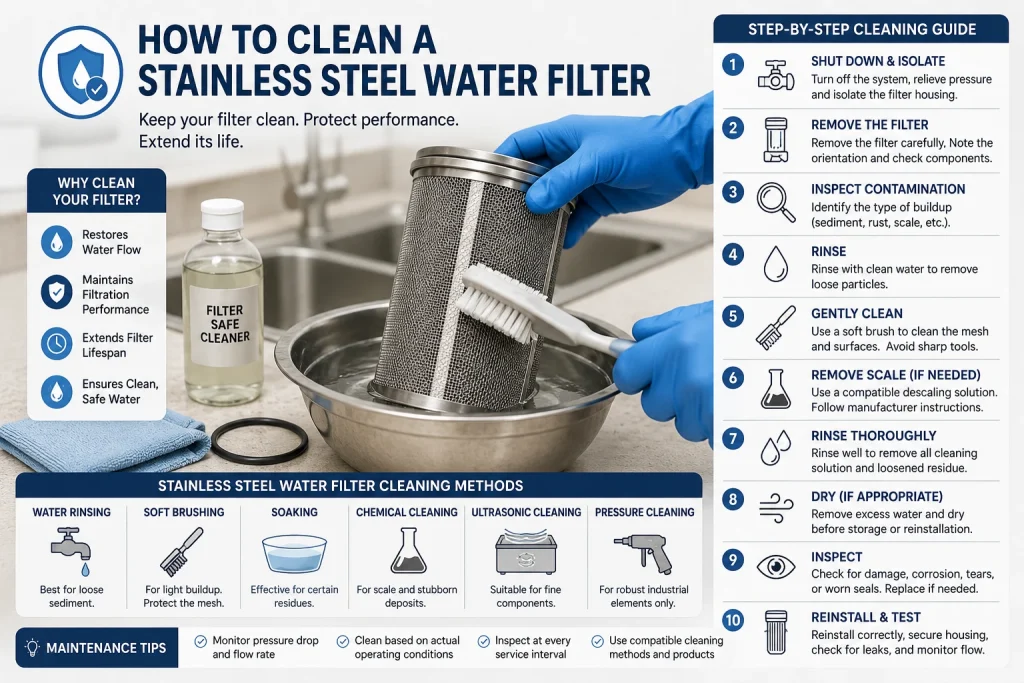
A stainless steel water filter is built to last, but it isn’t maintenance-free. As water passes through the filter, sediment, dirt, mineral deposits, and other particles gradually collect on the mesh or filter element. This buildup is exactly why reusable stainless steel filters are so popular in the first place they’re designed to be cleaned and used again rather than thrown away. Knowing how to clean a stainless steel water filter correctly helps maintain water flow, protect filtration performance, and extend the life of the filter. That said, the right cleaning method always depends on how the filter is constructed and where it’s used, so manufacturer instructions should be checked before you begin.
To clean a stainless steel water filter, shut down and isolate the filtration system, remove the filter according to the manufacturer’s instructions, rinse away loose contaminants, gently clean the filter using a compatible method, rinse it thoroughly, dry it where appropriate, inspect it for damage, and reinstall it correctly.
The sections below walk through each of these steps in more detail, along with guidance on cleaning frequency, tools, common mistakes, and when a filter needs to be replaced instead of cleaned.
What Is a Stainless Steel Water Filter?
A stainless steel water filter uses a woven mesh, sintered mesh, or perforated metal element to physically trap particles as water flows through it. Depending on how tightly the mesh is woven or how fine the perforations are, these filters can capture anything from coarse sediment down to very fine particulate matter. Common constructions include:
- Woven wire mesh filters – layers of stainless steel wire woven to a specific micron rating
- Sintered mesh filters – multiple layers of mesh bonded together under heat and pressure for added strength and finer filtration
- Perforated filter tubes – metal tubes with punched or drilled openings, often used as a support structure or for coarser filtration
Because stainless steel resists corrosion and can handle repeated cleaning cycles, these filter elements are frequently reusable rather than disposable, which sets them apart from many cartridge-style filters. This makes them a practical choice in applications where filters need to be serviced regularly rather than replaced.
Stainless steel filters show up in a wide range of settings, including drinking water systems, general process water, industrial filtration lines, commercial water systems, and pretreatment stages ahead of more sensitive downstream equipment. Not every stainless steel filter is designed or certified for drinking water use, so it’s important to confirm the intended application and any relevant certifications before assuming a given filter is suitable for potable water.
Why Do Stainless Steel Water Filters Need Cleaning?
Even though stainless steel itself doesn’t break down the way some filter media does, the filter still needs regular attention because of what it collects. Over time, a filter element can accumulate:
- Sediment and dirt
- Rust particles from upstream piping
- Mineral deposits and scale
- Suspended solids
- Contaminants specific to the application (oils, organic residue, process byproducts, and so on)
As this material builds up on the mesh surface or within its openings, it can reduce flow rate, increase pressure drop across the filter, and eventually lead to blockage. Left unaddressed, this buildup can also lower filtration efficiency and increase how often the system needs maintenance overall. It’s worth noting that cleaning helps manage this buildup, but it does not always restore a filter to its exact original condition some wear and gradual performance change is normal over a filter’s service life.
How Often Should You Clean a Stainless Steel Water Filter?
There’s no single cleaning schedule that applies to every stainless steel water filter. How often a filter needs attention depends on several factors working together:
- Water quality and contamination level
- Flow rate through the system
- Pressure drop across the filter
- The filter’s micron rating
- Filter construction (woven mesh, sintered mesh, or perforated tube)
- Overall system design
- Manufacturer recommendations
- How frequently the system is used
Rather than cleaning on a fixed calendar, many facility managers and maintenance teams track pressure drop and flow rate as practical indicators. A noticeable drop in flow or a rise in pressure differential across the filter housing is usually a more reliable signal that cleaning is needed than a generic time interval.
What You Need to Clean a Stainless Steel Water Filter
Having the right supplies on hand before you start makes the process smoother and reduces the risk of damaging the filter. A typical cleaning kit includes:
- Clean water for rinsing
- A soft-bristled brush
- A non-abrasive sponge or cloth
- A suitable container for soaking or cleaning
- A compatible detergent or cleaning solution, where appropriate
- A clean, lint-free cloth for wiping down components
- Gloves
- Eye protection
- Replacement seals or gaskets, in case the originals are damaged during disassembly
Any cleaning chemical you use must be compatible with stainless steel, the specific filter construction, and the application the filter serves. Avoid improvising with random household chemicals or combining products stick to solutions that are known to be safe for stainless steel and appropriate for the type of buildup you’re addressing.
How to Clean a Stainless Steel Water Filter Step by Step
Step 1: Shut Down and Isolate the System
Before touching the filter, turn off the filtration system and isolate the filter housing from the rest of the system. Relieve any pressure according to your system’s standard procedure, and shut off the water supply where appropriate. Give components time to reach a safe temperature and pressure before handling them. Never attempt to remove a filter while the housing is still pressurized this is one of the most important safety steps in the entire process.
Step 2: Remove the Filter
Once the system is safely isolated, remove the filter following the manufacturer’s instructions for your specific housing and filter type. Pay close attention to the filter’s orientation as you take it out, along with the condition of the housing, gaskets, O-rings, clamps, and any connections. Set removed components aside in a clean area so they don’t pick up additional dirt or debris before cleaning.
Step 3: Inspect the Contamination
Before you start cleaning, take a moment to look closely at the filter and identify what kind of buildup you’re dealing with. Common types include sediment, sand, rust particles, scale, mineral deposits, and organic residue. If you notice contamination that seems unusual for your system for example, an unexpected amount of rust or an unfamiliar residue it may be worth investigating whether something upstream in the filtration system needs attention.
Step 4: Rinse Away Loose Contaminants
Start with a simple rinse using clean water to remove loose particles from the filter surface. Where the filter’s design allows, rinsing from the appropriate direction (often opposite to normal flow) can help dislodge material trapped in the mesh. Avoid using excessive water pressure at this stage unless your manufacturer specifically confirms that higher pressure is safe for the filter.
Step 5: Gently Clean the Filter
With the loose debris rinsed away, use a soft brush or another non-abrasive method to clean the remaining buildup. Work carefully over the mesh openings, filter surfaces, frame, and end connections, paying extra attention to hard-to-reach areas. Avoid sharp tools, picks, or anything that could scratch, enlarge, or otherwise damage the mesh openings even small changes to the mesh geometry can affect filtration accuracy going forward.
Step 6: Address Mineral or Scale Buildup
If mineral deposits or scale are present, they may need a more targeted cleaning approach than a simple brush and rinse. Before using any descaling product:
- Check the manufacturer’s recommendations for your specific filter
- Confirm that the chemical is compatible with stainless steel
- Follow the cleaning product’s instructions exactly
- Never mix cleaning chemicals together
- Rinse the filter thoroughly once the chemical treatment is complete
This is not the place to improvise a cleaning solution. Stick to products designed for stainless steel and confirmed safe for your application.
Step 7: Rinse Thoroughly
After brushing or chemical treatment, rinse the filter thoroughly to remove any remaining cleaning solution, loosened sediment, or mineral residue. This step matters for every application, but it’s especially important for filters used in potable or process water systems any filter used in these settings should be cleaned and rinsed according to the specific requirements of that system and its manufacturer.
Step 8: Dry the Filter When Appropriate
Drying requirements vary depending on the filter’s construction and how it will be used next. If the filter is going to be stored rather than reinstalled right away, remove excess water and let it dry appropriately before placing it in a clean, protected location. Not every filter needs to be completely dry before reinstallation this depends on your system and manufacturer guidance, so check before assuming either way.
Step 9: Inspect the Filter
Before putting the filter back into service, inspect it closely for signs of damage, including:
- Torn or damaged mesh
- Enlarged filter openings
- Corrosion
- Cracks
- Bent components
- Broken welds
- Damaged seals
- Deformation
- Areas that remain blocked despite cleaning
A filter that shows any of these issues shouldn’t automatically go back into service just because it’s been cleaned. Structural damage affects filtration performance in ways that cleaning can’t fix.
Step 10: Reinstall the Filter
Once you’ve confirmed the filter is in good condition, reinstall it. Check that seals and gaskets are intact, install the filter in the correct orientation, and secure the housing properly. Follow the manufacturer’s torque or assembly instructions where applicable. Restart the system gradually, check carefully for leaks, and monitor flow and pressure once the system is back in normal operation.
How to Clean a Clogged Stainless Steel Water Filter
A clogged filter follows the same general process, with a bit more attention to stubborn buildup:
- Shut down and isolate the system.
- Remove the filter.
- Identify the type of contamination causing the clog.
- Rinse loose particles away.
- Use a soft brush where appropriate.
- Use a compatible cleaning solution for stubborn buildup.
- Rinse thoroughly.
- Inspect the mesh for damage or remaining blockage.
- Reinstall the filter and test the system.
If a filter remains significantly blocked even after a thorough cleaning, it may need professional cleaning or outright replacement. Persistent clogging can also be a sign that something upstream such as a failing pretreatment stage is sending more contamination than the filter is designed to handle.
How to Remove Mineral Deposits From a Stainless Steel Water Filter
Hard water is one of the most common causes of scale buildup on stainless steel filters. As water evaporates or moves through the mesh, dissolved minerals like calcium and magnesium can be left behind, gradually restricting the filter’s openings and reducing flow. Because scale tends to build up unevenly and can be tenacious once established, it often calls for a more targeted descaling approach rather than a plain water rinse.
Chemical compatibility is the key consideration here. Not every descaling product is appropriate for stainless steel, and using the wrong one can damage the filter or leave harmful residue behind. Whatever product you use, follow its instructions closely and rinse the filter thoroughly afterward to make sure no cleaning solution or loosened scale remains before the filter goes back into service.
Can You Pressure Wash a Stainless Steel Water Filter?
It depends on the filter. Some robust industrial filter elements can tolerate pressure cleaning as part of routine maintenance, particularly coarser mesh or perforated tube designs built for heavier-duty use. Fine mesh filters, on the other hand, are more vulnerable excessive pressure can distort the mesh, enlarge openings, or otherwise change the filter’s geometry in ways that affect filtration accuracy.
Always check the manufacturer’s maximum recommended cleaning pressure before using a pressure washer or similar equipment. Don’t assume that pressure washing is safe just because the filter is made of stainless steel; the mesh construction and micron rating matter just as much as the base material.
Can You Use a Cleaning Chemical on a Stainless Steel Water Filter?
Cleaning chemicals can be genuinely useful for certain types of contamination, particularly scale, grease, or stubborn residue that plain water and brushing won’t fully remove. That said, any chemical used needs to be compatible with both the stainless steel and the specific filter construction, and it needs to suit the application the filter is used in.
Filters used in potable water systems may carry additional requirements around what cleaning products are acceptable, since residual chemicals could affect water safety. Always follow the manufacturer’s instructions for your specific filter, and never mix cleaning chemicals together combining products can create unpredictable or hazardous reactions.
Stainless Steel Water Filter Cleaning Methods
| Cleaning Method | Best For | Important Consideration |
| Water rinsing | Loose sediment | Use appropriate pressure |
| Soft brushing | Light buildup | Avoid damaging mesh |
| Soaking | Certain residues | Use compatible solution |
| Chemical cleaning | Specific deposits | Verify compatibility |
| Ultrasonic cleaning | Suitable fine components | Follow manufacturer guidance |
| Pressure cleaning | Robust industrial elements | Avoid excessive pressure |
Not every method suits every filter. The right choice depends on the filter’s construction, the type of contamination present, and the application it’s used in when in doubt, check with the manufacturer before trying a new cleaning method.
Common Mistakes When Cleaning Stainless Steel Water Filters
A few habits tend to shorten a filter’s service life or reduce its effectiveness:
- Cleaning the filter while the system is still pressurized
- Using excessive water or air pressure during rinsing
- Scraping the mesh with sharp objects to remove stubborn debris
- Using abrasive brushes or scouring pads
- Applying cleaning chemicals that aren’t compatible with stainless steel
- Mixing different cleaning products together
- Skipping a thorough final rinse
- Ignoring visibly damaged mesh and reinstalling it anyway
- Reusing damaged seals or gaskets during reassembly
- Failing to check for leaks after reinstallation
- Not monitoring flow and pressure after the system is back online
Avoiding these mistakes goes a long way toward keeping a stainless steel filter performing well over its service life.
Signs a Stainless Steel Water Filter Needs Replacement
Cleaning restores performance up to a point, but it can’t fix structural problems. Consider replacing a filter if you notice:
- Torn mesh
- Enlarged filter openings
- Severe corrosion
- Cracked components
- Broken welds
- Permanent deformation
- Damaged seals that can’t be replaced separately
- Pressure drop that stays high even after cleaning
- Filtration performance that doesn’t recover
- A filter that no longer fits or seats correctly in its housing
If any of these issues are present, cleaning the filter again won’t resolve the underlying problem it’s time to replace the element.
Stainless Steel Water Filter Maintenance Tips
A consistent maintenance routine helps catch problems early and keeps the filtration system running efficiently:
- Monitor pressure drop across the filter regularly.
- Track flow rate to catch gradual declines.
- Clean based on actual operating conditions rather than a fixed calendar.
- Inspect the filter every time it’s serviced, not just when it looks obviously dirty.
- Follow the manufacturer’s recommended cleaning methods and intervals.
- Use cleaning methods and products confirmed compatible with the filter.
- Keep maintenance records so patterns become easier to spot over time.
- Replace worn or damaged seals promptly.
- Replace filters that show structural damage rather than continuing to clean them.
- Store cleaned filters somewhere clean and protected from contamination before reuse.
Frequently Asked Questions
- How do you clean a stainless steel water filter?
Shut down and isolate the system, remove the filter, rinse away loose contaminants, gently brush or chemically clean the filter as needed, rinse thoroughly, dry it if appropriate, inspect it for damage, and reinstall it correctly.
- How often should you clean a stainless steel water filter?
There’s no universal schedule. Cleaning frequency depends on water quality, flow rate, pressure drop, filter construction, and manufacturer recommendations many users clean based on observed pressure or flow changes rather than a fixed interval.
- How do you clean a clogged stainless steel filter?
Isolate and remove the filter, identify the contamination, rinse and brush away buildup, use a compatible cleaning solution for stubborn deposits, rinse thoroughly, and inspect before reinstalling. Severely clogged filters may need professional cleaning or replacement.
- How do you remove scale from a stainless steel water filter?
Mineral scale typically requires a descaling solution that’s confirmed compatible with stainless steel. Follow the product’s instructions and manufacturer guidance, then rinse the filter thoroughly to remove all residue.
- Can you pressure wash a stainless steel water filter?
Sometimes, for robust industrial filter elements but always within the manufacturer’s maximum recommended pressure. Fine mesh filters are more easily damaged by excessive pressure.
- Can you use detergent to clean a stainless steel water filter?
Yes, in many cases, as long as the detergent is compatible with stainless steel and appropriate for the application. Always rinse thoroughly afterward and avoid mixing cleaning products.
- Can stainless steel water filters be reused?
Yes reusability is one of the main advantages of stainless steel filter elements, provided they’re cleaned properly and remain free of structural damage.
- How do you know when a stainless steel filter needs replacement?
Look for torn mesh, enlarged openings, corrosion, cracks, broken welds, deformation, or pressure drop that doesn’t improve after cleaning. Any of these signals that replacement, not further cleaning, is needed.
- Can a stainless steel filter be used for drinking water?
Some stainless steel filters are designed and certified for drinking water applications, but not all of them are. Always confirm the specific filter’s intended use and any relevant certifications before using it for potable water.
- What is the best way to maintain a stainless steel water filter?
Monitor pressure drop and flow rate, clean based on actual operating conditions, inspect the filter at every service interval, follow manufacturer guidance, and replace the filter when it shows structural damage rather than continuing to clean it.
Conclusion
Cleaning a stainless steel water filter comes down to a consistent process: isolate the system, remove the filter carefully, inspect the type of contamination, rinse away loose debris, clean gently, address scale where needed, rinse thoroughly, inspect for damage, reinstall correctly, and monitor performance afterward. The right cleaning method for your filter depends on its construction, the contamination it’s collected, and the application it serves so manufacturer guidance should always be your starting point.
Looking for durable stainless steel water filters or custom filtration components? Contact Xintan Filter to discuss stainless steel mesh filters, reusable filter elements, and application-specific filtration solutions.