Introduction
Every modern power plant, whether it runs on coal, gas, biomass, nuclear fuel, or falling water, depends on a network of unglamorous components that keep filtration, cooling, and steam systems running safely. Among the most important of these is the power plant perforated tube a precision-drilled cylindrical component used throughout thermal, nuclear, hydroelectric, biomass, and combined-cycle facilities.
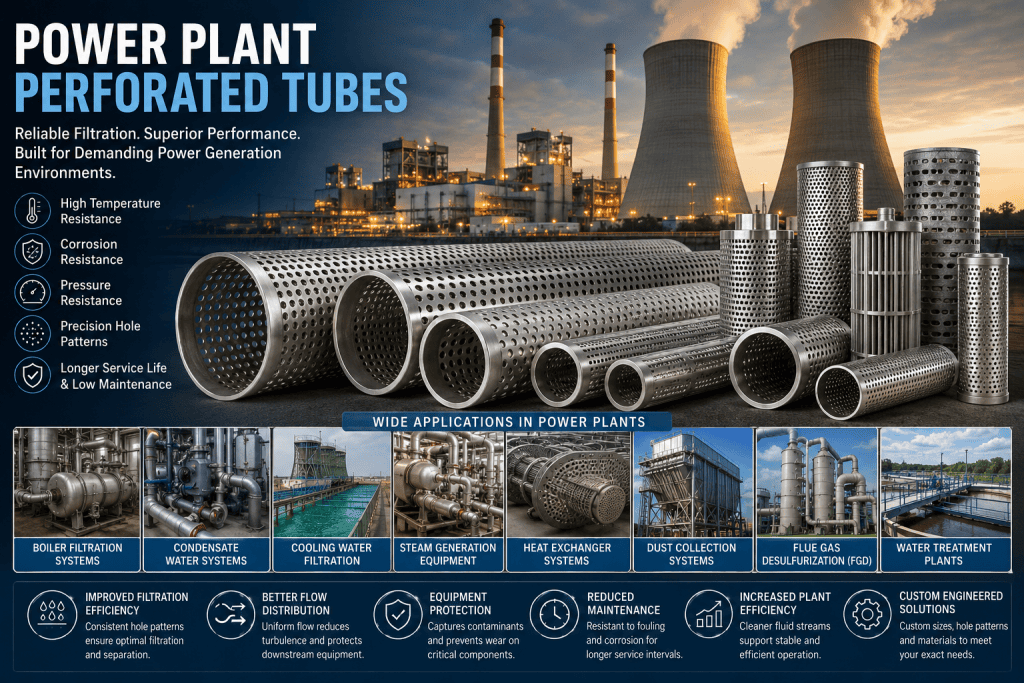
Power plant perforated tubes support filtration, water treatment, steam generation, cooling systems, dust collection, and emission control equipment. They act as structural cores for filter elements, flow straighteners in condensate lines, and support cylinders inside cyclone separators and FGD scrubbers. Because these components sit inside some of the harshest environments in industrial engineering, high heat, high pressure, corrosive condensate, and constant vibration high-temperature resistance, corrosion resistance, pressure resistance, and precision manufacturing aren’t optional extras. They’re the baseline requirement for any tube that’s going to survive years of continuous plant operation.
This guide walks through what a power plant perforated tube is, the materials and features that matter most, where these tubes are used across a facility, and how to select and maintain the right tube for your application.
What Is a Power Plant Perforated Tube?
Definition
A power plant perforated tube is a metal tube round or square in cross-section manufactured with a pattern of precisely sized and spaced holes along its wall. The perforation pattern is engineered to control flow rate, filtration efficiency, and structural strength simultaneously, rather than being a generic sieve-like product.
Construction and Working Principle
These tubes are typically formed from flat perforated sheet that is rolled and welded into a cylindrical or square shape, or perforated directly on a finished tube using CNC punching or laser drilling. The hole pattern round, slotted, staggered, or straight-row determines open area percentage, which in turn governs how much fluid or gas can pass through per unit of surface area. A support tube of this kind allows liquids, steam, or gases to flow radially through the wall while trapping particulate matter, supporting filter media, or distributing flow evenly across a vessel’s cross-section.
Why Perforated Tubes Are Widely Used in Power Generation Equipment
Power generation equipment moves enormous volumes of water, steam, and combustion gas through relatively small footprints. Perforated tubes give engineers a way to control that flow filtering out contaminants, protecting downstream equipment, and evening out pressure without introducing excessive pressure drop or maintenance burden.
Difference Between Standard Industrial Perforated Tubes and Power Plant-Grade Perforated Tubes
Standard industrial perforated tubes are often built to general filtration or architectural specifications. Power plant-grade tubes are held to tighter dimensional tolerances, manufactured from certified pressure-vessel or boiler-grade materials, and typically supplied with full material traceability and test certification, because a failure inside a boiler or turbine auxiliary system can shut down an entire generating unit.
Importance of Reliability in Critical Power Plant Systems
A single perforated tube failure — a collapsed filter core, a cracked cyclone liner, a corroded desulfurization internal — can force an unplanned outage costing far more than the component itself. Reliability, not just initial cost, is the deciding factor in most power plant procurement decisions.
Why Perforated Tubes Are Essential in Power Plants
- Reliable filtration support — perforated tubes form the structural backbone of cartridge filters, strainers, and separators, holding filter media in place under continuous pressure.
- High-temperature performance — boiler and steam-adjacent applications routinely see temperatures that would deform lower-grade materials.
- Pressure resistance — tubes must withstand both steady-state operating pressure and transient pressure spikes without deforming or fatiguing.
- Improved flow distribution — precision hole patterns even out flow velocity, reducing localized erosion and turbulence.
- Corrosion resistance — condensate, flue gas, and treated water are all chemically aggressive; the right alloy prevents premature wall thinning.
- Equipment protection — by capturing debris and scale before it reaches pumps, turbines, and heat exchangers, perforated tubes reduce wear on higher-value assets.
- Reduced maintenance — properly specified tubes resist fouling and blockage, extending service intervals.
- Longer operational life — correct material and design choices mean fewer replacement cycles.
- Increased plant efficiency — consistent flow and clean fluid streams support more stable, efficient plant operation overall.
Materials Used for Power Plant Perforated Tubes
Stainless Steel Perforated Tube
Stainless steel is the most common choice across power plant filtration and water treatment systems because it combines strong corrosion resistance with good mechanical strength at moderate-to-high temperatures. Grades such as 304, 304L, 316, and 316L are widely specified for condensate, cooling water, and general filtration duty.
Carbon Steel Perforated Tube
Carbon steel perforated tubes are cost-effective and offer solid mechanical strength, making them suitable for structural or lower-corrosion applications such as ash handling equipment or non-critical support structures, though they typically require protective coatings in wet or corrosive service.
Perforated Aluminum Tube
Perforated aluminum tube is lightweight and easy to fabricate, making it useful for non-high-temperature applications such as air intake filtration housings or acoustic/ventilation components where weight savings matter more than extreme heat resistance.
Duplex Stainless Steel
Duplex stainless steel grades combine the strength of ferritic steel with the corrosion resistance of austenitic stainless steel, making them well suited to aggressive environments such as flue gas desulfurization systems and seawater-cooled plants.
High-Temperature Alloy Materials
For the most demanding zones — boiler internals, superheater-adjacent equipment, and high-temperature flue gas paths — nickel-based and other high-temperature alloys resist creep, oxidation, and thermal fatigue far beyond what standard stainless steel can tolerate.
| Material | Temperature Resistance | Corrosion Resistance | Strength | Typical Power Plant Applications |
| Carbon Steel | Moderate | Low–Moderate (coating dependent) | High | Structural supports, ash handling, non-critical ducting |
| Stainless Steel | High | High | High | Condensate systems, cooling water filtration, general filtration |
| Duplex Stainless Steel | High | Very High | Very High | FGD systems, seawater cooling, aggressive chemical environments |
| High-Temperature Alloys | Very High | High | High | Boiler filtration, superheater-adjacent equipment, high-temp flue gas |
| Aluminum | Low–Moderate | Moderate | Moderate | Air intake filtration, lightweight housings, ventilation components |
Key Features of Power Plant Perforated Tubes
High Temperature Resistance
Tubes near boilers, steam lines, and flue gas paths must retain strength and dimensional stability at elevated operating temperatures without warping or embrittling.
Corrosion Resistance
Continuous exposure to treated water, condensate, and combustion byproducts demands materials and surface finishes that resist pitting, crevice corrosion, and general wall thinning.
Pressure Resistance
Tubes used in pressurized filtration housings or boiler auxiliary systems must be engineered to handle both steady operating pressure and transient surges.
Precision Hole Patterns
Consistent hole diameter, spacing, and pattern geometry ensure predictable open area, filtration performance, and structural integrity across the full length of the tube.
High Open Area
A well-designed perforation pattern maximizes open area for flow while preserving enough solid material to maintain structural strength.
Excellent Structural Strength
Perforated tubes must support filter media, resist collapse under differential pressure, and withstand vibration and thermal cycling over years of service.
Uniform Flow Distribution
Even hole spacing prevents localized high-velocity zones that could cause erosion or uneven filtration performance.
Long Service Life
Correct material selection combined with quality manufacturing extends the operational lifespan of the tube, reducing lifecycle cost.
Low Maintenance Requirements
Tubes resistant to fouling, scaling, and corrosion require less frequent cleaning and inspection.
Custom Manufacturing Options
Power plants often need non-standard diameters, lengths, hole patterns, or end configurations to match existing equipment custom manufacturing capability is essential.
Applications in Power Plants
Boiler Filtration Systems
Perforated tubes form the core structure of boiler feedwater filters, protecting downstream boiler tubes from scale and particulate that could cause fouling or tube failure.
Condensate Water Systems
In condensate polishing and return systems, perforated tubes support filter cartridges that remove corrosion products before water is returned to the boiler cycle.
Cooling Water Filtration
Cooling towers and heat exchanger intake lines rely on perforated tube strainers to keep debris out of condensers and cooling loops, protecting equipment and maintaining thermal efficiency.
Steam Generation Equipment
Within steam drums and auxiliary steam equipment, perforated tubes help separate moisture and manage flow, supporting more efficient and reliable steam generation.
Heat Exchanger Systems
Perforated tube components support baffles and internal flow distribution inside heat exchangers, improving thermal transfer and reducing localized erosion.
Air Intake Filtration
Combustion turbine air intake systems use perforated tube-based filter housings to remove dust and particulates before air reaches the turbine, protecting blades from erosion.
Dust Collection Systems
Perforated tubes serve as the structural cage inside baghouse filters and cartridge dust collectors, supporting filter media while withstanding continuous pulse-cleaning cycles.
Flue Gas Desulfurization (FGD) Systems
FGD systems expose internals to highly corrosive slurry and gas streams; corrosion-resistant perforated tubes support spray headers, mist eliminators, and internal distribution components.
Ash Handling Equipment
Perforated tubes are used in ash conveying and separation equipment to screen and manage fly ash and bottom ash byproducts.
Water Treatment Plants
Power plant water treatment systems use perforated tube-based strainers and filter supports to prepare boiler feedwater and manage wastewater discharge.
Turbine Auxiliary Systems
Lubricating oil filtration and other turbine auxiliary systems depend on perforated tube filter elements to protect bearings and rotating equipment from contamination.
Biomass and Waste-to-Energy Plants
In biomass and waste-to-energy facilities, perforated tubes are used in fuel handling, flue gas cleaning, and ash management systems that deal with more variable, abrasive fuel streams than conventional fossil-fuel plants.
Across each of these applications, correctly specified perforated tubes improve system efficiency, extend equipment reliability, and support safer overall plant operation by keeping contaminants, scale, and particulate out of critical flow paths.
How Perforated Tubes Improve Power Plant Performance
- Improved filtration efficiency through consistent, engineered open area
- Better water and steam flow via uniform, predictable flow distribution
- Reduced pressure loss across filtration and separation equipment
- Increased equipment reliability by keeping contaminants away from sensitive components
- Protection of pumps and turbines from erosion, fouling, and particulate damage
- Lower maintenance costs thanks to corrosion- and fouling-resistant designs
- Longer service intervals between inspections and replacements
- Enhanced energy efficiency as a result of cleaner fluid streams and more stable flow conditions
How to Choose the Right Power Plant Perforated Tube
Selecting the correct perforated tube requires balancing several interdependent variables:
- Material Selection — match the alloy to the temperature, pressure, and chemical exposure of the application.
- Hole Diameter — determines the size of particulate captured or filtered out.
- Hole Pattern — round, slotted, or staggered patterns affect flow characteristics and structural strength differently.
- Open Area Percentage — higher open area improves flow but can reduce structural rigidity.
- Tube Diameter — must match housing and connection dimensions.
- Tube Length — dictated by equipment design and available installation space.
- Wall Thickness — affects both pressure rating and expected service life.
- Operating Temperature — determines whether standard stainless steel or a high-temperature alloy is required.
- Operating Pressure — influences both material grade and wall thickness requirements.
- Corrosion Resistance — should be matched to the specific fluid or gas chemistry involved.
- Industry Standards — confirm the tube meets applicable material and manufacturing standards for the equipment involved.
Practical Selection Checklist
- Identify the operating temperature range and any transient extremes.
- Confirm maximum operating and surge pressure.
- Determine the fluid or gas chemistry and required corrosion resistance.
- Specify the minimum particle size that must be filtered or retained.
- Confirm tube diameter, length, and wall thickness against equipment drawings.
- Select a hole pattern and open area percentage suited to the flow requirement.
- Confirm which industry standards and certifications the equipment requires.
- Request material test certificates and traceability documentation from the supplier.
Common Challenges and Solutions
High Temperature Exposure — Standard stainless steel can lose strength at sustained high temperatures. Solution: specify high-temperature alloys for boiler-adjacent or superheater-zone applications.
Corrosion — Condensate, flue gas, and treated water are chemically aggressive. Solution: select duplex stainless steel or higher-grade alloys, and specify appropriate surface finishes.
Scaling and Fouling — Mineral deposits and particulate buildup reduce open area over time. Solution: design for adequate open area margin and implement routine cleaning schedules.
Blocked Perforations — Fine particulate or debris can plug holes, restricting flow. Solution: match hole diameter to expected particulate size and include upstream coarse filtration where needed.
Pressure Fluctuations — Transient pressure spikes can fatigue or deform tubes over time. Solution: specify wall thickness and material strength with adequate safety margin above expected transient loads.
Mechanical Wear — Continuous vibration and flow-induced erosion wear down tube walls. Solution: use wear-resistant materials and reinforce high-erosion zones.
Thermal Expansion — Repeated heating and cooling cycles can stress welds and joints. Solution: account for thermal expansion in tube design and mounting hardware.
Improper Material Selection — Choosing a lower-grade material to reduce upfront cost often leads to premature failure. Solution: base material selection on full operating conditions, not just initial price.
Maintenance Best Practices
- Routine inspection — schedule regular visual and dimensional checks to catch early signs of wear or corrosion.
- Cleaning methods — use appropriate mechanical or chemical cleaning suited to the fouling type and tube material.
- Corrosion monitoring — track wall thickness over time to identify corrosion trends before failure occurs.
- Pressure testing — periodically verify that tubes and housings maintain rated pressure integrity.
- Surface inspection — check for pitting, cracking, or erosion, particularly at welds and perforation edges.
- Preventive maintenance — plan cleaning and inspection cycles around known fouling and wear rates rather than waiting for failure.
- Replacement planning — track tube service life and budget for replacement before components reach end-of-life in service.
Quality Standards and Certifications
Depending on the equipment, operating conditions, and customer specifications, power plant perforated tubes may need to meet:
- ASTM Material Standards governing chemical composition and mechanical properties
- ISO Quality Management Systems covering manufacturing process control
- ASME Boiler and Pressure Vessel Standards, where the tube is used in pressure-retaining or boiler-adjacent equipment
- Material Test Certificates (MTC) confirming material grade and properties
- Inspection Reports documenting dimensional and quality checks
- Traceability Documentation linking each tube back to its material heat and production batch
The specific combination of standards required depends heavily on the equipment application, so it’s worth confirming requirements with both the equipment manufacturer and the tube supplier before finalizing an order.
Why Choose a Professional Perforated Tube Manufacturer?
- Precision CNC manufacturing for consistent hole geometry and tight dimensional tolerances
- High-temperature material expertise to correctly match alloys to demanding applications
- Custom perforation patterns tailored to specific flow and filtration requirements
- Material traceability to support certification and regulatory requirements
- Strict quality control throughout production, from raw material to finished tube
- OEM manufacturing capability for equipment builders needing exact-match replacement components
- Engineering support to help specify the right tube for a given application
- Global export capability to supply power plant projects wherever they’re located
Frequently Asked Questions
What is a power plant perforated tube?
It’s a metal tube manufactured with a precise pattern of holes, used throughout power generation facilities for filtration, flow distribution, and structural support in systems like boilers, cooling water lines, and dust collection equipment.
Which material is best for power plant applications?
It depends on the specific application. Stainless steel is the most common all-around choice, duplex stainless steel suits highly corrosive environments like FGD systems, and high-temperature alloys are needed for boiler-adjacent or superheater-zone equipment.
Why are stainless steel perforated tubes used in power plants?
Stainless steel offers a strong balance of corrosion resistance, mechanical strength, and cost, making it suitable for the majority of condensate, cooling water, and general filtration applications.
Can perforated tubes withstand high temperatures and pressure?
Yes, when manufactured from the appropriate material such as high-temperature alloys or duplex stainless steel and engineered with sufficient wall thickness, perforated tubes can be built to withstand demanding temperature and pressure conditions.
What hole pattern is best for power plant filtration?
The best pattern depends on the required open area, particle retention size, and structural strength needed; round staggered patterns are common for balanced flow and strength, while slotted patterns may suit specific filtration needs.
Can power plant perforated tubes be custom manufactured?
Yes, most power plant applications call for custom dimensions, hole patterns, and materials tailored to specific equipment and operating conditions rather than off-the-shelf products.
What quality standards should power plant perforated tubes meet?
Applicable standards vary by equipment and application but commonly include ASTM material standards, ISO quality management requirements, and ASME boiler and pressure vessel standards where the tube is used in pressure-retaining service.
How do perforated tubes improve cooling and water treatment systems?
They filter out debris and particulate, distribute flow evenly, and protect downstream pumps, heat exchangers, and turbines from contamination and erosion.
How often should perforated tubes be inspected in power plants?
Inspection frequency depends on the application and fouling rate, but routine visual, dimensional, and corrosion checks are generally recommended as part of a scheduled preventive maintenance program.
How do I choose the right perforated tube for power generation equipment?
Start by defining the operating temperature, pressure, fluid chemistry, and required filtration performance, then match material, hole pattern, open area, and dimensions to those conditions while confirming compliance with any applicable industry standards.
Conclusion
Power plant perforated tubes play a quiet but essential role across filtration, water treatment, steam generation, cooling, and emission control systems throughout a generating facility. Getting the specification right the correct material, perforation pattern, dimensions, and surface finish directly affects filtration efficiency, equipment protection, and how long a plant can run between maintenance cycles. Cutting corners on tube specification tends to show up later as unplanned downtime or premature equipment failure, which almost always costs more than the tube itself.
If your facility is specifying, replacing, or upgrading perforated tube components, working with an experienced perforated tube manufacturer who understands power generation applications can help you avoid costly missteps. Reach out to a qualified manufacturer to discuss custom power plant perforated tube solutions engineered for your exact operating conditions.