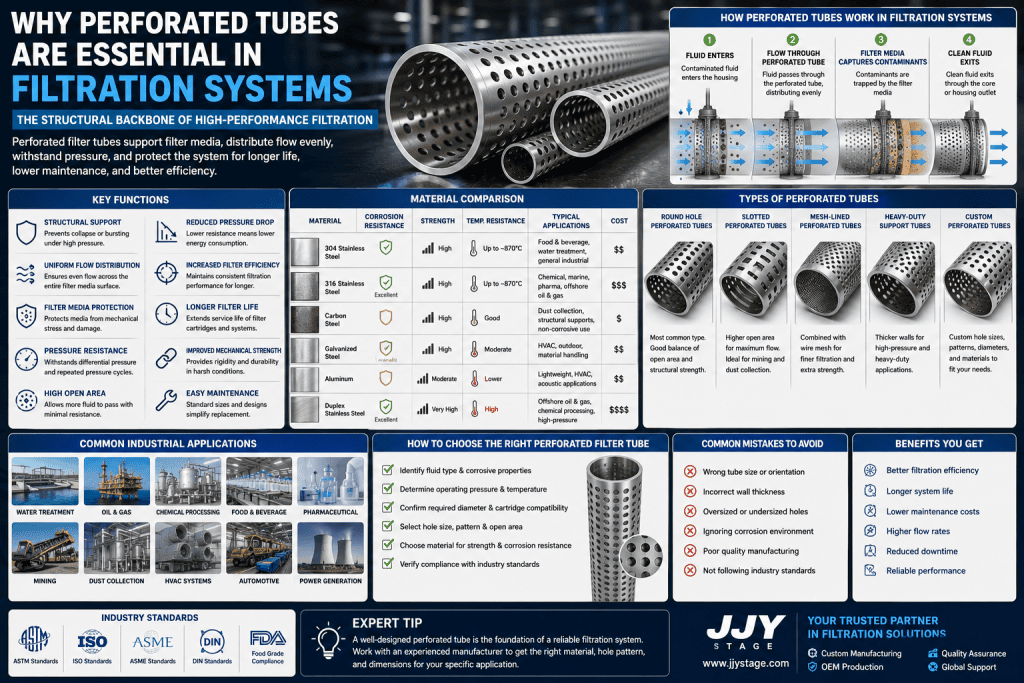
Water treatment systems — whether municipal, industrial, or commercial — depend on far more than the filter media doing the actual filtering. A water filter perforated tube provides the structural backbone that keeps that media in place, evenly distributes water flow, and prevents premature failure under continuous operating pressure.
Without a properly engineered perforated tube, filter cartridges are prone to collapse, uneven flow, and reduced filtration efficiency all of which drive up maintenance costs and shorten equipment life. In this guide, we’ll cover what water filter perforated tubes are, how they work, the materials and hole patterns available, where they’re used across water treatment applications, and how to select the right one for your system.
What Is a Water Filter Perforated Tube?
A water filter perforated tube is a cylindrical metal tube manufactured with a uniform pattern of holes or slots, designed to support filter media while allowing water to pass through freely.
Construction and design
These tubes are typically formed by rolling perforated sheet metal into a cylindrical shape and welding the seam, or by perforating a pre-formed tube. Hole size, spacing, and pattern are engineered to balance open area (for flow) against structural rigidity (for pressure resistance).
How it works in a water filtration system
The tube sits inside or around the filter cartridge, acting as a rigid skeleton. As water moves through the system, it passes through the tube’s perforations while the surrounding filter media captures sediment, particulates, and other contaminants. The tube itself is not the filtration medium it’s the support structure that lets the medium do its job reliably.
Perforated tube vs. other filter support components
Compared to wire mesh filters or sintered filters, a perforated tube is primarily a structural component rather than a filtration medium. Wire mesh and sintered elements are engineered to capture fine particulates based on precise opening sizes; a perforated tube’s holes are typically larger, prioritizing flow capacity and mechanical strength. In many filtration assemblies, a perforated tube works alongside a mesh or media layer, reinforcing it rather than replacing its filtration function.
Why Perforated Tubes Are Important in Water Filtration
Supporting filter cartridges and media The tube provides the rigid framework that filter cartridges and pleated media are built around, preventing deformation during operation.
Maintaining even water distribution Uniform perforation spacing ensures water is distributed evenly across the entire filter surface rather than concentrated at one point, which reduces localized wear and improves consistency.
Preventing filter collapse Under differential pressure — especially as filters load with contaminants — unsupported media can buckle or tear. The tube absorbs this mechanical stress.
Improving filtration efficiency By stabilizing the media and maintaining consistent flow, perforated tubes help filters perform closer to their rated efficiency for the full duration of their service life.
Reducing pressure drop A well-designed hole pattern with adequate open area minimizes resistance to flow, lowering the pressure drop across the filtration system and reducing pumping energy costs.
Extending filter lifespan Reduced mechanical stress and even flow distribution mean filter cartridges last longer between replacements, a meaningful savings in continuous-operation water treatment facilities.
How Water Filter Perforated Tubes Work
The filtration process generally follows these steps:
- Raw water enters the filtration system through an inlet into the housing or vessel.
- Water flows through the perforated support tube, which distributes it evenly across the filter media rather than concentrating pressure in one area.
- Filter media captures contaminants — sediment, particulates, and other impurities are trapped on or within the media layer.
- Clean water exits the system through the tube’s open core or the housing outlet.
- The perforated tube maintains structural integrity under operating pressure, keeping the filter media properly positioned throughout the filtration cycle.
Suggested visual: a cross-section diagram showing raw water entering the housing, passing through the perforated tube wall, filtering through the media, and exiting as clean water, with arrows indicating flow direction and the pressure differential across the media.
Common Materials Used
304 Stainless Steel
A widely used, cost-effective option offering good corrosion resistance and strength. Well suited to general municipal and industrial water treatment where water chemistry isn’t highly aggressive.
316 Stainless Steel
Contains added molybdenum for superior resistance to chlorides and aggressive water chemistries. The preferred choice for desalination, brackish water, and applications with higher corrosion risk.
Carbon Steel
Offers high mechanical strength at a lower cost but has poor inherent corrosion resistance in wet environments. Typically requires a protective coating for water filtration use.
Galvanized Steel
Provides a zinc coating that offers moderate corrosion protection at a lower cost than stainless steel, suitable for less aggressive water treatment applications.
Aluminum
Lightweight with moderate corrosion resistance, best suited to lower-pressure systems where weight reduction is a priority over maximum strength.
Material comparison:
| Material | Corrosion Resistance | Strength | Cost | Water Treatment Suitability | Expected Service Life |
| 304 Stainless Steel | Good | High | Moderate | General municipal & industrial water treatment | Long |
| 316 Stainless Steel | Excellent | High | Higher | Desalination, RO, aggressive water chemistry | Very long |
| Carbon Steel | Low (uncoated) | High | Low | Limited — requires coating for wet use | Short-moderate |
| Galvanized Steel | Moderate | High | Low-moderate | Less aggressive water treatment applications | Moderate |
| Aluminum | Moderate | Moderate | Moderate | Lightweight, low-pressure systems | Moderate |
Key Features of Water Filter Perforated Tubes
High Corrosion Resistance Stainless steel tubes resist rust and chemical degradation even in continuous contact with treated or raw water, critical for long-term reliability in municipal plants.
Excellent Flow Distribution Consistent hole spacing prevents flow channeling and ensures the entire filter media surface is used effectively — important in high-throughput systems like industrial water filtration lines.
High Open Area A greater percentage of open area allows more water through with less resistance, valuable in high-flow applications such as cooling water systems.
Strong Structural Support Adequate wall thickness and hole pattern design let the tube withstand the mechanical demands of pressurized filtration vessels without deforming.
Pressure Resistance Properly engineered tubes maintain their shape under the pressure cycling common in reverse osmosis pre-filtration and other pressurized systems.
Long Service Life Correctly specified material and design minimize wear, corrosion, and fatigue, reducing the frequency of tube replacement.
Easy Cleaning and Maintenance Smooth, uniform perforations are easier to clean during backwashing or maintenance cycles compared to irregular or damaged support structures.
Customizable Hole Sizes and Patterns Tubes can be engineered with specific hole diameters and patterns to match the flow and particulate requirements of a given water treatment process, such as activated carbon filtration.
Types of Perforated Tubes for Water Filtration
Round Hole Perforated Tubes The standard choice for most water filtration applications, offering a reliable balance of open area and structural strength.
Slotted Perforated Tubes Elongated slots provide a higher open area percentage, well suited to sand filtration systems and applications with larger particulate loads.
Mesh-Lined Perforated Tubes Combine a perforated tube with an inner or outer wire mesh layer, offering structural support alongside finer filtration — useful in activated carbon filter assemblies.
Heavy-Duty Support Tubes Feature thicker walls for high-pressure applications such as reverse osmosis pre-filtration and desalination pretreatment.
Custom Water Filter Tubes Manufactured to specific diameter, hole pattern, and material requirements for unique system designs or OEM filtration equipment where standard tubes aren’t a fit.
Applications in Water Treatment
Municipal Water Treatment Plants
Perforated tubes support cartridge and multimedia filters used to remove sediment and particulates from drinking water supplies at scale.
Industrial Water Filtration
Support tubes reinforce filter media in process water systems across manufacturing facilities, handling continuous high-volume flow.
Wastewater Treatment
Heavy-duty perforated tubes withstand the abrasive and variable contaminant loads typical of wastewater filtration stages.
Reverse Osmosis (RO) Systems
Perforated tubes provide critical pre-filtration support, protecting delicate RO membranes from particulates that could otherwise cause fouling or damage.
Sand Filtration Systems
Slotted perforated tubes are commonly used as underdrain components, evenly distributing backwash flow through sand media beds.
Activated Carbon Filters
Perforated tubes support carbon media beds, maintaining consistent flow paths for effective adsorption of organic contaminants and chlorine.
Desalination Plants
Corrosion-resistant 316 stainless steel tubes are essential in desalination pretreatment, where high salinity accelerates material degradation.
Cooling Water Systems
Perforated tubes support filtration components that keep cooling water free of debris, protecting downstream heat exchangers and equipment.
Food & Beverage Water Treatment
Food-grade stainless steel perforated tubes support filtration systems that meet the hygiene standards required for water used in food and beverage production.
Pharmaceutical Water Purification
High-precision perforated tubes support the fine filtration stages required to meet pharmaceutical-grade water purity standards.
How to Choose the Right Water Filter Perforated Tube
Key factors to evaluate include:
- Material Selection — based on water chemistry, corrosivity, and hygiene requirements
- Hole Diameter — affects flow capacity and particulate handling
- Hole Pattern — round or slotted, depending on flow and structural needs
- Open Area Percentage — balances flow capacity against tube strength
- Wall Thickness — determines pressure resistance and durability
- Tube Diameter — must match filter cartridge or housing specifications
- Operating Pressure — dictates required strength rating
- Water Quality — influences material choice, especially for high-chloride or high-turbidity water
- Corrosion Environment — critical in desalination, wastewater, and industrial process water
- Industry Standards — compliance with relevant ASTM, ISO, ASME, or NSF specifications
Quick selection checklist:
- Assess water chemistry and corrosivity
- Determine operating pressure and expected flow rate
- Confirm tube diameter and cartridge compatibility
- Choose hole size and pattern based on particulate profile
- Select a material balancing cost with corrosion resistance
- Confirm compliance with applicable industry and water treatment standards
Common Challenges and Solutions
Corrosion Often caused by material mismatched to water chemistry. Solution: upgrade to 316 stainless steel or another corrosion-resistant option suited to the specific water conditions.
Clogging typically results from hole sizes too small for the particulate load, or infrequent maintenance. Solution: reassess hole size and implement a regular cleaning schedule.
Pressure loss Usually caused by inadequate open area or buildup within the tube. Solution: select a higher open-area design and increase maintenance frequency.
Filter media damage Occurs when the support tube is undersized or improperly fitted. Solution: verify tube dimensions and wall thickness match the pressure and media requirements of the system.
Incorrect hole size Leads to either restricted flow or inadequate structural support. Solution: work with a manufacturer to calculate optimal hole size for your flow rate and particulate profile.
Poor material selection results in premature corrosion or mechanical failure. Solution: match material properties directly to water chemistry, pressure, and temperature conditions.
Maintenance Best Practices
Routine inspection Regularly check perforated tubes for corrosion, deformation, or blockage during scheduled filter maintenance.
Cleaning methods Backwashing, chemical cleaning, or manual brushing can be used depending on the material and the type of buildup, always following manufacturer guidance to avoid damaging the tube.
Preventive maintenance Establish a replacement or inspection schedule based on water quality and operating conditions rather than waiting for visible failure.
Corrosion prevention Where aggressive water chemistry is present, consider protective coatings or upgrading to a more corrosion-resistant material like 316 stainless steel.
Storage recommendations Store spare tubes in a dry, clean environment to prevent corrosion or contamination before installation.
Extending service life Combining correct material selection with routine maintenance and timely cleaning is the most effective way to maximize the operational life of a water filter perforated tube.
Why Choose a Professional Perforated Tube Manufacturer?
Water treatment performance depends heavily on the precision and reliability of the components behind the filter media. A professional manufacturer offers:
- Engineering support to properly size tubes for your specific water chemistry and flow requirements
- Precision perforation ensuring consistent hole spacing and dimensional accuracy
- Custom manufacturing for non-standard diameters, hole patterns, or lengths
- Material certifications confirming compliance with water treatment and industry standards
- Quality inspection to catch defects before tubes reach installation
- OEM production for manufacturers building water filtration equipment at scale
- Technical consultation to help specify the right perforated tube from the design stage onward
Partnering with an experienced manufacturer reduces the risk of premature failure and ensures your water filtration system performs reliably over its intended service life.
Frequently Asked Questions
What is a water filter perforated tube?
It’s a cylindrical metal tube with a pattern of holes or slots that supports filter media in a water filtration system, allowing water to pass through while maintaining structural integrity.
Why are perforated tubes used in water filtration systems?
They provide structural support for filter media, distribute water flow evenly, prevent filter collapse, and help maintain consistent filtration performance over time.
Which material is best for water treatment?
304 stainless steel suits general municipal and industrial applications, while 316 stainless steel is better suited to aggressive water chemistries such as desalination or high-chloride environments.
How do perforated tubes improve filtration efficiency?
By distributing water evenly across filter media and protecting it from mechanical stress, perforated tubes help media perform closer to its rated efficiency for longer.
What hole size is best for water filtration?
It depends on the application’s flow rate and particulate profile — larger holes support higher flow, while smaller holes offer more structural contact points for fine media.
Can water filter perforated tubes be customized?
Yes. Manufacturers can adjust hole size, pattern, diameter, length, and material to match specific water treatment system requirements.
How long do stainless steel perforated tubes last?
Service life varies with water chemistry and maintenance, but properly specified stainless steel tubes commonly last many years in well-maintained systems.
Which industries use water filter perforated tubes?
Municipal water treatment, industrial process water, wastewater treatment, desalination, food and beverage, and pharmaceutical water purification all rely on these components.
How do I choose the correct perforated tube?
Evaluate water chemistry, operating pressure, required flow rate, cartridge compatibility, and applicable industry standards before selecting material, hole size, and pattern.
What industry standards should water filtration tubes meet?
Depending on the application, tubes should comply with relevant ASTM, ISO, ASME, and, where applicable, NSF standards for water treatment components.
Conclusion
Water filter perforated tubes play a foundational role in the performance and reliability of water treatment systems — protecting filter media, distributing flow evenly, and maintaining structural stability under continuous operating pressure. Selecting the right material, hole pattern, and specifications for your specific water chemistry and system conditions is essential for long-term performance and cost efficiency.
For water treatment applications with unique pressure, flow, or water quality requirements, consulting an experienced perforated tube manufacturer ensures your filtration system is built on components engineered to last.