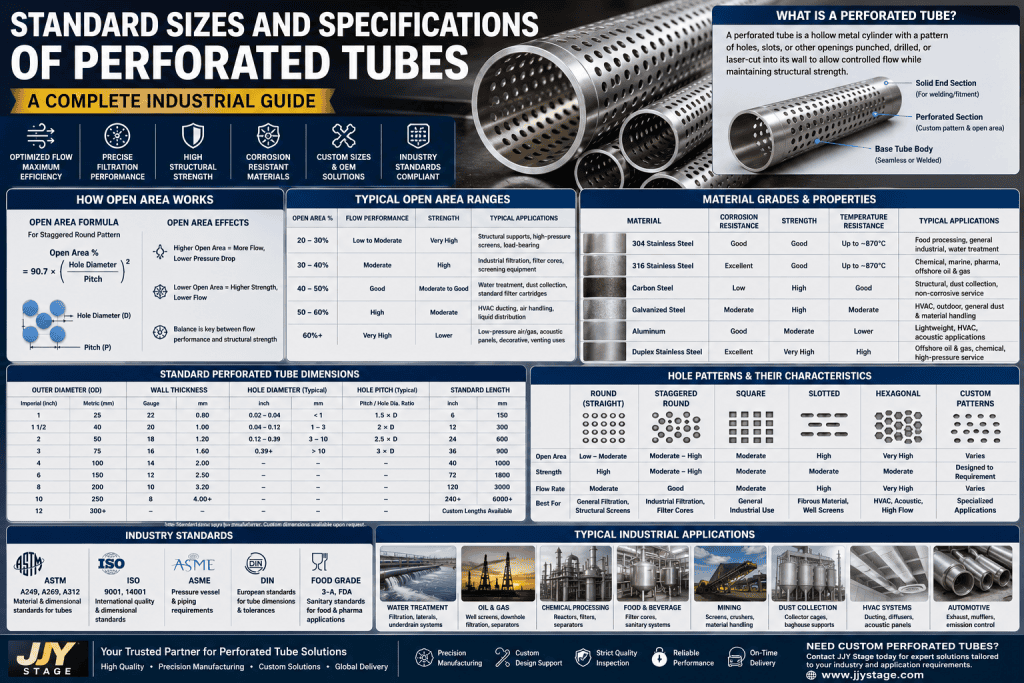
Choosing the right perforated tube sizes and perforated tube specifications is one of the most important decisions an engineer or procurement team will make when designing a filtration, structural, or fluid-handling system. Get the dimensions wrong, and you risk poor flow performance, premature failure, or a component that simply doesn’t fit the equipment it was meant for. This guide walks through the standard dimensions, materials, hole patterns, and industry standards that govern perforated tube manufacturing, so you can specify the right part the first time — whether you’re buying an off-the-shelf size or commissioning a custom run.
Tube diameter, wall thickness, hole size, hole pitch, and open area percentage all interact with one another. Change one, and you change how the tube filters, how much pressure it can withstand, and how long it will last in service. Understanding these variables — and how they map to the standards that govern them — is the foundation of a good specification.
What Is a Perforated Tube?
A perforated tube is a hollow metal cylinder with a pattern of holes, slots, or other openings punched, drilled, or laser-cut into its wall. The tube starts as either a seamless or welded metal tube, or a flat sheet that is perforated first and then rolled and welded into a cylindrical shape.
Basic construction. A perforated tube consists of the base tube body, the perforated section (which may run the full length or only a portion of it), and often solid, unperforated end sections that allow the tube to be welded, threaded, or fitted into a housing.
Manufacturing process. Two common approaches exist. In the first, a solid tube is perforated directly using CNC punching, drilling, or laser cutting. In the second, flat sheet stock is perforated first, then roll-formed into a cylinder and seam-welded. The second method is generally more economical for high-volume production and allows tighter control over hole pattern uniformity.
Working principle. The perforations allow controlled passage of liquid, gas, or particulate matter through the tube wall while the solid metal between the holes provides structural support. The size, shape, and spacing of the holes determine what passes through and what is retained or filtered out.
Common industrial applications. Perforated tubes are used as filter supports and cores, exhaust and muffler components, oil and gas well screens, dust collector cages, aeration and sparger tubes, and structural elements in mining and material-handling equipment.
Why Perforated Tube Sizes and Specifications Matter
Specifications are not just paperwork they directly determine how a perforated tube performs in service.
- Filtration efficiency. Hole diameter and open area percentage determine the particle size range the tube can filter and how much media surface area is exposed to flow.
- Structural strength. Wall thickness and hole pitch determine how much of the tube’s cross-section remains solid metal, which governs collapse resistance and load-bearing capacity.
- Flow capacity. Open area percentage and inner diameter together set the maximum flow rate the tube can handle without excessive pressure drop.
- Equipment compatibility. Outer diameter, inner diameter, and length must match the housing, filter cartridge, or fitting the tube will be installed into.
- Pressure resistance. Wall thickness, material grade, and hole geometry together determine burst pressure and collapse pressure ratings.
- Product lifespan. Material grade and surface finish determine resistance to corrosion, abrasion, and fatigue cracking around perforation edges.
- Maintenance efficiency. Correctly sized tubes reduce clogging frequency and make cleaning or media replacement easier and more predictable.
Standard Perforated Tube Sizes
Outer Diameter (OD)
Outer diameter is typically the first dimension specified, since it governs how the tube fits inside a housing or around a filter media pack. Common industrial perforated tube outer diameters range from about 1 inch (25 mm) for small filtration cores up to 12 inches (300 mm) or more for large-scale water treatment and dust collection applications. Standard stock sizes are often available in increments matching common pipe schedules, for example 1″, 2″, 3″, 4″, 6″, and 8″ OD — while custom diameters can be produced to match specific OEM housing dimensions.
When selecting OD, consider the clearance required inside the housing, the thickness of any filter media wrapped around the tube, and whether the tube needs to nest inside or around another component.
Inner Diameter (ID)
Inner diameter matters most in applications where fluid or gas travels through the bore of the tube itself, such as filter cores or sparger tubes. A larger ID relative to OD (i.e., a thinner wall) increases internal flow capacity but reduces structural strength, so ID is usually specified together with wall thickness rather than in isolation. In filtration systems, ID must also be compatible with the inner support components or end caps of the filter assembly to ensure a proper seal.
Tube Length
Standard perforated tube lengths commonly range from 6 inches to 10 feet (roughly 150 mm to 3 meters), with very common stock lengths at 12″, 24″, 36″, and 40″ for filter cores and cartridges. Longer lengths, up to 20 feet or more, are used in well screens and large-diameter process piping. Custom lengths are readily available from most manufacturers, and OEM programs often supply tubes pre-cut and finished to an exact application length, including any solid end sections needed for welding or fitting.
Wall Thickness
Wall thickness is chosen based on the structural demands of the application:
- Light-duty applications — typically 0.5 mm to 1.0 mm (roughly 20–24 gauge), used for low-pressure filter cores and decorative or acoustic applications.
- Medium-duty applications — typically 1.2 mm to 2.5 mm, used for standard industrial filtration, dust collection, and general process equipment.
- Heavy-duty applications — typically 3 mm and above, used for structural supports, high-pressure filtration, well screens, and mining equipment subject to abrasion and impact.
Hole Diameter
Hole diameter is one of the most application-specific variables, since it directly sets the filtration or retention threshold.
- Micro perforations — under 1 mm, used for fine filtration and applications requiring high structural integrity with minimal open area.
- Small holes — roughly 1 mm to 3 mm, common in standard filter supports and screens.
- Medium holes — roughly 3 mm to 10 mm, used in general industrial filtration, dust collection, and aeration.
- Large holes — above 10 mm, used in coarse screening, mining, and structural or acoustic applications where high open area or airflow is prioritized over fine filtration.
Hole Pitch
Hole pitch refers to the center-to-center spacing between adjacent holes. Tighter pitch increases open area and flow but reduces the amount of solid metal remaining between holes, which can lower structural strength and increase the risk of cracking under cyclic loading. Wider pitch improves strength and rigidity but reduces open area and flow capacity. Pitch is typically specified as a ratio relative to hole diameter (for example, a pitch of 1.5 to 3 times the hole diameter is common for round staggered patterns) to balance these competing demands.
Open Area Percentage
Open area percentage is the proportion of the tube’s surface that consists of holes rather than solid metal, and it is one of the key performance indicators for a perforated tube. Typical open area ranges run from around 20% for structural or heavy-duty tubes up to 50% or more for high-flow filtration and aeration applications. Higher open area improves airflow, liquid flow, and filtration throughput, but reduces mechanical strength, so selecting the right open area is always a balance between flow performance and structural requirements for the specific service conditions.
Standard Perforated Tube Specifications
Material Grades
The material grade determines corrosion resistance, mechanical strength, and suitability for a given operating environment.
| Material | Corrosion Resistance | Strength | Temperature Resistance | Typical Applications |
| 304 Stainless Steel | Good, general-purpose | Good | Up to ~870°C (intermittent) | Food processing, general industrial filtration, water treatment |
| 316 Stainless Steel | Excellent, including chlorides | Good | Up to ~870°C (intermittent) | Chemical processing, marine, pharmaceutical, offshore oil & gas |
| Carbon Steel | Low (requires coating) | High | Good at moderate temperatures | Structural supports, dust collection, non-corrosive process equipment |
| Galvanized Steel | Moderate (zinc coating) | High | Moderate; coating degrades at high heat | HVAC, outdoor structural, general dust and material handling |
| Aluminum | Good in mild environments | Moderate | Lower than steel | Lightweight enclosures, HVAC, acoustic applications |
| Duplex Stainless Steel | Excellent, high chloride resistance | Very high | High | Offshore oil & gas, chemical processing, high-pressure service |
Hole Patterns
- Round holes (staggered) — the most common pattern, offering a good balance of open area and structural strength with evenly distributed load paths.
- Round holes (straight) — arranged in aligned rows and columns; simpler to manufacture but generally offers lower structural strength than staggered patterns at the same open area.
- Square holes — used where higher open area is needed relative to hole size, common in some screening applications.
- Slotted holes — elongated openings used for well screens and applications requiring directional flow control or specific particle retention along one axis.
- Hexagonal holes — provide high open area with good strength characteristics, often used in specialty filtration and acoustic panels.
- Custom perforation patterns — designed for application-specific flow, filtration, or structural requirements, including variable hole density along the tube length.
Surface Finish
- Mill finish — the as-manufactured finish, suitable for general industrial use where appearance is not critical.
- Polished — improves cleanability and corrosion resistance, common in food, beverage, and pharmaceutical applications.
- Electropolished — provides the smoothest, most corrosion- and bacteria-resistant surface, used in high-purity and sanitary applications.
- Galvanized — a zinc coating applied for corrosion protection on carbon steel tubes used outdoors or in humid environments.
- Powder coated — provides a durable, decorative, and corrosion-resistant finish, often used in HVAC and architectural applications.
- Custom finishes — including passivation, anodizing, or specialty coatings for specific chemical or thermal environments.
Manufacturing Tolerances
Precision matters for both fit and performance. Reputable manufacturers control:
- Diameter tolerance — typically held to fractions of a millimeter for standard sizes to ensure proper fit within housings.
- Length tolerance — generally tighter for shorter, precision-fit tubes than for long structural or well-screen lengths.
- Hole diameter tolerance — critical for filtration applications where consistent particle retention is required.
- Roundness — out-of-round tubes can create sealing problems in cartridge and housing applications.
- Straightness — important for long tubes used in well screens or structural columns.
- Quality inspection — includes dimensional checks, visual inspection of hole edges for burrs, and material certification traceable to mill test reports.
Industry Standards for Perforated Tubes
Perforated tubes are frequently manufactured and inspected against recognized standards to ensure consistency, safety, and interoperability between suppliers:
- ASTM standards (e.g., ASTM A249, A269, A312) govern base tube material, chemical composition, and mechanical properties for stainless and carbon steel tubing used as perforated tube stock.
- ISO standards provide internationally recognized dimensional and quality benchmarks, useful for manufacturers and buyers operating across multiple countries.
- ASME requirements apply particularly to pressure-related applications, where perforated tubes are integrated into pressure vessels or piping systems.
- DIN standards are widely referenced in European engineering specifications for tube dimensions and tolerances.
- Food-grade and pharmaceutical compliance (such as 3-A Sanitary Standards or FDA material requirements) applies where perforated tubes contact food, beverage, or pharmaceutical products, governing surface finish and material purity.
Working to recognized standards ensures that a perforated tube from one manufacturer can be reliably compared, qualified, and in many cases substituted for one from another — which matters enormously for procurement and long-term maintenance planning.
Standard Sizes for Different Industries
Oil & Gas
Well screens and downhole filtration tubes tend to use heavier wall thicknesses and slotted or staggered round hole patterns to withstand high pressure and abrasive wellbore conditions, often in 316 or duplex stainless steel.
Water Treatment
Filtration and aeration tubes commonly use medium-duty wall thickness with medium hole sizes and moderate-to-high open area, typically in 304 or 316 stainless steel for corrosion resistance in treated and raw water.
Chemical Processing
Corrosive environments call for 316 or duplex stainless steel with tighter manufacturing tolerances and, often, electropolished or passivated finishes to resist chemical attack.
Food & Beverage
Sanitary applications require polished or electropolished 304 or 316 stainless steel, smooth hole edges free of burrs, and compliance with food-grade material standards.
Pharmaceutical
Similar to food and beverage but with even tighter tolerance and surface finish requirements, often specifying electropolished 316L stainless steel to meet cleanability and validation standards.
Mining
Heavy-duty wall thickness and larger hole sizes are typical, using carbon steel or galvanized steel to withstand abrasion, impact, and outdoor exposure.
Dust Collection
Medium-duty carbon or stainless tubes with medium-to-large hole sizes and moderate open area, balancing airflow with structural support for filter bags or cartridges.
HVAC
Lighter-duty aluminum or galvanized steel tubes are common, often prioritizing acoustic performance and airflow over high-pressure resistance.
Automotive
Exhaust and muffler perforated tubes typically use stainless steel with small-to-medium holes optimized for acoustic dampening and durability under thermal cycling.
Industrial Filtration
General-purpose filter cores and supports span a wide range of sizes, most commonly medium-duty stainless steel with hole sizes matched to the specific filter media being supported.
Custom Perforated Tube Specifications
While standard sizes cover a large share of industrial needs, many applications call for custom specifications:
- Custom diameters to fit proprietary housings or non-standard equipment.
- Custom lengths, including multi-diameter or stepped tube designs.
- Custom hole sizes tailored to a specific particle retention requirement.
- Custom hole patterns, including variable-density perforation along the tube length to fine-tune flow distribution.
- Material selection for unusual chemical, temperature, or hygiene requirements.
- Surface treatments specified for particular corrosion or cleanability needs.
- OEM manufacturing, where tubes are produced to a customer’s exact drawing, including end machining, welding, and assembly with other components.
A common example: a water treatment OEM may need a 4″ OD, 0.065″ wall, 316 stainless tube with 3 mm staggered round holes at 45% open area and solid 2″ end sections for cartridge fitment — a specification that falls outside standard stock and requires custom manufacturing.
How to Select the Right Size and Specification
Use the following checklist when specifying a perforated tube:
- Operating conditions — temperature, pressure, and whether service is continuous or intermittent.
- Flow requirements — required flow rate and acceptable pressure drop across the tube.
- Pressure ratings — required burst and collapse pressure margins.
- Temperature — both process temperature and any thermal cycling the tube will experience.
- Corrosion environment — chemical exposure, humidity, and whether the application involves chlorides or other aggressive media.
- Installation space — available diameter and length envelope within the housing or equipment.
- Equipment compatibility — matching OD, ID, and end configuration to the housing, fittings, or filter cartridge system.
- Budget considerations — balancing standard stock availability against the performance benefits of a custom specification.
Common Mistakes to Avoid
- Choosing the wrong diameter without confirming clearance inside the housing or around filter media.
- Incorrect wall thickness that under- or over-engineers the tube for its actual pressure and structural loads.
- Oversized or undersized holes that compromise filtration efficiency or allow excessive particle carryover.
- Ignoring industry standards, which can create compatibility and quality-assurance problems down the line.
- Selecting unsuitable materials that fail prematurely in corrosive or high-temperature environments.
- Focusing only on cost, which often leads to premature failure and higher total lifecycle cost.
- Not consulting an experienced manufacturer, missing opportunities to optimize hole pattern, pitch, and open area for the specific application.
Frequently Asked Questions
What are the standard perforated tube sizes? Standard perforated tube sizes commonly range from about 1 inch to 12 inches in outer diameter, with lengths from 6 inches up to 10 feet or more, though exact stock sizes vary by manufacturer and industry.
How do I select the correct perforated tube diameter? Match the outer diameter to the available clearance in your housing or equipment, and consider the inner diameter needed for flow capacity through the tube bore.
What wall thickness should I choose? Base wall thickness on the structural and pressure demands of the application — light-duty for low-pressure filtration, medium-duty for general industrial use, and heavy-duty for structural or high-pressure service.
What are the common hole sizes? Common hole diameters range from micro perforations under 1 mm for fine filtration up to large holes above 10 mm for coarse screening and structural applications.
Can perforated tubes be custom manufactured? Yes. Most manufacturers offer custom diameters, lengths, hole sizes, hole patterns, materials, and surface finishes to meet application-specific requirements, including full OEM programs.
Which material is best for industrial filtration? 304 and 316 stainless steel are the most common choices, with 316 preferred in more corrosive or chloride-heavy environments; material selection should always match the specific process conditions.
What standards apply to perforated tubes? Perforated tubes are commonly manufactured and inspected against ASTM, ISO, ASME, and DIN standards, with additional food-grade or pharmaceutical compliance where applicable.
How does wall thickness affect performance? Wall thickness directly affects structural strength, collapse and burst pressure resistance, and overall product lifespan under mechanical and thermal stress.
What is the difference between standard and custom perforated tubes? Standard tubes use common stock diameters, lengths, and hole patterns for faster lead times and lower cost, while custom tubes are engineered to exact application requirements when standard sizes don’t fit.
How do I choose the right perforated tube specification? Start with your operating conditions, flow requirements, and equipment compatibility, then work with an experienced manufacturer to finalize material, wall thickness, hole pattern, and open area percentage.
Conclusion
Selecting the correct perforated tube sizes and perforated tube specifications is essential to achieving reliable filtration performance, structural integrity, and long service life across industrial applications. From outer diameter and wall thickness to hole pattern, material grade, and open area percentage, each specification decision affects how the tube performs in the field. Whether you need a standard stock size or a fully custom design, working with an experienced perforated tube manufacturer ensures your specification is matched precisely to your operating conditions, industry standards, and long-term performance requirements.