Introduction
Selecting the right support tube is a critical decision in industrial filtration, fluid handling, and structural applications. Whether you’re designing a filtration system for a water treatment plant, manufacturing filter cartridges for chemical processing, or sourcing components for oil and gas operations, the choice between a perforated tube and a slotted tube directly impacts filtration efficiency, flow rate, pressure resistance, and equipment lifespan.
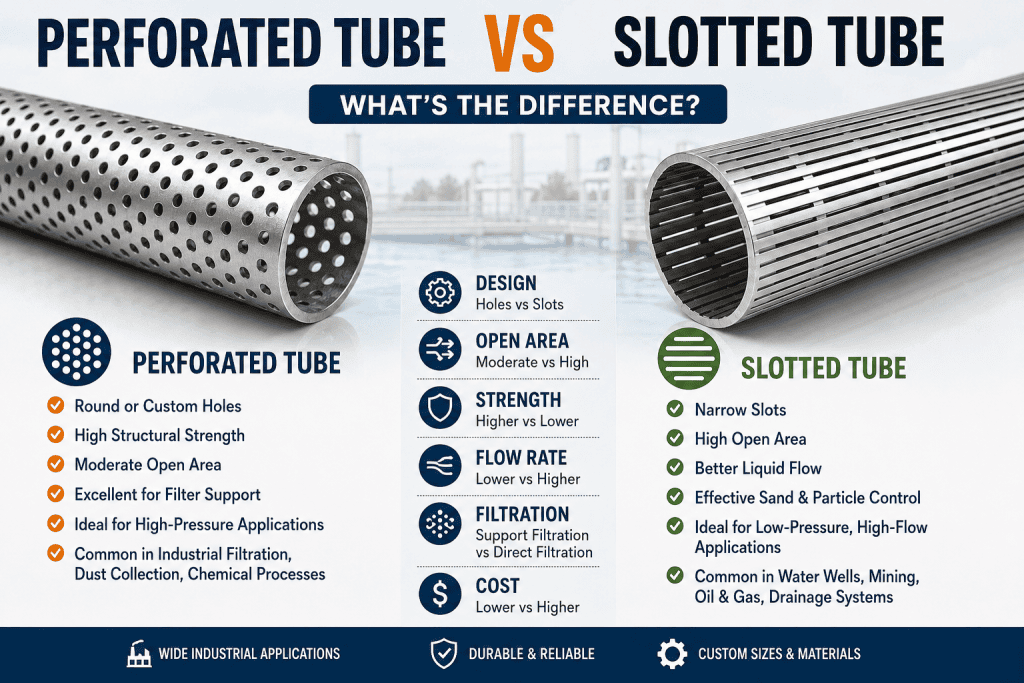
Although both products are widely used as support structures and filtration components, they are designed differently and perform best under different operating conditions. A perforated tube features precisely punched or drilled round, square, or customized holes distributed across the tube surface, offering excellent structural strength and reliable support for filter media. In contrast, a slotted tube uses narrow continuous or staggered slots that maximize open area and improve liquid flow while effectively retaining larger particles.
Understanding the difference between perforated tube and slotted tube helps engineers, procurement managers, and manufacturers choose the most cost-effective solution for their specific application. Factors such as pressure, operating environment, required flow capacity, particle size, corrosion resistance, and maintenance requirements all influence the final decision.
In this guide, we’ll compare perforated tube vs slotted tube in detail, covering their manufacturing methods, materials, advantages, disadvantages, industrial applications, and buying considerations so you can confidently select the right filtration support tube for your project.
What Is a Perforated Tube?
A perforated tube is a cylindrical metal tube manufactured with evenly distributed holes across its surface. These holes are produced through precision punching, laser cutting, CNC drilling, or stamping processes to create a strong yet highly functional support structure.
Perforated tubes are commonly used as filter support tubes, structural reinforcement components, protective covers, silencers, and screening elements across numerous industries.
Because the holes are evenly distributed, a perforated steel tube provides an excellent balance between mechanical strength and fluid flow. It supports filter media while allowing liquids or gases to pass through with minimal resistance.
How Perforated Tubes Are Manufactured
The production process generally includes the following steps:
- Selecting the appropriate metal sheet
- Precision punching or laser cutting the hole pattern
- Rolling the sheet into a cylindrical shape
- Welding the longitudinal seam
- Straightening and sizing
- Surface finishing such as polishing or passivation
- Final inspection and quality testing
Modern CNC-controlled equipment ensures consistent hole sizes, accurate spacing, and high production efficiency for both standard and custom designs.
Common Materials
Perforated tubes are available in a wide range of materials depending on the operating environment.
Common options include:
- Stainless Steel 304
- Stainless Steel 316
- Carbon Steel
- Mild Steel
- Galvanized Steel
- Aluminum
- Duplex Stainless Steel
- Hastelloy
- Nickel Alloys
- Titanium
Among these, stainless steel perforated tube products are the most popular due to their corrosion resistance, durability, and long service life.
Common Hole Patterns
Manufacturers offer numerous hole configurations to suit different applications.
Popular patterns include:
- Round holes
- Square holes
- Rectangular holes
- Hexagonal holes
- Staggered hole pattern
- Straight-line hole pattern
- Decorative patterns
- Custom hole layouts
The hole diameter and spacing determine the tube’s open area, which directly affects airflow, liquid flow, and filtration performance.
Typical Applications
Perforated tubes are widely used in industrial environments, including:
- Filter cartridges
- Hydraulic filters
- Oil filters
- Air filtration systems
- Dust collection systems
- Chemical processing
- Water treatment
- Food processing
- Pharmaceutical manufacturing
- Automotive exhaust systems
- Acoustic silencers
- Industrial machinery protection
- Structural reinforcement
- Decorative architectural applications
Because of their excellent strength, industrial perforated tubes are often chosen as support tubes for high-pressure filtration systems.
What Is a Slotted Tube?
A slotted tube is a metal tube manufactured with long, narrow openings instead of round holes. These slots may be continuous, staggered, bridge-shaped, or precision-machined to achieve specific filtration characteristics.
Unlike perforated tubing, slotted tubes are primarily designed to maximize flow while preventing larger particles such as sand, gravel, or debris from entering the system.
They are frequently used in wells, drainage systems, water treatment facilities, mining operations, and industrial filtration equipment.
Manufacturing Process
Slotted tubes are produced using precision machining techniques such as:
- CNC slot milling
- Laser cutting
- Wire EDM
- Slot punching
- Bridge slot manufacturing
- Precision rolling and welding
The slot width is carefully controlled to ensure consistent filtration performance throughout the tube.
Slot Configurations
Common slot designs include:
- Straight slots
- Staggered slots
- Continuous slots
- Bridge slots
- Longitudinal slots
- Spiral slots
- Precision machined slots
Each configuration offers different advantages depending on the application and desired flow characteristics.
Common Materials
Slotted tubes are manufactured using many of the same materials as perforated tubes.
Typical materials include:
- Stainless Steel 304
- Stainless Steel 316
- Carbon Steel
- Duplex Stainless Steel
- Galvanized Steel
- Nickel Alloys
- Special corrosion-resistant alloys
Material selection depends on the operating temperature, chemical exposure, pressure requirements, and service environment.
Typical Applications
Slotted tubes are commonly found in:
- Water wells
- Groundwater extraction
- Sand control systems
- Oil wells
- Gas wells
- Irrigation systems
- Drainage systems
- Industrial filtration
- Mining operations
- Wastewater treatment
- Pump protection systems
- Agricultural water systems
Because of their large open area, slotted filter tubes are especially effective where high liquid flow is required.
Perforated Tube vs Slotted Tube: Key Differences
Although perforated and slotted tubes may appear similar, they differ significantly in design, manufacturing, strength, and performance.
| Feature | Perforated Tube | Slotted Tube |
| Manufacturing Process | Punching, drilling, laser cutting | CNC slot cutting, laser cutting, precision machining |
| Hole/Slot Design | Round, square, rectangular, custom holes | Narrow continuous or staggered slots |
| Open Area | Moderate | Higher than perforated tubes |
| Mechanical Strength | Excellent structural strength | Good, but lower than perforated tubes with similar wall thickness |
| Flow Capacity | Good | Excellent due to larger open area |
| Pressure Resistance | Very high | Moderate to high depending on slot design |
| Filtration Performance | Excellent support for filter media | Excellent particle separation in liquid systems |
| Debris Retention | Depends on hole size and filter media | Better for retaining larger particles like sand |
| Corrosion Resistance | Depends on material grade | Depends on material grade |
| Cost | Generally more economical | Typically more expensive due to precision manufacturing |
| Maintenance | Easy cleaning and replacement | May require more careful cleaning in some applications |
| Customization | Extensive options for hole size, spacing, diameter, and thickness | Highly customizable slot width, length, spacing, and pattern |
| Best Applications | Filter cartridges, industrial filtration, structural support, silencers | Water wells, sand control, drainage, mining, groundwater filtration |
Performance Comparison
When comparing perforated steel tube vs slotted steel tube, neither option is universally better. Instead, each excels in specific operating conditions.
A perforated metal tube is typically the preferred choice when:
- High structural strength is required.
- The tube supports filter media or cartridges.
- The system operates under high pressure.
- Cost efficiency is important.
- Uniform load distribution is needed.
A slotted tube is often the better option when:
- Maximum liquid flow is essential.
- Sand control is critical.
- Water well applications require efficient drainage.
- Low pressure drop improves system performance.
- Larger open areas enhance filtration efficiency.
Both tube types can also be customized with different diameters, wall thicknesses, materials, and surface finishes to meet demanding industrial requirements.
Advantages of Perforated Tubes
A perforated tube is one of the most versatile components used in industrial filtration and structural support systems. Its evenly distributed holes provide an excellent balance between strength, airflow, and filtration performance. From filter cartridges and dust collection systems to chemical processing plants, perforated tubes offer dependable performance in demanding environments.
Below are the key advantages of using perforated steel tubes in industrial applications.
High Structural Strength
One of the biggest benefits of a perforated metal tube is its exceptional mechanical strength. Even after the holes are punched or laser-cut, the remaining metal provides outstanding rigidity and load-bearing capacity.
This makes perforated tubing ideal for:
- High-pressure filtration systems
- Structural support tubes
- Heavy-duty filter cartridges
- Hydraulic filters
- Industrial machinery
Compared to many alternative support materials, perforated tubes can withstand heavy loads and continuous operation without deforming.
Uniform Hole Distribution
Modern CNC punching and laser cutting technology create highly consistent hole patterns across the entire tube surface.
Uniform hole spacing offers several benefits:
- Balanced fluid distribution
- Consistent filtration performance
- Even pressure distribution
- Improved structural integrity
- Better support for filter media
A precisely manufactured perforated filter tube minimizes weak points while maximizing filtration efficiency.
Excellent Support for Filter Media
Perforated tubes are widely used as filter support tubes because they provide a strong internal structure for various filtration materials.
Common filter media include:
- Wire mesh
- Sintered metal filters
- Pleated filter cartridges
- Activated carbon filters
- Fiber filter elements
- Stainless steel mesh
The perforated tube prevents filter collapse while allowing liquids or gases to flow freely through the filtration system.
Cost-Effective Manufacturing
Compared with precision-machined slotted tubes, perforated tubes generally have lower manufacturing costs.
Reasons include:
- Faster production
- High-speed CNC punching
- Efficient material utilization
- Lower machining time
- Large-scale manufacturing capability
For many industrial filtration projects, perforated tubing provides an excellent balance between performance and affordability.
Wide Range of Material Options
Perforated tubes are available in numerous materials to suit different operating environments.
Popular material choices include:
- Stainless Steel 304
- Stainless Steel 316
- Carbon Steel
- Mild Steel
- Galvanized Steel
- Aluminum
- Duplex Stainless Steel
- Titanium
- Nickel Alloys
Selecting the appropriate material ensures long service life, corrosion resistance, and compatibility with your process.
Easy Customization
Leading perforated tube manufacturers can customize nearly every aspect of the tube.
Customization options include:
- Tube diameter
- Tube length
- Wall thickness
- Hole diameter
- Hole spacing
- Open area percentage
- Hole pattern
- Surface finish
- Welding method
This flexibility allows manufacturers to design solutions tailored to specific filtration systems.
Long Service Life
High-quality stainless steel perforated tubes offer excellent durability.
Benefits include:
- Corrosion resistance
- Wear resistance
- High fatigue strength
- Reduced maintenance
- Longer replacement intervals
Although the initial investment may be slightly higher than carbon steel, stainless steel significantly lowers lifetime operating costs.
Advantages of Slotted Tubes
A slotted tube is specifically designed for applications requiring high flow capacity, effective particle retention, and efficient drainage.
Its narrow slots create a larger open area than traditional perforated tubing, making it particularly effective in water wells, mining, and sand control systems.
Larger Open Area
One of the primary advantages of a slotted steel tube is its high open area percentage.
Benefits include:
- Increased water flow
- Higher liquid throughput
- Reduced flow restriction
- Better filtration efficiency
- Improved drainage performance
A larger open area allows more fluid to pass through without significantly increasing pressure loss.
Better Liquid Flow
Slotted tubes provide excellent hydraulic performance.
Compared with many perforated designs, they offer:
- Higher flow rates
- More efficient fluid movement
- Faster drainage
- Better groundwater extraction
- Improved system productivity
This makes slotted tubes a preferred choice for water treatment and well applications.
Lower Pressure Drop
The larger openings reduce resistance as liquids move through the tube.
Lower pressure drop results in:
- Reduced pumping energy
- Improved filtration efficiency
- Lower operating costs
- Increased equipment lifespan
- Better overall system performance
This advantage is especially valuable in continuous industrial processes.
Effective Sand Control
One of the most important uses of slotted filter tubes is preventing sand from entering wells and pumping equipment.
Properly designed slot widths:
- Retain sand particles
- Allow water to pass freely
- Protect pumps
- Reduce maintenance
- Improve well productivity
This is why slotted tubes are widely used in groundwater extraction and oil wells.
Ideal for Water Wells
Water wells demand high flow capacity while preventing sediment from entering the system.
Slotted tubes provide:
- Efficient groundwater intake
- Long operating life
- Reliable filtration
- Stable flow performance
- Reduced clogging
They are commonly installed in municipal, agricultural, and industrial water wells.
High Drainage Efficiency
Drainage systems benefit from the continuous slots that quickly remove excess water.
Typical applications include:
- Stormwater systems
- Agricultural drainage
- Groundwater management
- Landfill drainage
- Civil engineering projects
High drainage efficiency reduces flooding risks and improves system reliability.
Common Applications
Although perforated tubes and slotted tubes differ in design, many industries use both depending on performance requirements.
Oil & Gas Industry
The oil and gas sector relies heavily on both tube types.
Perforated Tubes
- Filter support structures
- Pipeline filtration
- Hydraulic filtration
- Equipment protection
- Process filtration
Slotted Tubes
- Sand control
- Well completion
- Production tubing
- Downhole filtration
- Water injection systems
Slotted tubes are especially effective in preventing sand production while maintaining high flow rates.
Water Treatment Plants
Water treatment facilities require reliable filtration systems that can operate continuously.
Perforated tubes are commonly used as:
- Support tubes for filter cartridges
- Activated carbon filters
- Pressure vessel filters
- Multi-stage filtration systems
Slotted tubes are used for:
- Intake screens
- Groundwater extraction
- Drainage systems
- Backwash systems
- Sand filtration
Both contribute to efficient water purification and long-term system performance.
Chemical Processing
Chemical plants often operate under harsh conditions involving corrosive liquids, high temperatures, and continuous production.
Perforated tubes provide:
- Structural support
- Filter cartridge cores
- Catalyst supports
- Reactor filtration
Slotted tubes are used for:
- Process liquid filtration
- Chemical separation
- Drainage systems
- Particle removal
Stainless steel materials are commonly selected for their corrosion resistance
Food & Beverage Industry
Food processing facilities require hygienic filtration components that meet strict cleanliness standards.
Applications include:
Perforated Tubes
- Beverage filtration
- Dairy processing
- Brewing equipment
- Sugar processing
- Food-grade filter cartridges
Slotted Tubes
- Juice processing
- Water filtration
- Wastewater treatment
- Ingredient separation
Stainless steel 304 and 316 are the preferred materials because they resist corrosion and are easy to clean.
Pharmaceutical Manufacturing
Pharmaceutical production demands precise filtration and contamination control.
Perforated tubes are used as:
- Support tubes for sterile filters
- Pharmaceutical filter cartridges
- Cleanroom filtration systems
- Process filtration
Slotted tubes are occasionally used in specialized liquid processing systems requiring high flow rates.
Mining Operations
Mining equipment handles abrasive materials under extremely demanding conditions.
Perforated tubes are commonly installed in:
- Dust collectors
- Hydraulic filters
- Lubrication systems
- Equipment protection
Slotted tubes are used for:
- Dewatering systems
- Mineral separation
- Water recovery
- Slurry filtration
- Sand control
Their durability helps minimize downtime and maintenance costs.
Dust Collection Systems
Industrial dust collectors depend on strong internal support structures.
Perforated tubes provide:
- Excellent filter cartridge support
- Uniform airflow
- Reduced filter collapse
- Improved cleaning efficiency
- Longer filter life
These qualities make perforated tubes the preferred option for pulse jet dust collectors and air filtration systems.
Industrial Filtration Equipment
Industrial filtration remains the largest application for both products.
Typical industries include:
- Petrochemical
- Power generation
- Marine
- Automotive
- Cement
- Steel manufacturing
- Paper mills
- Environmental engineering
Choosing between a perforated tube and a slotted tube depends on factors such as filtration accuracy, pressure requirements, flow rate, and operating conditions.
Which One Should You Choose?
Choosing between a perforated tube and a slotted tube depends on your application’s operating conditions rather than selecting one as universally better. Each tube design is engineered to solve different filtration and support challenges. Evaluating factors such as filtration accuracy, flow requirements, operating pressure, material compatibility, maintenance, and budget will help you make the right investment.
Consider Your Application Requirements
Start by identifying the primary function of the tube.
Choose a perforated tube if you need:
- Structural support for filter cartridges
- High mechanical strength
- Even load distribution
- Protection for filter media
- General industrial filtration
- Dust collection systems
- Hydraulic and pneumatic filtration
Choose a slotted tube if your application requires:
- Maximum water flow
- Efficient drainage
- Sand control
- Groundwater extraction
- Well screens
- High open area
- Low flow resistance
Matching the tube design to the application improves efficiency, reduces maintenance, and extends service life.
Evaluate Filtration Efficiency
Filtration performance depends on the particle size you need to capture and the filter media used.
Perforated Tubes
Perforated tubes usually serve as support tubes for filter cartridges. They work with external filter media such as:
- Stainless steel wire mesh
- Pleated filters
- Sintered metal filters
- Polyester filter media
- Activated carbon filters
The holes provide structural support rather than acting as the primary filtration surface.
Slotted Tubes
Slotted tubes often perform filtration directly through their precisely machined slots.
They are ideal for:
- Sand separation
- Water wells
- Coarse particle retention
- Groundwater filtration
- Drainage applications
If the tube itself performs the filtration, slot width becomes one of the most critical design parameters.
Compare Flow Rate Requirements
Flow rate significantly influences tube selection.
Perforated Tubes
Offer:
- Stable flow performance
- Moderate open area
- Balanced pressure distribution
Ideal for:
- Industrial filters
- Process equipment
- Air filtration
- Gas filtration
Slotted Tubes
Provide:
- Larger open area
- Higher liquid throughput
- Reduced pressure loss
- Better drainage
These advantages make them the preferred choice for liquid-heavy applications.
Consider Pressure Conditions
Pressure resistance is another major factor.
High Pressure Systems
Perforated tubes generally provide better:
- Compression strength
- Burst resistance
- Structural rigidity
They are widely used inside pressure vessels and heavy-duty filtration equipment.
Lower Pressure Applications
Slotted tubes excel where:
- Flow is more important than structural support
- Liquid movement is continuous
- Pressure drop must remain low
Material Selection
The material affects corrosion resistance, durability, and operating life.
Common choices include:
Stainless Steel 304
Suitable for:
- Food processing
- Indoor industrial environments
- General filtration
Stainless Steel 316
Recommended for:
- Marine environments
- Chemical processing
- Pharmaceutical production
- Saltwater exposure
Carbon Steel
Best for:
- Cost-sensitive projects
- Dry operating environments
- Structural applications
Duplex Stainless Steel
Ideal for:
- Offshore applications
- Oil & gas
- Highly corrosive environments
Selecting the correct alloy can significantly increase equipment lifespan.
Budget Considerations
Budget should include both purchase price and long-term operating costs.
Perforated Tubes
Typically offer:
- Lower manufacturing costs
- Faster production
- Easier replacement
- Lower maintenance expenses
Slotted Tubes
Usually involve:
- Precision machining
- Higher production costs
- Specialized manufacturing
- Greater initial investment
However, their superior flow performance can reduce pumping costs in certain applications, offsetting the higher purchase price over time.
Maintenance Requirements
Maintenance affects both productivity and operating costs.
Perforated Tubes
Advantages include:
- Easy cleaning
- Simple inspection
- Quick replacement
- Durable construction
Slotted Tubes
Require attention to:
- Slot cleaning
- Sediment buildup
- Well maintenance
- Flow monitoring
Choosing the right tube can reduce unplanned downtime and maintenance frequency.
Expected Service Life
The lifespan of either tube depends on:
- Material quality
- Corrosion exposure
- Operating pressure
- Cleaning practices
- Manufacturing precision
High-quality stainless steel perforated and slotted tubes often provide many years of reliable service when properly maintained.
Buying Guide
Purchasing the right industrial tube involves more than comparing prices. Consider the following factors before selecting a supplier or product.
1. Material Grade
Choose a material suited to your operating environment.
- Stainless Steel 304 for general applications
- Stainless Steel 316 for corrosive conditions
- Carbon Steel for economical solutions
- Duplex Stainless Steel for offshore and chemical industries
2. Hole or Slot Size
The opening size determines:
- Filtration efficiency
- Particle retention
- Flow performance
- Pressure drop
Select dimensions based on your filtration requirements.
3. Wall Thickness
Wall thickness influences:
- Mechanical strength
- Pressure resistance
- Tube durability
- Service life
Heavier walls are preferred for demanding industrial environments.
4. Open Area Percentage
Higher open area generally means:
- Better flow
- Lower pressure loss
- Improved drainage
However, excessive open area may reduce structural strength, so a balance is essential.
5. Operating Environment
Evaluate environmental factors such as:
- Temperature
- Humidity
- Corrosive chemicals
- Saltwater exposure
- Abrasive materials
Material selection should match these conditions.
6. Compliance with Industry Standards
Ensure the product complies with relevant quality and manufacturing standards, such as:
- ASTM
- ISO
- ASME
- DIN
- EN
Certified products offer greater reliability and consistency.
7. Manufacturer Expertise
Work with an experienced manufacturer that provides:
- Engineering support
- Custom designs
- Material certifications
- Quality inspections
- Consistent production
- Fast delivery
- Technical assistance
An experienced supplier can recommend the best solution for your application and reduce the risk of costly design errors.
Frequently Asked Questions
1. What is the difference between a perforated tube and a slotted tube?
A perforated tube features evenly spaced round, square, or custom-shaped holes, making it ideal for structural support and filter media reinforcement. A slotted tube uses narrow slots that provide a larger open area, making it better suited for high-flow filtration, drainage, and sand control.
2. Which tube offers better filtration performance?
It depends on the application. Perforated tubes excel as support structures for filter media, while slotted tubes perform better when the tube itself serves as the primary filtration element, especially in water wells and sand control systems.
3. Which option is stronger?
Perforated tubes generally offer higher mechanical strength and better pressure resistance due to their hole pattern and structural design.
4. Are perforated tubes less expensive?
In most cases, yes. Perforated tubes are typically more economical because punching or drilling holes is less complex than precision slot machining.
5. Which industries use slotted tubes?
Slotted tubes are widely used in:
- Water treatment
- Oil and gas
- Mining
- Groundwater extraction
- Irrigation
- Municipal water systems
- Environmental engineering
6. Can both types be customized?
Yes. Manufacturers can customize:
- Diameter
- Length
- Wall thickness
- Hole or slot size
- Open area
- Material grade
- Surface finish
- End connections
Custom solutions ensure optimal performance for specific operating conditions.
7. What materials are commonly used?
Common materials include:
- Stainless Steel 304
- Stainless Steel 316
- Carbon Steel
- Galvanized Steel
- Aluminum
- Duplex Stainless Steel
- Titanium
- Nickel Alloys
The best material depends on the application’s pressure, temperature, and corrosion requirements.
8. Which tube is better for water treatment?
Slotted tubes are generally preferred for groundwater extraction and drainage due to their high open area and excellent flow characteristics. Perforated tubes are commonly used as support tubes inside filtration equipment.
9. How do I select the right tube?
Consider the following factors:
- Filtration requirements
- Flow rate
- Pressure conditions
- Material compatibility
- Operating environment
- Maintenance needs
- Budget
- Expected service life
Consulting an experienced manufacturer can help you choose the most suitable solution.
10. How long do perforated and slotted tubes last?
With proper material selection and routine maintenance, both perforated and slotted tubes can provide long service lives. Stainless steel versions are especially durable in corrosive and demanding industrial environments.
Conclusion
When comparing perforated tube vs slotted tube, there is no one-size-fits-all solution. Each design offers unique advantages that make it suitable for specific industrial applications.
A perforated tube is the preferred choice when structural strength, pressure resistance, and reliable support for filter media are the primary requirements. It is widely used in industrial filtration systems, filter cartridges, dust collectors, hydraulic equipment, and chemical processing due to its durability, cost-effectiveness, and versatility.
A slotted tube, on the other hand, excels in applications that demand high flow capacity, efficient drainage, and effective particle retention. Its larger open area and precision slot design make it ideal for water treatment, groundwater extraction, oil and gas production, mining, and sand control systems.
By evaluating factors such as filtration efficiency, flow rate, operating pressure, material grade, maintenance requirements, and budget, you can confidently choose the right solution for your project. Partnering with an experienced manufacturer ensures access to high-quality materials, precision engineering, and custom designs tailored to your specific needs.